# How to Reduce Cart Abandonment: Fixes in Order of Payoff
Most abandonment advice starts with recovery emails, which is starting at the end. An email is what you send after losing the sale. The cheaper work is not losing it, and the causes of loss are predictable enough to fix in order.
Two things worth saying before the list. A large share of abandonment is not abandonment at all — it is people using the cart as a shortlist, and no fix will convert them in that session. And the causes below are ordered by how often they are the real problem on a store, not by how interesting they are.
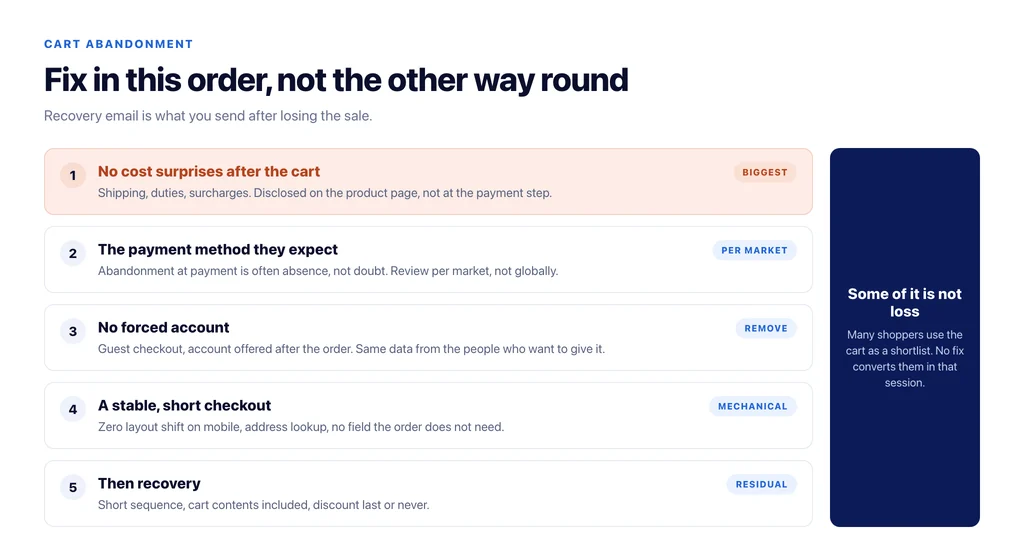
First: no cost surprises after the cart
The dominant cause, by a distance. A shopper who reaches checkout and discovers shipping, duties or a surcharge they had not budgeted for leaves, and they leave feeling misled rather than merely undecided.
The fix is not free shipping. It is disclosure early enough that nothing changes after the decision: shipping cost or a threshold shown on the product page, duties named for international destinations, and any surcharge visible in the cart rather than at the payment step.
If there is a free-shipping threshold, say how far away they are while they can still act on it. That single line converts and increases order value at the same time.
Second: the payment method they expect
Abandonment at the payment step is often not doubt, it is absence. A shopper who uses one wallet, one instalment provider or one local method will leave if it is not there, and they will not email to tell you.
Look at the payment methods by market, not globally. The expected method in one country is unavailable in another, and a checkout that works well domestically can be nearly unusable abroad.
Third: no forced account creation
Requiring an account before purchase is a self-inflicted wound that stores keep because the data is useful. Guest checkout with an optional account offer after the order gets the same data from the people who want to give it, and does not lose the ones who do not.
If the account is genuinely required — trade pricing, regulated goods — say so at the cart, with the reason, rather than revealing it as a wall at the last step.
Fourth: a checkout that is stable and short
Two mechanical faults do more damage than any amount of copy.
Layout shift. A banner, a stock notice or a lazy-loaded image that pushes the pay button as a thumb comes down produces a mis-tap and, often, an exit. This is a Core Web Vitals problem with a direct revenue cost — see core web vitals for ecommerce.
Field count. Every optional field is a decision. Address lookup instead of five manual lines, no separate billing address unless asked, no phone number unless delivery requires it, and no marketing consent question in the middle of the payment flow.
Fifth: the things a shopper needs to know to commit
Delivery date, not delivery speed. “Arrives Thursday” answers the question; “2–4 working days” makes them do arithmetic. Returns terms in one sentence where the decision happens. A visible contact route, which matters far more for a first-time buyer than for a returning one.
For higher-price items add whatever removes the specific fear of that category: fit, compatibility, or what happens if it arrives damaged.
Sixth, and only now: recovery
With the above fixed, recovery emails work on the residual — genuine interruptions and shortlisters. Keep it to a short sequence, make the first message quick and useful rather than promotional, and reserve any discount for the last message, if at all. Discounting the first email teaches your regulars to abandon deliberately.
Include the cart contents and a working link straight back into it. Most recovery emails fail on that link, not on the copy.
Measure the step, not the total
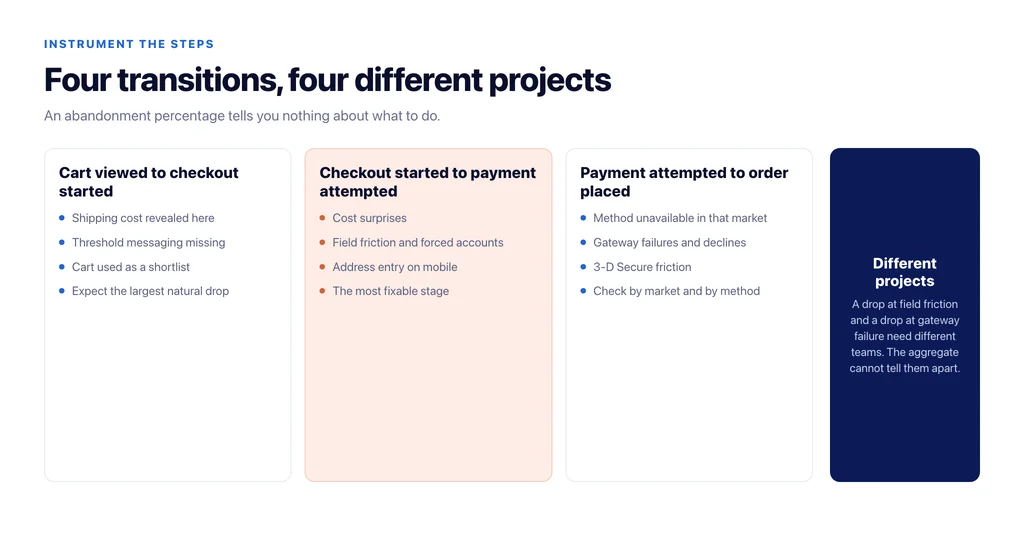
An abandonment percentage tells you nothing about what to do. Instrument the four transitions — cart viewed, checkout started, payment attempted, order placed — and read where the drop concentrates.
A collapse between checkout start and payment attempt points at cost surprises or field friction. A collapse at payment attempt points at method availability or a failing gateway. Those are different projects, and the aggregate number cannot distinguish them. The arithmetic for splitting it is in the ecommerce conversion rate calculator.
Guest checkout, wallets and the mobile keyboard
Three implementation details account for a disproportionate share of mobile abandonment, and none of them is a copy decision.
Express wallets at the top of the checkout, not the bottom. A shopper who can authenticate with a fingerprint never sees the address form. Placing the wallet buttons after the form means everyone completes the form first, which is the thing you were trying to avoid.
Input types that summon the right keyboard. A numeric field that opens a full alphabetic keyboard on a phone adds friction to every order. Postcode, phone and card fields all have correct input types and autocomplete attributes, and themes frequently get them wrong.
Address lookup with a manual fallback. Lookup services fail for new builds, rural addresses and unusual formats. If there is no visible way to enter an address by hand, those orders are simply lost, and nothing in the analytics will explain why.
None of these is visible in a desktop test, which is why they survive in production for years.
The checklist
- Shipping cost, duties and surcharges disclosed before the cart.
- Free-shipping threshold shown with the remaining amount.
- Payment methods reviewed per market, not globally.
- Guest checkout available; account offered after the order.
- Zero layout shift in cart and checkout on mobile.
- Fields reduced to what the order genuinely needs.
- Delivery date and returns terms visible at the decision point.
- Four funnel transitions instrumented separately.
- Recovery sequence short, cart contents included, discount last or never.
Sources
- Cart abandonment rate statistics — Baymard Institute
- Cumulative Layout Shift (CLS) — web.dev
- Page experience in Google Search results — Google Search Central
- Configuring WooCommerce settings — WooCommerce
- Measure ecommerce (GA4) — Google for Developers
Frequently Asked Questions
Want this run against your store? Book a call with The Reach Bureau.