# Buying Guide SEO: Guides That Sell and Get Quoted
A buying guide is the highest-leverage content type a store can publish, and the version most stores publish is worthless. The difference is not length or polish. It is whether the guide makes a decision easier or simply describes the products you happen to stock.
There is also a newer reason to care. Guides are the format AI answers quote most readily, because a guide that states which option suits which situation is exactly what a summariser needs. A guide that says every product is excellent gives it nothing to lift.
What a buying guide is for
Someone who searches for a guide has a decision, not a query. They have narrowed to a category and cannot choose within it. The guide’s job is to give them the axis of choice and then place the options along it.
That means the useful unit is not the product, it is the situation. “If you are commuting on pavement, this. If you are on trails twice a week, this. If you are training for a marathon, this.” Every sentence that does not help someone locate themselves on that axis is filler.
Lead with the decision, not the products
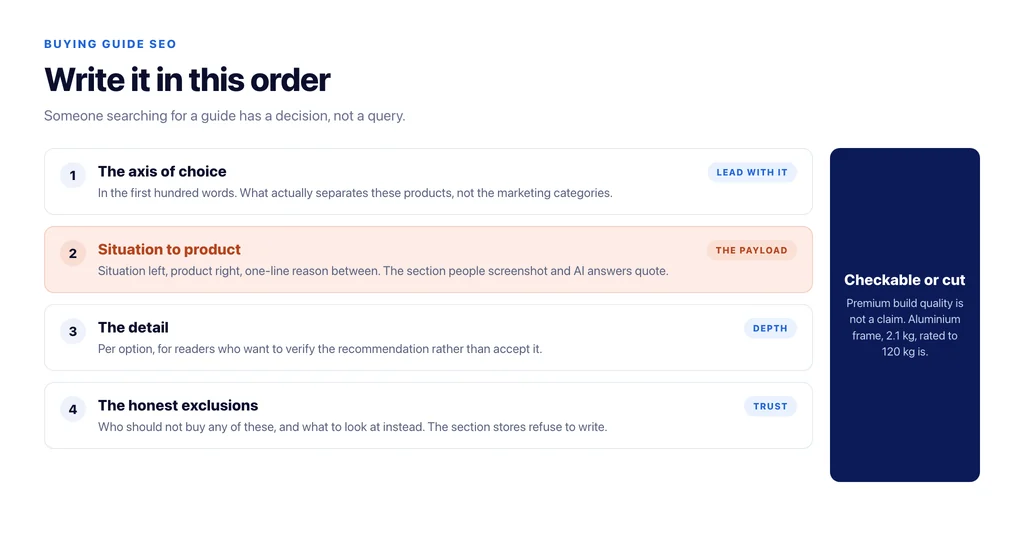
The structure that works, in order:
The axis of choice, stated in the first hundred words. What actually separates these products — not the marketing categories, the real variables.
Then the recommendation table: situation on the left, product on the right, one-line reason in the middle. This is the section people screenshot, and the section AI answers quote.
Then the detail, per option, for readers who want to verify the recommendation rather than accept it.
Then the honest exclusions: who should not buy any of these, and what to look at instead. This one paragraph does more for trust than the rest of the guide combined, and it is the section stores refuse to write.
Be specific enough to be checkable
Vague guides do not rank and do not get quoted, because there is nothing in them to attach a claim to. Specificity means numbers, thresholds and conditions: capacities, dimensions, compatibility, how long a consumable lasts, what temperature it tolerates.
If a claim cannot be checked, it does not belong in a guide. “Premium build quality” is not a claim. “Aluminium frame, 2.1 kg, rated to 120 kg” is. The second one survives being summarised by a machine and read by a sceptic.
Do not write it as a catalogue of what you stock
The strongest guides recommend against something you sell, and recommend a competitor’s product where it is genuinely the right answer for a narrow case. This feels like leaving money on the table. In practice it is what makes the rest of the recommendations believable, and it is the difference between a guide people cite and a page people bounce from.
The commercial return comes from being the guide that gets linked, quoted and remembered, not from steering every reader into the highest-margin item.
Where AI generation actually helps
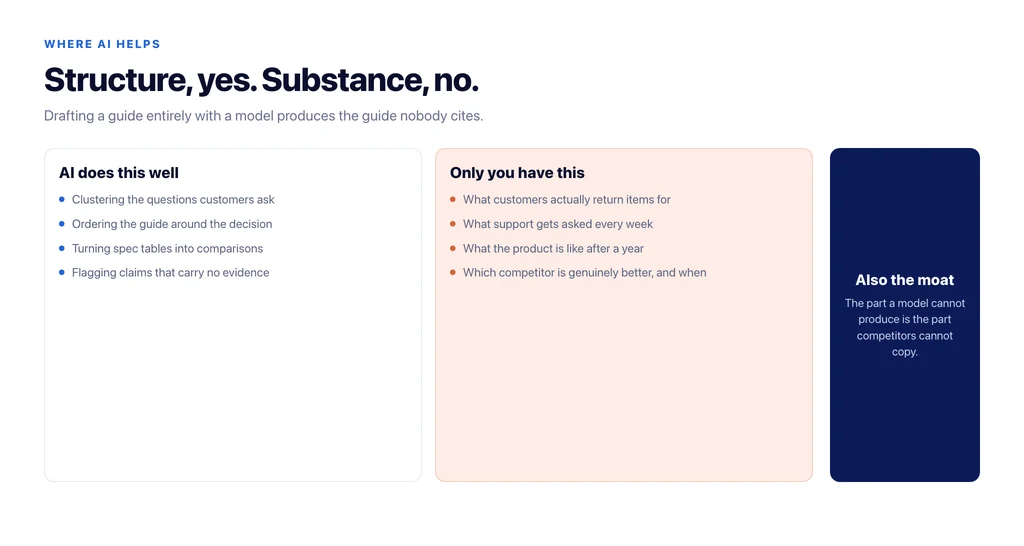
Drafting a guide entirely with a language model produces exactly the guide described above as worthless: fluent, structurally correct, specifics invented or averaged from other people’s pages.
Where it does help is the surrounding work. Clustering the questions customers ask so the guide answers them in order. Turning a specification table into readable comparisons. Drafting the section skeleton so a human fills it with real numbers. Checking a finished draft for claims that carry no evidence.
The specifics — what your customers actually return items for, what your support team gets asked, what happened when someone used the thing for a year — cannot come from a model. That is also the only part competitors cannot copy.
Keep it alive or take it down
A guide is a dated artefact. Products go out of stock, models get replaced, prices move. A guide recommending three items where two are unavailable is worse than no guide, because it fails at the exact moment someone trusted it.
Set a review cadence per guide, tie it to the products it names, and let the store tell you when a recommended item is retired. If nobody will own the update, publish fewer guides.
Internal links, in both directions
The guide should link to the categories and products it recommends, with the anchor text a shopper would use. The categories should link back to the guide from the depth section below their product grid. Without the second half, the guide sits orphaned and gets read by nobody — the pattern we described in internal linking for ecommerce.
What makes a guide quotable rather than just readable
A guide gets pulled into an AI answer for mechanical reasons, and they are worth knowing because they overlap almost entirely with what makes a guide useful to a person.
The recommendation has to be extractable as a statement. “For trail running twice a week, choose X because of the outsole depth” survives being lifted out of context. “There are many great options depending on your needs” does not, and a page made of that gets read and never cited.
The claim has to be attached to a condition. Assistants summarise by matching a situation in the question to a situation in the source. A guide organised by situation is easy to match; a guide organised by product name is not.
The facts have to be visible in the rendered page, not only in structured data or a tab that loads on click. And the page has to be reachable by the crawlers that feed those systems — worth verifying at the server and CDN layer rather than assuming, because that is where the block usually lives.
The checklist
- The axis of choice stated in the first hundred words.
- A situation-to-product table with a one-line reason for each.
- Every claim checkable: numbers, thresholds, conditions.
- At least one honest exclusion or recommendation against.
- Real experience in it that a model could not have produced.
- A named owner and a review date tied to the products it names.
- Links out to the categories and products, and links in from them.
- Availability checked before it goes live, and on every review.
Sources
- Creating helpful, reliable, people-first content — Google Search Central
- Review snippet structured data — Google Search Central
- SEO best practices for ecommerce sites — Google Search Central
Frequently Asked Questions
Want this run against your store? Book a call with The Reach Bureau.