# Product Comparison Content That Earns Links and Sales
Comparison content is where late-stage shoppers go, and it is the format most likely to be quoted by an AI answer, because a comparison that reaches a conclusion is exactly what a summariser needs. It is also the format stores get most wrong, by writing a comparison in which their own product wins every category.
The useful version is harder to write and worth considerably more. Here is what separates them.
The three comparisons worth publishing
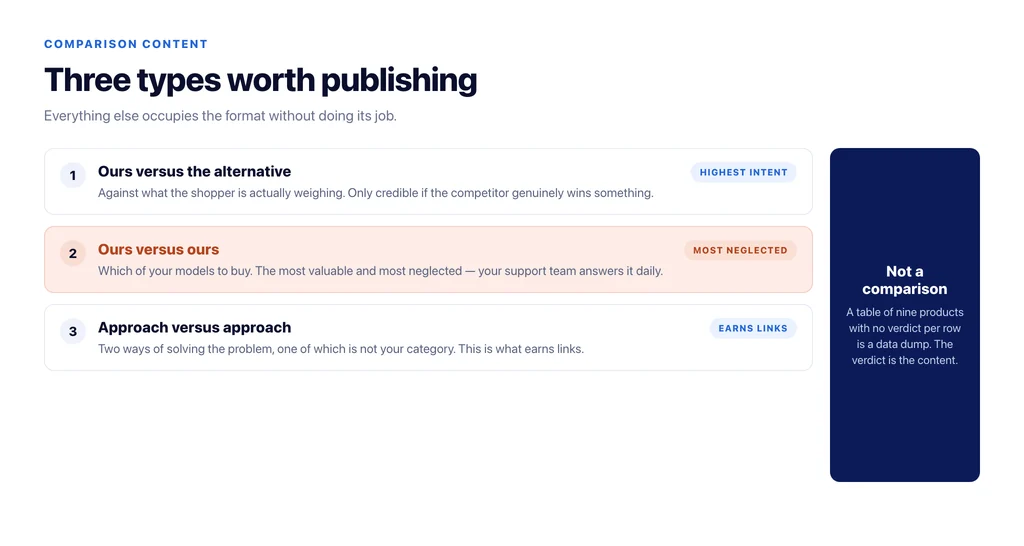
Ours versus the alternative. Your product against the thing a shopper is actually weighing it against — including a competitor. This ranks for the highest-intent queries in your category and it is only credible if the competitor genuinely wins something.
Ours versus ours. Which of your models to buy. The most commercially valuable comparison a store can publish and the most neglected, because it feels like cannibalisation. It is not; it is the question your support team answers all day.
Approach versus approach. Two ways of solving the problem, only one of which involves your category. This is the one that earns links, because it is genuinely informational and other people cite it when explaining the choice.
Everything else — a table of nine products with no conclusion, a listicle ranking by nothing in particular — occupies the format without doing its job.
Compare on the axes people actually decide on
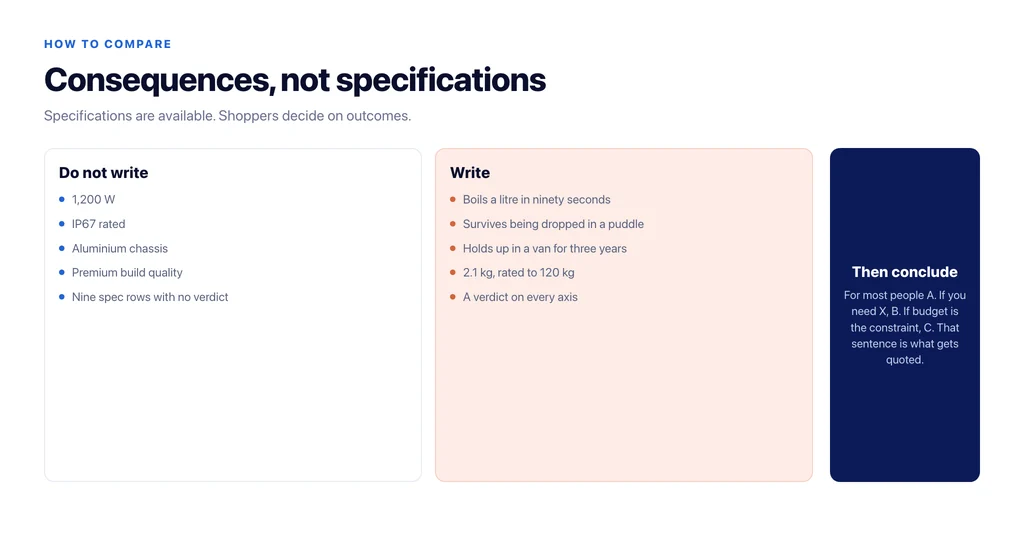
Most comparison tables compare specifications because specifications are available. Shoppers decide on consequences.
The translation matters: not “1,200 W” but “boils a litre in ninety seconds”. Not “IP67” but “survives being dropped in a puddle”. Not “aluminium chassis” but “holds up in a van for three years”. Pick four or five axes that carry the decision and drop everything else, however easy it was to tabulate.
Then state which option wins each axis, and why. A table with no verdict per row is a data dump; the verdict is the content.
Reach a conclusion, with conditions
The single change that makes a comparison useful is a conclusion attached to a situation: “For most people, A. If you need X, B. If budget is the constraint, C.”
This is what converts a browsing shopper, and it is the sentence structure that gets lifted into answers, because it maps a situation in the question to a recommendation in the source. A page that says both options are excellent will be read and never cited.
Be honest in a way that costs you something
A comparison where your product wins every axis is read as marketing and treated accordingly, by readers and by the systems summarising them.
Concede where the competitor genuinely wins — price, availability, ecosystem, weight, whatever it is — and say so plainly in a single sentence without a defensive clause after it. Two things follow. Readers believe the rest of the page, and the page becomes citable by people who would never link to a sales pitch.
If nothing on the page could be described as a concession, it is not a comparison.
Keep it current, because comparisons decay fastest
Comparison content ages faster than any other format. Prices move, models are replaced, one of the compared products is discontinued.
Every comparison needs a named owner, a review date, and a trigger tied to the products it names so the store can tell you when one is retired. A comparison recommending an unavailable product does active damage at the exact moment somebody trusted it.
How to structure it for links as well as sales
The commercial version links to your product pages with the anchor a shopper would use. The linkable version needs one more thing: something in it that is worth referencing on its own — a measured result, a compatibility matrix, a cost-over-three-years calculation.
That is the piece other people cite when they need a fact, and it is what gets the page linked without an outreach campaign. The surrounding blog architecture is covered in blog strategy for ecommerce.
The formats that work when there is nothing to compare
Some categories have no meaningful competitor set — bespoke products, single-model ranges, services attached to goods. The comparison instinct still applies, but the axis changes.
Compare against the alternatives the shopper is actually considering, which are usually not products: doing nothing, doing it themselves, buying secondhand, or paying somebody to do it. Those comparisons rank for real queries and almost nobody writes them, because they are not competitive analysis in the usual sense.
The other durable format is before and after: the same situation with and without the product, with numbers attached. Cost over three years, time spent per week, failures avoided. This is the version that earns links, because the arithmetic is referenceable on its own.
Both keep the property that makes comparison content work — a conclusion attached to a condition — without requiring a competitor to name.
The checklist
- One of the three comparison types, chosen deliberately.
- Four or five axes, expressed as consequences rather than specifications.
- A verdict per axis, not just data.
- A conclusion mapped to situations, in the first screen and again at the end.
- At least one honest concession, stated without a defensive clause.
- One referenceable fact of your own — a measurement, a matrix, a calculation.
- Links to the product pages compared, with shopper-language anchors.
- Named owner, review date, and a trigger from the product catalogue.
Sources
- Creating helpful, reliable, people-first content — Google Search Central
- SEO best practices for ecommerce sites — Google Search Central
- Merchant listing structured data — Google Search Central
- Product data specification — Google Merchant Center Help
Frequently Asked Questions
Want this run against your store? Book a call with The Reach Bureau.