# Blog Strategy for Ecommerce: What to Publish and What to Skip
Most ecommerce blogs are a cost centre with a content calendar. They publish because publishing is the plan, the posts rank for queries with no commercial connection to the catalogue, and after two years nobody can say what the blog earned.
A blog can be one of the most profitable parts of a store. It requires being unusually strict about what goes in it, because the default — publish frequently about the category — is what produces the cost centre.
The only test a post has to pass
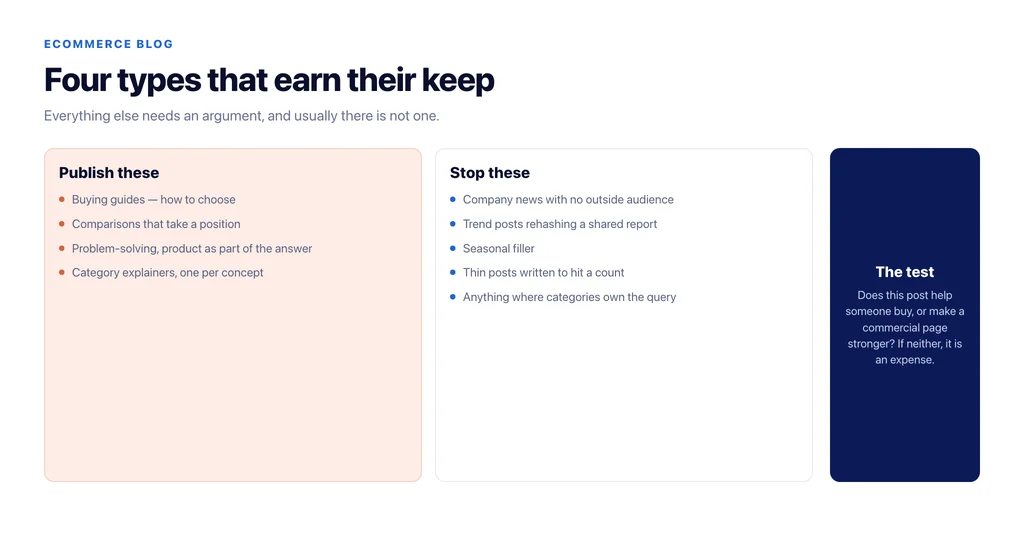
Does this post either help someone buy, or make a commercial page stronger?
Helping someone buy means it sits between a shopper’s question and a purchase: how to choose, what fits what, what the trade-offs are, what to do about a problem your product solves.
Making a commercial page stronger means it earns links or citations that flow to a category, or it captures a broad informational query and passes those readers into the right category with a relevant link.
A post that does neither is not a blog post, it is an expense. That includes almost all company news, most industry-trends commentary, and any post whose target query has no buying intent anywhere near it.
The four post types that earn their keep
Buying guides. How to choose within a category. The highest-value type, the most linked, and the format AI answers quote most readily.
Comparisons. This product or approach versus that one, with a position taken. Captures late-stage queries and pre-empts the comparison the shopper would otherwise do on someone else’s site.
Problem-solving posts. The problem your product solves, addressed properly, with the product as one part of the answer rather than the whole of it. These attract the links that guides do not.
Category-supporting explainers. The definitional queries adjacent to your categories, answered once, thoroughly, and linked into the relevant category. One per concept, not one per month.
Everything else needs an argument. Most of the time there is not one.
What to stop writing
Company news, unless there is genuinely an audience for it beyond the team. Trend posts that rehash a report everyone has read. Seasonal filler that says nothing a shopper needed. Thin posts written to hit a monthly count. Anything targeting a query where the ranking pages are all category pages, because a post cannot win those and should not try.
Cutting these is not a loss. It frees the effort that makes the four types above good.
Structure it around commercial pages, not around the blog
The mistake in most cluster models is treating the blog as the structure. For a store, the commercial pages are the structure and the posts are supports.
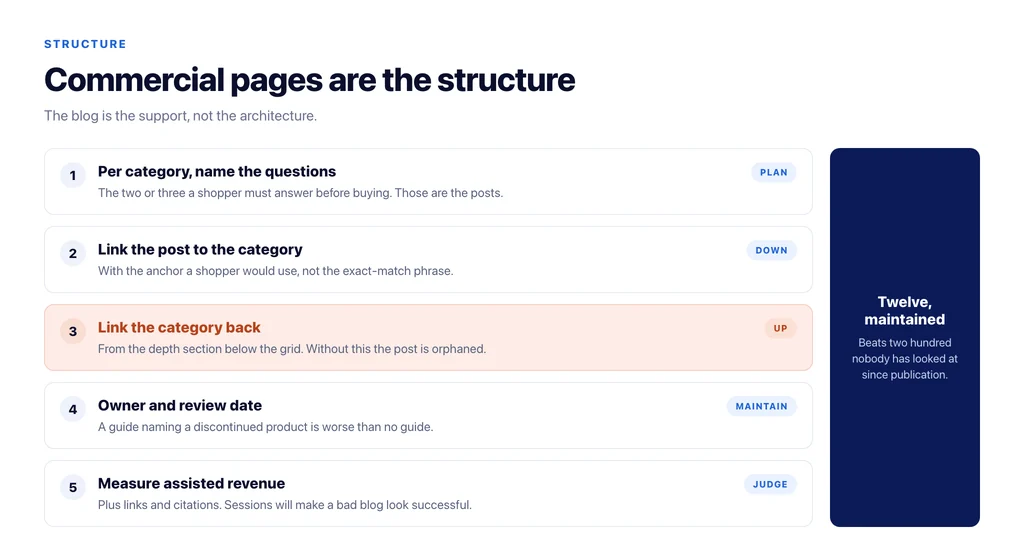
That means: for each significant category, decide the two or three questions a shopper must answer before buying, and write those. Link every post to the category with the anchor a shopper would use, and link the category’s depth section back to the posts that matter. The result is a small number of posts per category, each with a job, rather than a chronological archive.
The internal-link mechanics are covered in internal linking for ecommerce.
Fewer, deeper, maintained
Publishing cadence is the wrong unit of planning. A store with twelve genuinely useful posts, each maintained, will out-earn a store with two hundred that nobody has looked at since publication.
Maintenance is the part that gets dropped. A guide naming a discontinued product, a comparison against a model nobody sells, a post recommending a plugin that no longer exists — each one is worse than nothing, because it fails at the moment someone trusted it. Assign an owner and a review date per post, and if nobody will own it, do not publish it.
Measure the blog on assisted revenue
Sessions and rankings will make a bad blog look successful. Three measures make the picture honest.
Assisted revenue: sessions that touched a post and later converted, over a sensible window. Entry-page revenue: purchases where a post was the landing page, which will be small and is not the point. And link and citation acquisition per post, which is how the blog pays for the commercial pages.
If a post has no assisted revenue, no links and no citations after six months, it did not work. Rewrite it into something that passes the test at the top of this page, or remove it and redirect to the category it should have supported.
What to do with an archive you inherited
Most stores are not planning a blog from scratch; they have two hundred posts and a suspicion that most of them do nothing.
Sort them into four groups. Posts with assisted revenue or links — keep, update, make sure they link to the right category. Posts targeting a real query but written thinly — consolidate several into one deeper piece at the strongest URL and redirect the rest. Posts targeting a query where the category should rank — redirect to the category and remove them from the sitemap. Posts targeting nothing anyone searches — remove and redirect to the nearest relevant category.
Do not delete without redirecting; even a weak post usually holds an internal link or two and occasionally an external one.
Expect the exercise to remove more than half the archive, and expect traffic to fall slightly and revenue not to. That is the correct outcome: the pages that left were not carrying revenue, and what remains is now maintainable by whoever actually has the time.
The checklist
- Every planned post passes the test: helps someone buy, or strengthens a commercial page.
- Post types limited to guides, comparisons, problem-solving and category explainers.
- Two or three posts per significant category, each with a defined job.
- Every post links to its category; every category links back to the posts that matter.
- An owner and a review date per post.
- No publishing cadence target. Quality gate instead.
- Measured on assisted revenue, links and citations, not sessions.
- Posts that fail after six months rewritten or redirected.
Sources
- Creating helpful, reliable, people-first content — Google Search Central
- SEO best practices for ecommerce sites — Google Search Central
- Breadcrumb structured data — Google Search Central
- Canonicalization — Google Search Central
Frequently Asked Questions
Want this run against your store? Book a call with The Reach Bureau.