# Entity SEO Tools: What They Do and What They Cannot
Entity SEO tools sell a promise that is easy to misread: that a piece of software can make search engines and AI systems understand your brand. What they can do is narrower and still useful. What they cannot do is the part that actually decides whether you are understood.
Here is the honest split, by tool category, and what to do with the output.
What an entity is, in one paragraph
An entity is a thing a search system holds as a distinct node with attributes and relationships — a brand, a product, a person, a place — rather than as a string of characters. When your brand is an entity, a search system knows it makes a particular class of product, that it is different from a similarly named company, and what it is associated with. When it is only a string, every mention has to be re-interpreted from context, and the wrong interpretation wins as often as the right one.
Category one: markup generators and validators
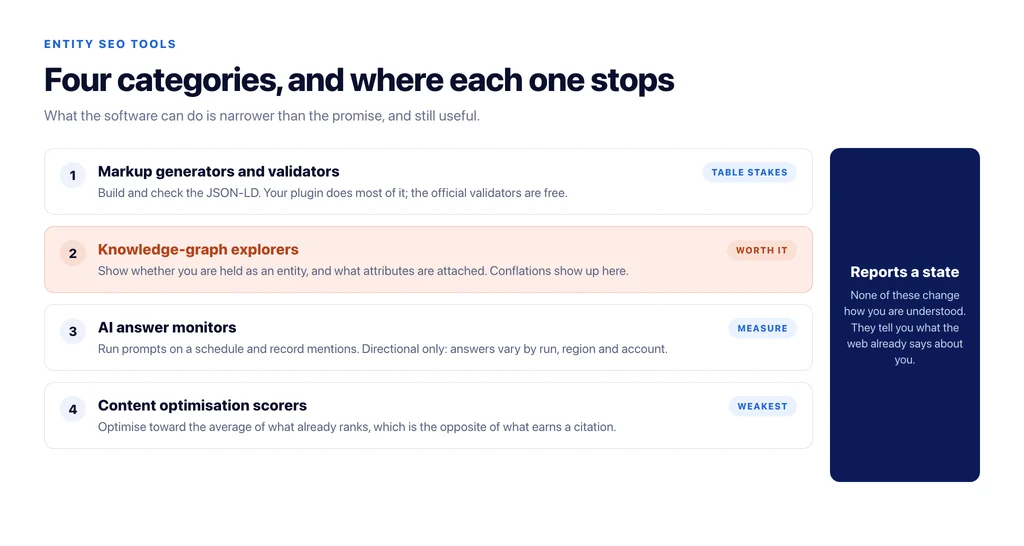
What they do: build `Organization`, `Product`, `BreadcrumbList` and related JSON-LD, then check it parses and matches the visible page.
Worth paying for: rarely as standalone tools. Your SEO plugin already generates most of it, and the free official validators check it. What is worth the time is the field-level work these tools surface — a WooCommerce store’s default `Product` markup omits `brand` and identifiers, which matters for shopping surfaces.
The limit: valid markup is not understanding. Markup that agrees with the page and the product feed is table stakes, not an advantage.
Category two: entity and knowledge-graph explorers
What they do: show whether a search system already holds your brand as an entity, what attributes it has attached, and which other entities it associates with yours.
Worth paying for: at the diagnostic stage, yes. Finding out that your brand is conflated with a similarly named company, or that your associated attributes describe a business you exited three years ago, is genuinely actionable and hard to see otherwise.
The limit: they report a state, they do not change it. And the state is largely a reflection of what the rest of the web says about you.
Category three: AI answer and citation monitors
What they do: run prompts across assistants on a schedule and record whether you are mentioned, in what context, and which sources were cited.
Worth paying for: if you would otherwise not measure this at all, yes, because the alternative is asserting progress with no evidence. Treat the numbers as directional. Answers vary between runs, by region and by account, so a single check is noise.
The limit: they measure the outcome, not the cause. Knowing you appear in 12% of answers does not tell you which of the sources shaping that answer to go and influence.
Category four: content optimisation scorers
What they do: compare your page against ranking pages and suggest terms and entities to include.
Worth paying for: the weakest category for entity work. They optimise toward the average of what already ranks, which is the opposite of what earns a citation. Useful as a coverage checklist, dangerous as a target.
What no tool can do
Three things, and they are the ones that decide the outcome.
Being described consistently. The same brand name, the same category language, the same claims — on your site, in your profiles, in directories, in press, in the places your customers discuss you. Inconsistency is the single biggest reason a brand stays a string. No tool can fix it, because it lives in other people’s copy.
Being mentioned by sources that matter. Entity strength follows from being referenced where the topic is discussed, with enough context that the reference is unambiguous. That is outreach, product work and being worth talking about.
Publishing checkable facts about yourself. Where you operate, what you make, who runs it, what the specifications are. Machines extract facts; they do not extract positioning statements.
If your brand is conflated with another company
This is the most common concrete entity problem, and it has a concrete remedy rather than a strategy.
Start by confirming it: search your brand name alone and with your category, and look at what attributes an explorer has attached. Conflation shows as facts belonging to someone else — a different founding year, a different location, a different industry.
Then reduce the ambiguity everywhere you control. Use the full legal name alongside the trading name in your `Organization` markup, with `sameAs` pointing at the profiles that unambiguously belong to you. Put the disambiguating facts in visible text on an about page: where you are, what you make, when you started, who runs it. Use one consistent name format in profiles and directories rather than three variants.
Then give the correct association something to attach to. Being mentioned alongside your category, by sources that discuss that category, is what separates two similarly named companies in a knowledge graph. A single accurate reference in a place the topic is discussed does more than a dozen directory listings.
Expect this to resolve over months, not weeks, and re-check quarterly. Anything faster is measuring noise.
How to sequence the work
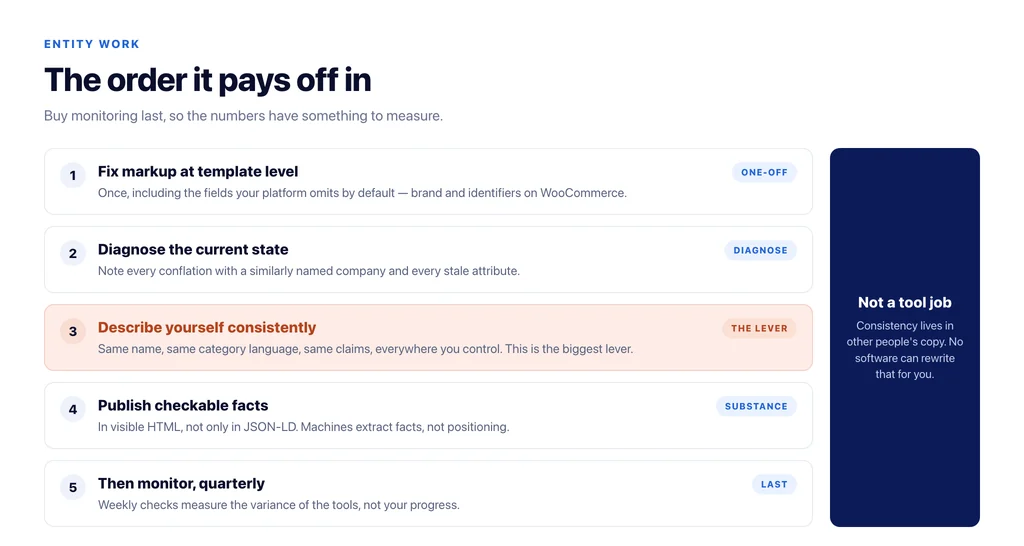
- Fix the markup once, at template level, including the fields your platform omits by default.
- Diagnose the current entity state and note every conflation or stale attribute.
- Make your own descriptions consistent everywhere you control, starting with the ones search systems read most.
- Publish the checkable facts in visible HTML, not only in JSON-LD.
- Then, and only then, spend on monitoring — so the numbers have something to measure.
- Work on mentions where the topic is discussed, and re-check the entity state quarterly, not weekly.
The related brand-level work is covered in brand entity SEO, and the retrieval side in how to get cited by AI.
Sources
- Organization structured data — Google Search Central
- Organization — schema.org
- Merchant listing structured data — Google Search Central
- Product structured data — Google Search Central
Frequently Asked Questions
Want this run against your store? Book a call with The Reach Bureau.