A brand entity is the difference between a search engine knowing your name and knowing what you are.
Plenty of stores are indexed, rank for their own name, and still do not exist as a *thing* — a record with attributes and relationships that a system can reason about. When an assistant assembles "best retailers for X" or a knowledge panel shows a competitor and not you, that gap is what you are seeing.
This is the brand half of entity work. It is slower than technical SEO and it is more durable, because a brand a search engine understands is difficult for a competitor to displace with a better page.
The three signals that build a brand entity
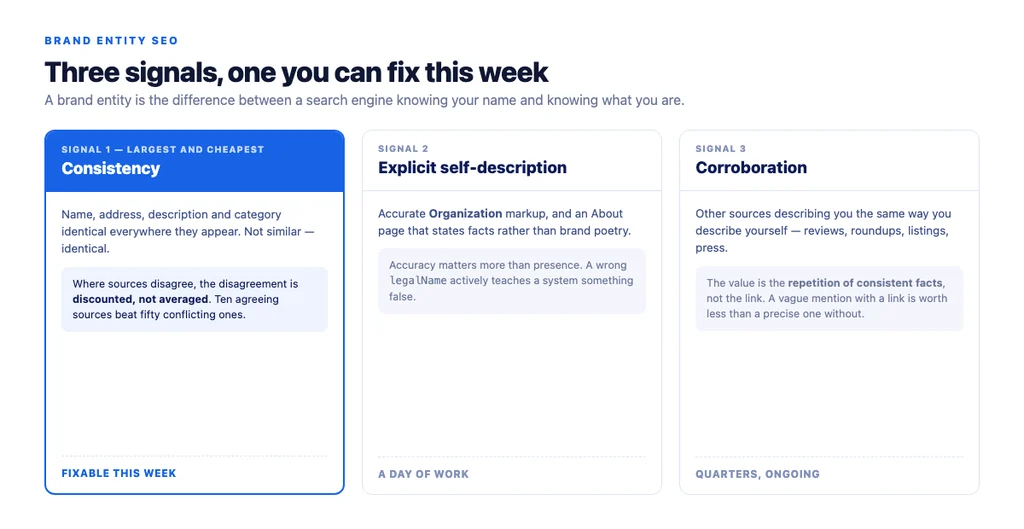
1. Consistency
The single largest factor, and the cheapest to fix.
Your brand name, address, description and category should be identical everywhere they appear: your site, your Google Business Profile, marketplace seller pages, social profiles, directory listings, press mentions. Not similar — identical.
Where sources disagree, the disagreement does not get averaged. It gets discounted, and a record built from contradictory inputs stays weak no matter how many inputs there are.
The most common inconsistencies we find:
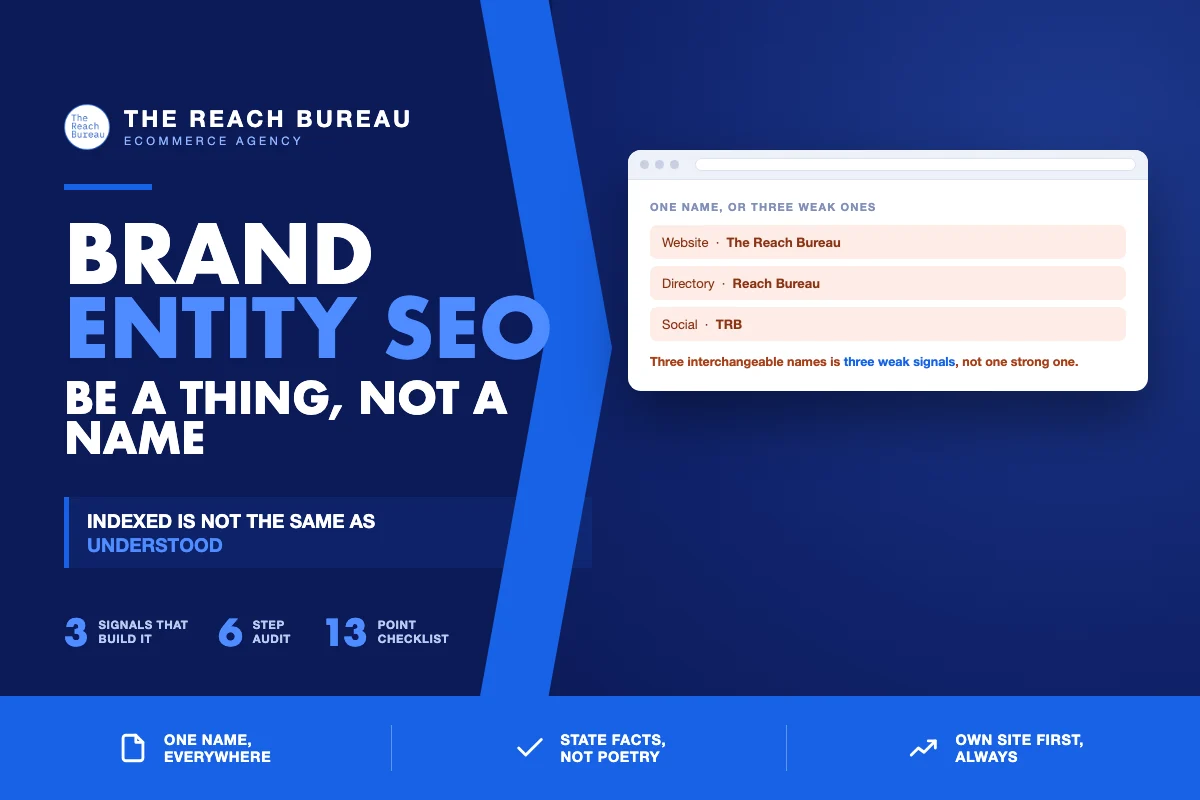
- Brand name written three ways: with "The", without, and abbreviated
- An old address still live on a directory listing nobody remembers creating
- A description that says one thing on the site and another on social
- A legal entity name used in some places and a trading name in others
2. Explicit self-description
Search engines prefer stated facts to inferred ones. Two places carry most of that weight.
Organization structured data. Legal name, URL, logo, contact details, social profiles, address. This is your own machine-readable statement of what you are. Its accuracy matters more than its presence — we have found live sites with an email address in the legalName field, which actively teaches a system something false.
An About page that states facts. Founded when, based where, what you sell, who you serve, how many people. Not brand poetry. This page is read by systems building an entity record and written, in most cases, as marketing copy that states nothing checkable.
3. Corroboration
Other sources describing you the same way you describe yourself.
Reviews, roundups, directory listings, press, supplier pages, marketplace profiles. The value is not the link — it is the repetition of consistent facts. A mention with your correct name and category is worth more to your entity than a link from a page that describes you vaguely.
The audit: what does it currently think?
An afternoon of searching, and most stores have never done it.
1. Search your exact brand name. Knowledge panel? Correct information in it? Anything wrong traces back to a source you can usually find. 2. Search your brand name plus your category. Do you appear as a seller of what you actually sell? 3. Ask an assistant "what is [brand]?" and "what does [brand] sell?" The answer is the working model, including the confidently wrong parts. 4. Search your brand name minus your domain. What do other people say about you, and does it match what you say? 5. List every profile you own — site, GBP, marketplaces, socials, directories — and put the name, description and address side by side. 6. Validate Organization markup field by field for accuracy, not just presence.
Step 5 produces the fix list, and it is usually longer than expected.
Fixing it, in order
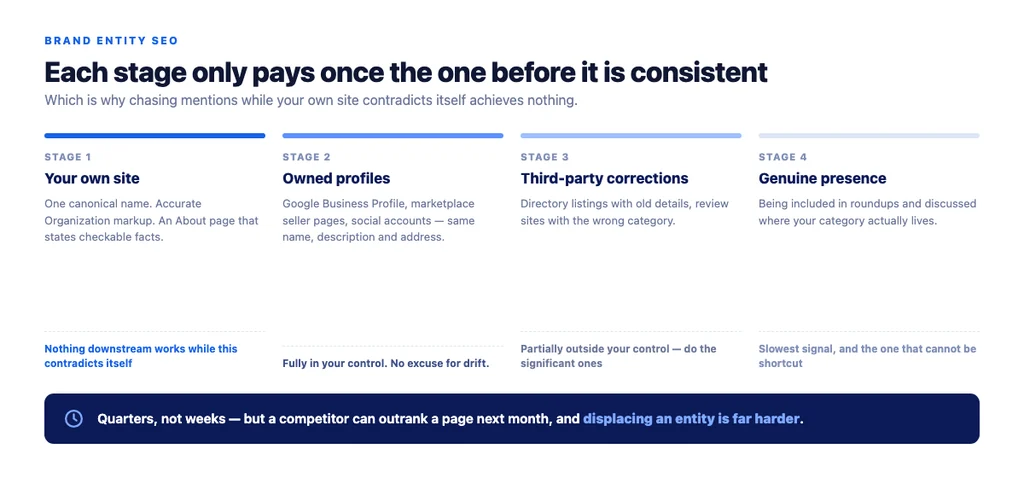
Your own site first. Organization markup accurate, About page factual, one canonical brand name used consistently. Nothing else works while your own site contradicts itself.
Owned profiles second. Google Business Profile, marketplace seller pages, social accounts. Same name, same description, same address.
Third-party corrections third. Directory listings with old information, review sites with the wrong category. Slower, partially outside your control, and worth doing for the significant ones only.
Genuine presence last and ongoing. Being included in roundups and discussed in communities where your category lives. This is the slowest signal and the one that cannot be shortcut.
What this is not
- It is not link building. Consistent mentions matter; purchased links do not build understanding.
- It is not a Wikipedia page. Useful if you genuinely meet the notability bar, counterproductive if you try to force it.
- It is not fast. Entity records update slowly and this work compounds over quarters, not weeks.
- It is not a plugin. Emitting
Organizationmarkup with wrong values is worse than emitting none.
Why it matters more now
Assembled answers require understanding rather than matching. A system generating "reliable retailers for X" is drawing on a model of who sells what, and a brand absent from that model cannot be included regardless of how well its pages are optimised.
That is the practical argument. The durability argument is stronger: a competitor can outrank a page next quarter. Displacing an established brand entity is considerably harder, which makes this some of the most defensible work available to a store.
The checklist
- One canonical brand name defined and documented
- That name used identically on site, GBP, marketplaces, socials, directories
- Address and contact details identical everywhere
Organizationmarkup present and every field verified accuratelegalNamechecked specifically — it is commonly wrong- Social profile URLs listed in
Organizationmarkup - About page states founded date, location, what you sell, who you serve
- About page contains checkable facts, not brand poetry
- Brand name searched; knowledge panel contents verified
- Assistant asked what the brand is and sells; answer checked
- All owned profiles listed and compared side by side
- Significant third-party listings corrected where wrong
- Category described consistently across every surface
Sources
- Google Search Essentials — Google Search Central
- Creating Helpful, Reliable, People-First Content — Google Search Central
- SEO Best Practices for Ecommerce Sites — Google Search Central
- Intro to Product Structured Data on Google — Google Search Central
- Ecommerce Product Data and Content on Google — Google Search Central
Frequently Asked Questions
Want this run against your store? Book a call with The Reach Bureau.