
# Brand Authority for AI Search: Turning Mentions Into Recognition
Authority for AI search is not a score, and no tool assigns you one. It is whether a system holds your brand as a distinct thing with known attributes, corroborated by enough independent sources that it can be named confidently in an answer.
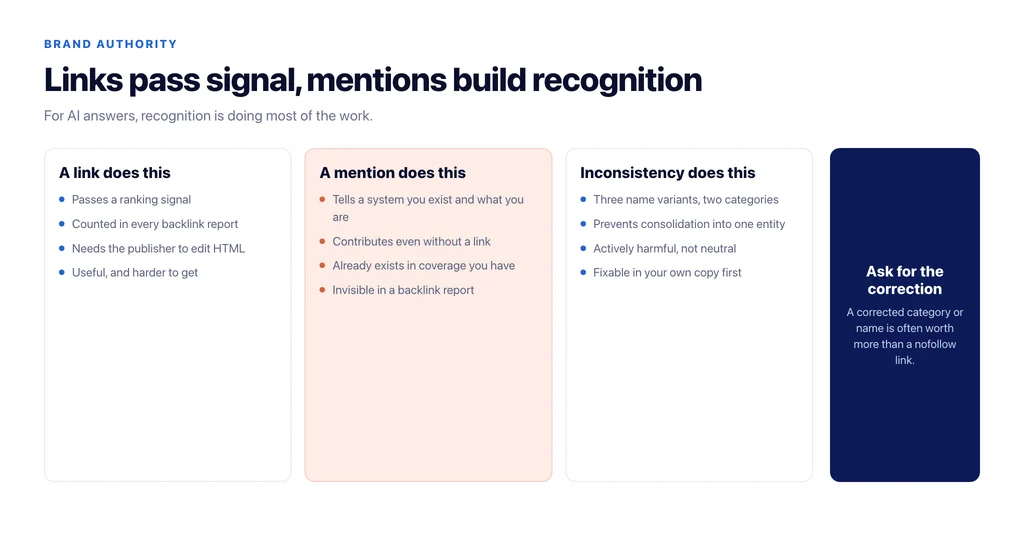
That is a different target from link building, though the work overlaps. Links pass a signal. Mentions build recognition. For AI answers, recognition is doing most of the work, and that changes which activities are worth the time.
Why mentions matter here more than links
A language system assembling an answer needs to know that your brand exists, what category it belongs to, and what is true about it. It gathers that from how you are described across many sources — retailer listings, marketplaces, reviews, directories, forums, press, and your own site.
A link is one form of that description, and a strong one. But an unlinked mention in a relevant context contributes to recognition almost as well, which means a large amount of the coverage stores already have is doing useful work that never appears in a backlink report.
The corollary is uncomfortable: coverage in places that describe you inconsistently actively hurts. Three variants of your name and two different category descriptions leave a system unable to consolidate you into one entity.
Start by auditing how you are described, not who links to you
The audit that matters takes an afternoon. Search your brand name alone, with your category, and with your main product type. Then collect every description of your business you find, verbatim, including your own.
You are looking for four things: name variants, category descriptions that disagree, factual claims that conflict, and confusion with another company. Most stores find all four, usually including one description that has been wrong since a repositioning nobody propagated.
Fix your own copy first, because it is free and because it is what everyone else copies from. One name format, one category sentence, one set of facts.
Convert unlinked mentions, but for the right reason
Reaching out to sites that mention you without linking is still worthwhile, and the conversion rate is high because there is no persuasion involved — someone already wrote about you.
Two adjustments for the AI-search era. First, ask for the correction of a wrong description as readily as for a link; a corrected category or name is worth more to recognition than a nofollow link. Second, prioritise mentions on pages where your category is discussed, because context is what makes a mention usable.
Finding them is mechanical: search your brand name, exclude your own domain, and check which results do not link. A backlink tool’s mentions report does the same job faster.
Publish the facts a system needs to hold about you
Recognition needs anchors, and anchors are facts.
Put them in visible text, on pages that exist for the purpose: what you make, which categories you operate in, where you are, when you started, who runs the business, and how to verify any of it. Mirror the same facts in `Organization` markup with `sameAs` pointing at the profiles that unambiguously belong to you.
Author and founder identity belongs here too. A named person with a consistent description across your site and their own profiles is a stronger corroboration than another paragraph about your values.
The activities that actually move it
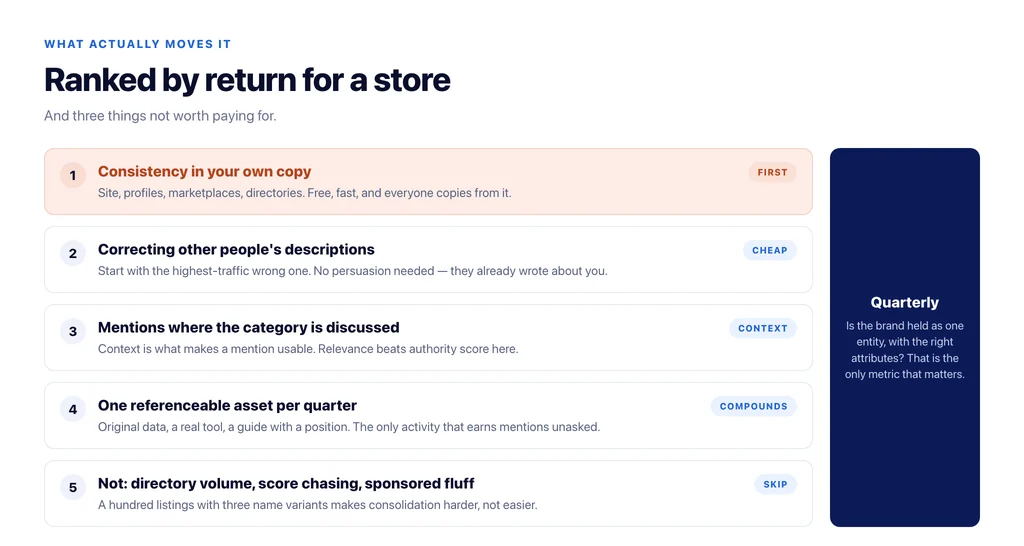
In rough order of return for a store:
Consistency of your own description everywhere you control it — site, profiles, marketplaces, directories, packaging copy.
Correcting wrong descriptions where others control them, starting with the highest-traffic ones.
Earning mentions on pages where your category is discussed, rather than on high-authority pages about nothing in particular.
Publishing something worth referencing — original data, a genuinely useful tool, a guide that takes a position. This is the only one that generates mentions without asking.
Being present where your customers discuss the category, in a form that is neither spam nor invisible.
What not to spend on
Directory volume. A hundred listings with three name variants makes consolidation harder, not easier.
Authority-score chasing. A high-score link from a page unrelated to your category contributes little to recognition.
Sponsored posts that describe you in the publisher’s words rather than yours, without the facts that anchor the description.
Where marketplaces and retailers fit in
For most stores the largest volume of third-party description sits on marketplace and retailer listings, and it is the most neglected.
These pages are usually populated from your own feed, which means the inconsistencies are yours: an old brand name on one channel, a shortened product name on another, a category assignment that made sense to somebody in a spreadsheet. Fixing them is a feed job rather than an outreach job, and it fixes many sources at once.
It matters more than it looks, for two reasons. Marketplace listings are heavily crawled and frequently cited, so they carry disproportionate weight in what a system believes about your products. And a marketplace describing your brand differently from your own site is exactly the ambiguity that keeps a brand from consolidating into one entity.
Audit the listings you control on every channel you sell through, then correct them at the feed level so the fix survives the next sync.
The checklist
- Audit every description of your brand you can find, verbatim.
- Standardise name format, category sentence and facts in your own copy.
- Publish the anchoring facts in visible text, mirrored in `Organization` markup with `sameAs`.
- List unlinked mentions and work through them, asking for corrections as well as links.
- Prioritise category-relevant contexts over authority scores.
- Build one referenceable asset per quarter rather than ten forgettable ones.
- Re-check quarterly: is the brand held as one entity, with the right attributes?
The tool side of this — what software can and cannot tell you — is covered in entity SEO tools.
Sources
- Organization structured data — Google Search Central
- Organization — schema.org
- Creating helpful, reliable, people-first content — Google Search Central
- SEO best practices for ecommerce sites — Google Search Central
Frequently Asked Questions
Want this run against your store? Book a call with The Reach Bureau.