Affiliate partnerships are one of the few link-adjacent tactics that is both commercially sensible and easy to get wrong in a way that hurts you.
The tactic is legitimate: you partner with publishers, they recommend your products, you pay commission on sales. The problem is that a commercial arrangement behind a link is exactly what search engines ask you to disclose, and most affiliate programmes leave the disclosure to the publisher — who often does not do it.
The rules are not complicated. Getting them wrong is common because nobody reads them.
The rule in one paragraph
Google's spam policies treat links as manipulative when they exist primarily to influence rankings rather than to help people — and that includes links exchanged for money, goods or services. Affiliate links are exchanged for commission, which makes them commercial. The fix is not to avoid them; it is to mark them so they are not counted as editorial endorsements.
That is the whole thing. Marked correctly, affiliate links are fine. Unmarked, they are a link scheme regardless of intent.
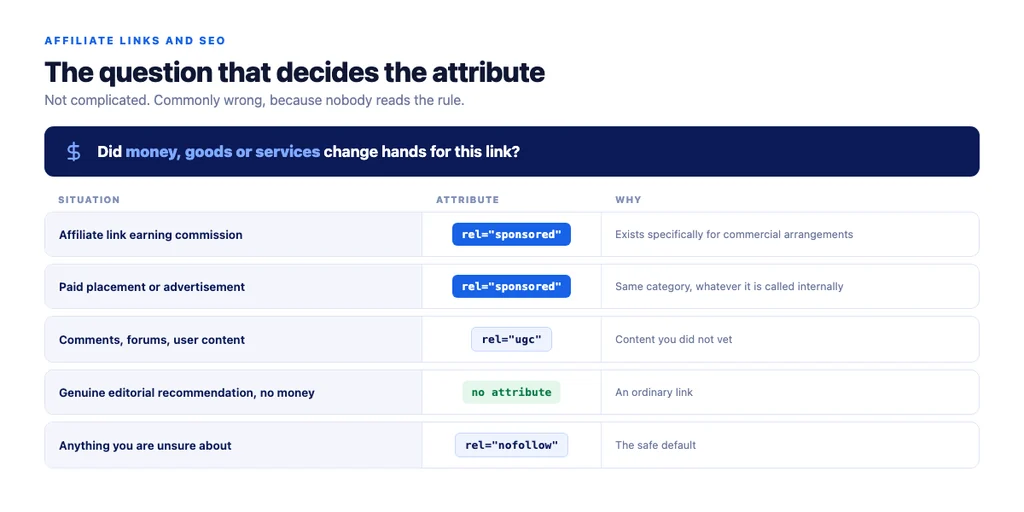
Which attribute to use
| Situation | Attribute | Why |
|---|---|---|
| Affiliate link earning commission | rel="sponsored" | Explicitly for links from a commercial arrangement |
| Paid placement or advertisement | rel="sponsored" | Same category |
| User-generated content, comments, forums | rel="ugc" | Content you did not vet |
| Genuinely editorial recommendation, no money | no attribute | An ordinary link |
| Anything you are unsure about | rel="nofollow" | The safe default |
rel="sponsored" and rel="nofollow" can both be used; sponsored is more precise about why.
As a merchant running an affiliate programme, you cannot force publishers to tag correctly, but you can and should:
- State the requirement in your affiliate terms
- Explain what tag to use, with an example, in your onboarding
- Spot-check placements periodically
- Remove partners who ignore it after being asked
Where merchants go wrong
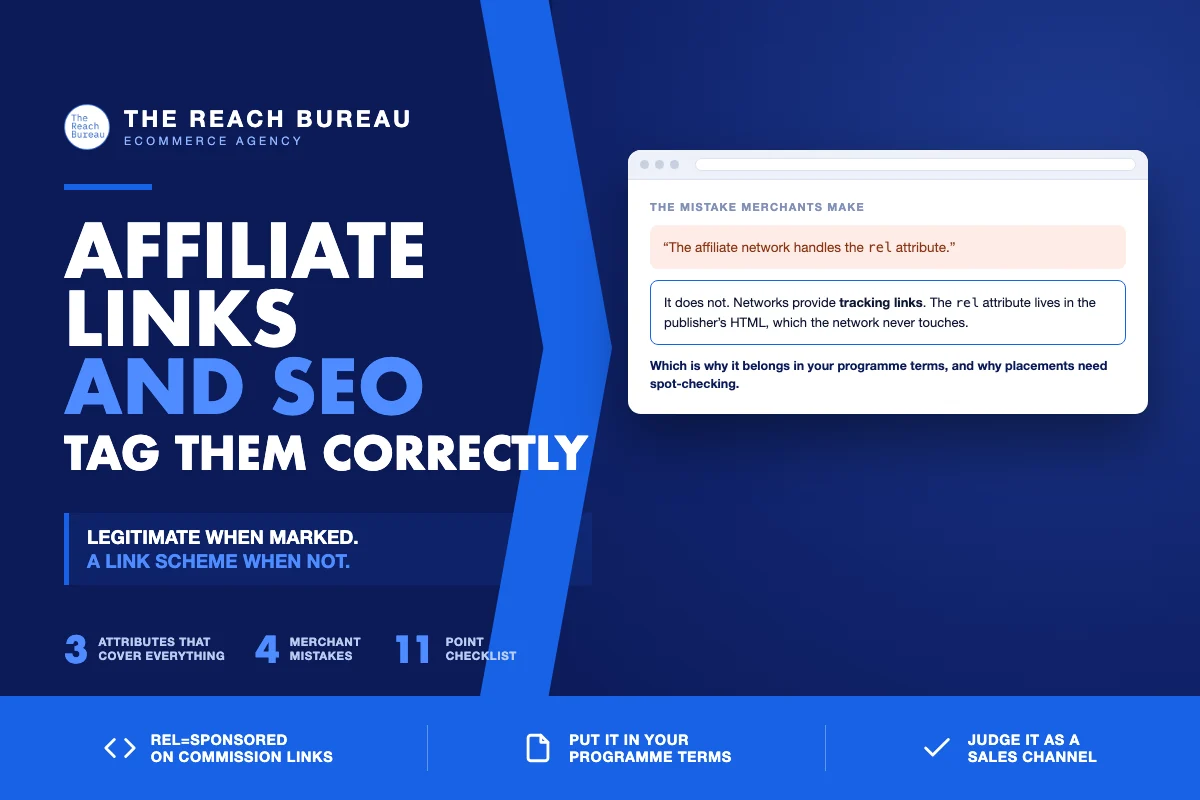
Assuming the network handles it. Most affiliate networks provide tracking links, not link attributes. The rel attribute is applied by the publisher's HTML, which the network does not control.
Treating affiliate placements as a link building tactic. They are a sales channel. If you are pursuing affiliate partnerships for the SEO value, you are pursuing links that should be tagged not to pass value — which means the strategy is self-defeating.
Paying for placement in "best of" roundups without disclosure. This is a paid link with extra steps. If money moved and the link is not tagged, it is a link scheme irrespective of what the arrangement was called.
Ignoring your own outbound affiliate links. If your store publishes buying guides that include affiliate links to products you do not stock, those need tagging too. The rule applies in both directions.
What affiliate partnerships are genuinely good for
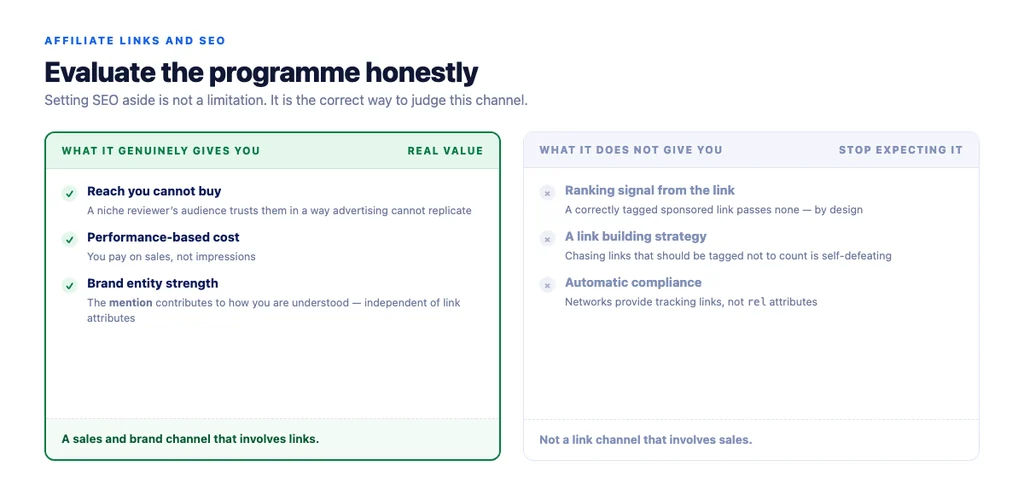
Setting SEO aside — which is the right way to evaluate them — affiliate arrangements do real commercial work:
- Reach into audiences you cannot buy efficiently. A niche reviewer's audience trusts them in a way advertising cannot replicate.
- Performance-based cost. You pay on sales rather than on impressions.
- Category presence. Being included in independent roundups matters for how your brand is understood, and that value does not depend on the link passing authority.
That last point is worth dwelling on. A tagged affiliate link passes no ranking signal, but the *mention* still contributes to your brand entity — the record search engines hold of what you are and what you sell. Consistent, accurate mentions across the sites that cover your category strengthen that record regardless of link attributes.
Which reframes the whole tactic: affiliate partnerships are a sales and brand channel that happens to involve links, not a link channel that happens to involve sales.
Disclosure beyond search engines
Search guidelines are not the only rules here. Advertising regulators in most markets require affiliate relationships to be disclosed to readers — visibly, not buried in a footer. That is a legal obligation on the publisher, and as the merchant it is worth requiring in your terms because non-compliant partners create risk that eventually attaches to your brand.
Requiring clear disclosure also happens to improve performance: readers who know a recommendation is commercial and read it anyway are better-qualified traffic.
The checklist
- Affiliate links tagged
rel="sponsored"(or at minimumnofollow) - Requirement stated explicitly in affiliate programme terms
- Onboarding includes an example of correct tagging
- Placements spot-checked periodically
- Partners who ignore the requirement removed after being asked
- Not assuming the affiliate network handles attributes — it does not
- Paid roundup placements tagged, whatever the arrangement is called
- Your own outbound affiliate links tagged too
- UGC and comment links tagged
rel="ugc" - Reader-facing disclosure required in partner terms
- Programme evaluated on sales and brand presence, not on link value
Sources
- Spam Policies for Google Web Search — Google Search Central
- Google Search Essentials — Google Search Central
- Creating Helpful, Reliable, People-First Content — Google Search Central
- SEO Best Practices for Ecommerce Sites — Google Search Central
- Ecommerce Product Data and Content on Google — Google Search Central
FAQs
Want this run against your store? Book a call with The Reach Bureau.