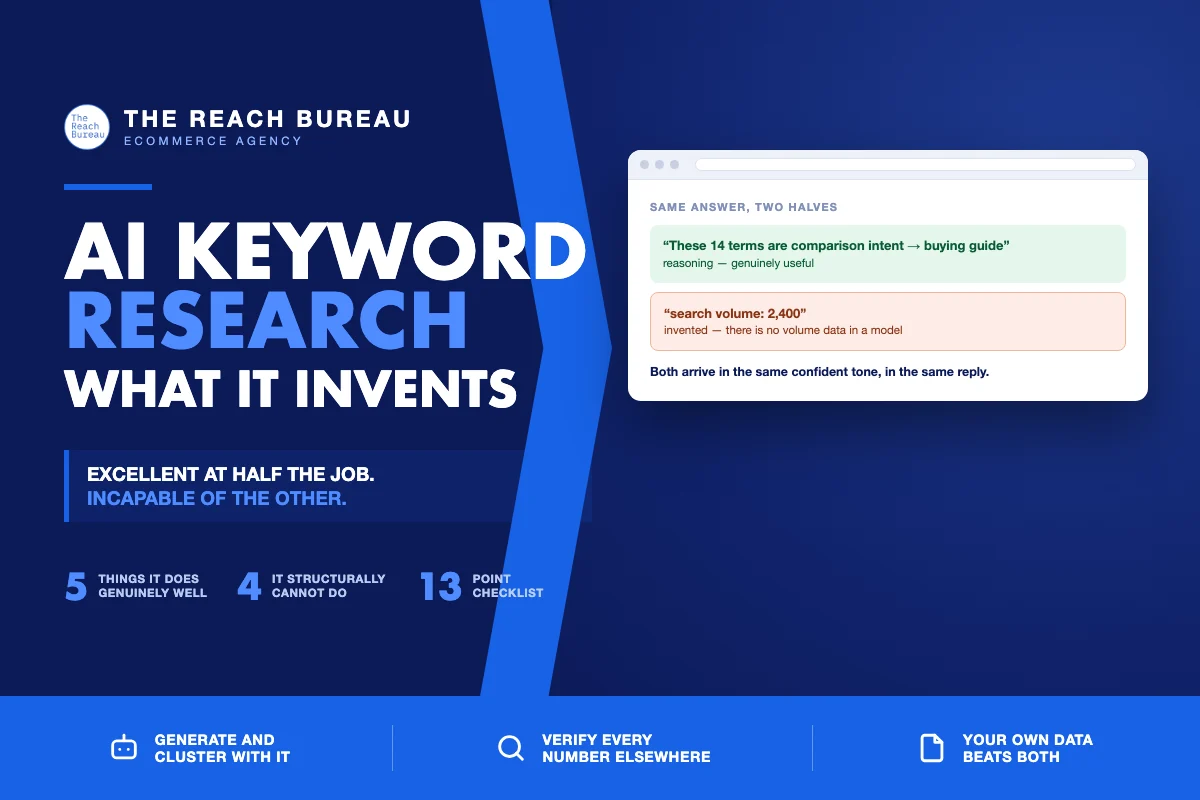
A language model will happily tell you that "waterproof trail running shoes" gets 2,400 searches a month. It has no idea. It generated a plausible number because you asked for one.
This is the central problem with AI keyword research and the reason so much of it produces content plans targeting terms nobody searches. Models are genuinely excellent at one half of the job and structurally incapable of the other half, and the difference is not obvious from the output — a fabricated volume figure looks exactly like a real one.
Used properly, AI makes keyword research faster and better. Used as a data source, it produces confident nonsense.
What language models are genuinely good at
Generating the space of how people phrase things. Ask for fifty ways a shopper might describe wanting a waterproof hiking boot and you get a genuinely useful list, including phrasings a keyword tool would not surface because nobody has searched them enough to register.
Clustering by intent. Give a model a list of 300 terms and ask it to group them by what the searcher wants — research, comparison, purchase, support — and it does this well and fast. This is tedious human work that models handle reliably.
Mapping terms to page types. Which of these belong on a category page, a product page, a guide? Models are good at this because it is a reasoning task, not a data task.
Spotting gaps in a set. "What questions about this category are missing from this list?" surfaces real omissions.
Drafting the constraint-shaped queries people now type into assistants — longer, multi-constraint phrasings that traditional keyword tools underrepresent because they are individually rare.
What they cannot do
Search volume. There is no volume data inside a language model. Any number it gives you is generated, not retrieved. This is the single most damaging misuse, because the number looks authoritative and gets planned against.
Difficulty scores. Same problem. Difficulty is computed from live link and ranking data the model does not have.
Current SERP composition. What ranks today, whether an AI Overview appears, whether the results are dominated by forums — none of this is in the model.
Trend direction. Whether a term is growing or dying requires time-series data.
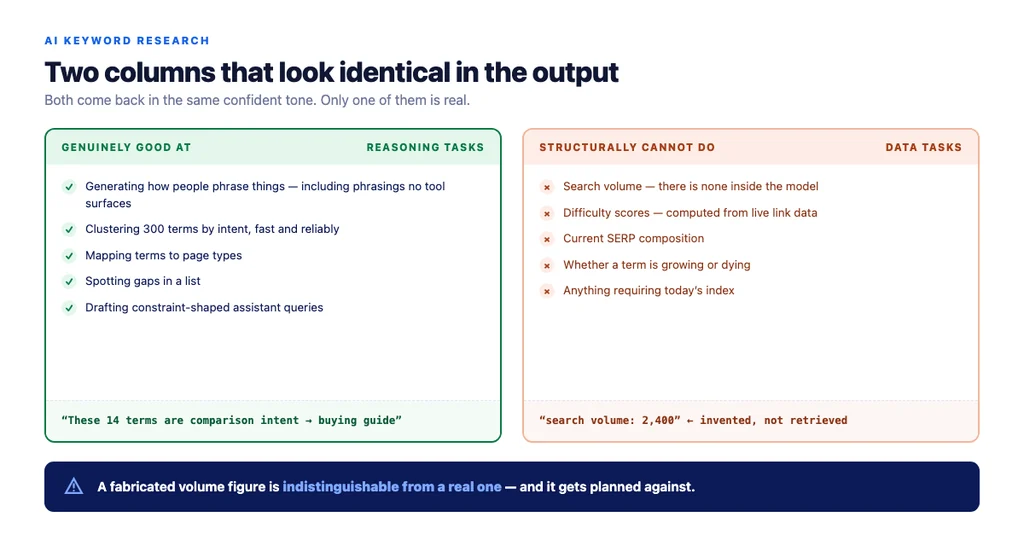
The trap is that all of this comes back in the same confident tone. A model listing "search volume: 2,400" alongside a genuinely useful intent cluster gives no signal about which half is real.
A workflow that uses both
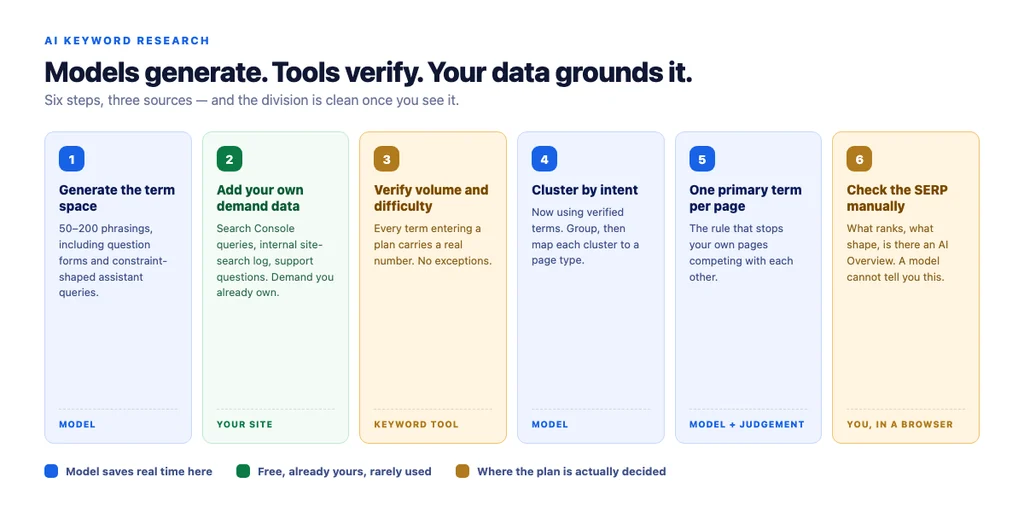
The division is clean once you see it: models generate and organise, tools verify and quantify.
1. Generate the term space with a model. Fifty to two hundred phrasings for a category, including constraint-shaped assistant queries and question forms. 2. Add real inputs the model cannot know: your Search Console query list, your internal site-search log, and the questions your support team answers. These are demand data you already own and almost nobody uses. 3. Verify volume and difficulty in a keyword tool. Every term that survives into a plan must have a real number attached. No exceptions — this is the step that separates a plan from a wish. 4. Cluster with the model, now using verified terms. Group by intent, then map each cluster to a page type. 5. Assign one primary term per page. The rule that prevents your own pages competing. 6. Check the SERP for your primary terms manually. What ranks, what shape are the results, is there an AI Overview. A model cannot tell you this and it changes whether a term is worth pursuing.
Steps 1, 4 and 5 are where AI saves real time. Steps 2, 3 and 6 are where the work is decided.
Your own data beats both
The most underused keyword source in ecommerce is not a tool or a model. It is your own site.
Internal site search. Every query typed into your own search box is a customer telling you what they want in their words, with purchase intent already established. If people search your site for "wide fit" and you have no page for it, that is a gap discovered without any tool.
Search Console queries. What you already appear for, including the phrasings you never targeted. Pages picking up unexpected queries are telling you what they are genuinely about.
Support tickets. The questions people ask before buying are the questions your content should answer.
None of this needs AI or a keyword tool, and all of it is demand data with your own customers attached.
How to prompt for keyword work
If you are using a model for the generation half, the prompt shape matters:
- Ask for phrasings, not keywords. "How would someone describe wanting X?" produces better raw material than "give me keywords for X."
- Give it your product context. Category, price band, who buys it, what distinguishes your range. Generation without context produces generic output.
- Ask explicitly for question forms and constraint-shaped queries. These are underrepresented in keyword tools and increasingly how people search.
- Tell it not to estimate volume. Otherwise it will, and you may forget it invented the numbers.
- Ask for the reasoning on clustering. If it groups two terms together, knowing why lets you check whether the grouping is right.
The checklist
- Model used for generating phrasings, not for volume figures
- Volume estimates from a model explicitly discarded
- Product context provided in the generation prompt
- Question forms and constraint-shaped queries requested
- Internal site-search log exported and reviewed
- Search Console query list exported and reviewed
- Support-team questions collected
- Every planned term verified in a keyword tool with real volume and difficulty
- Terms clustered by intent
- Each cluster mapped to a page type
- One primary term assigned per page
- SERP checked manually for each primary term
- Terms with no verified data excluded from the plan
Sources
- Google Search Essentials — Google Search Central
- Creating Helpful, Reliable, People-First Content — Google Search Central
- Google Search and AI-Generated Content — Google Search Central Blog
- SEO Best Practices for Ecommerce Sites — Google Search Central
- Ecommerce Product Data and Content on Google — Google Search Central
Frequently Asked Questions
Want this run against your store? Book a call with The Reach Bureau.