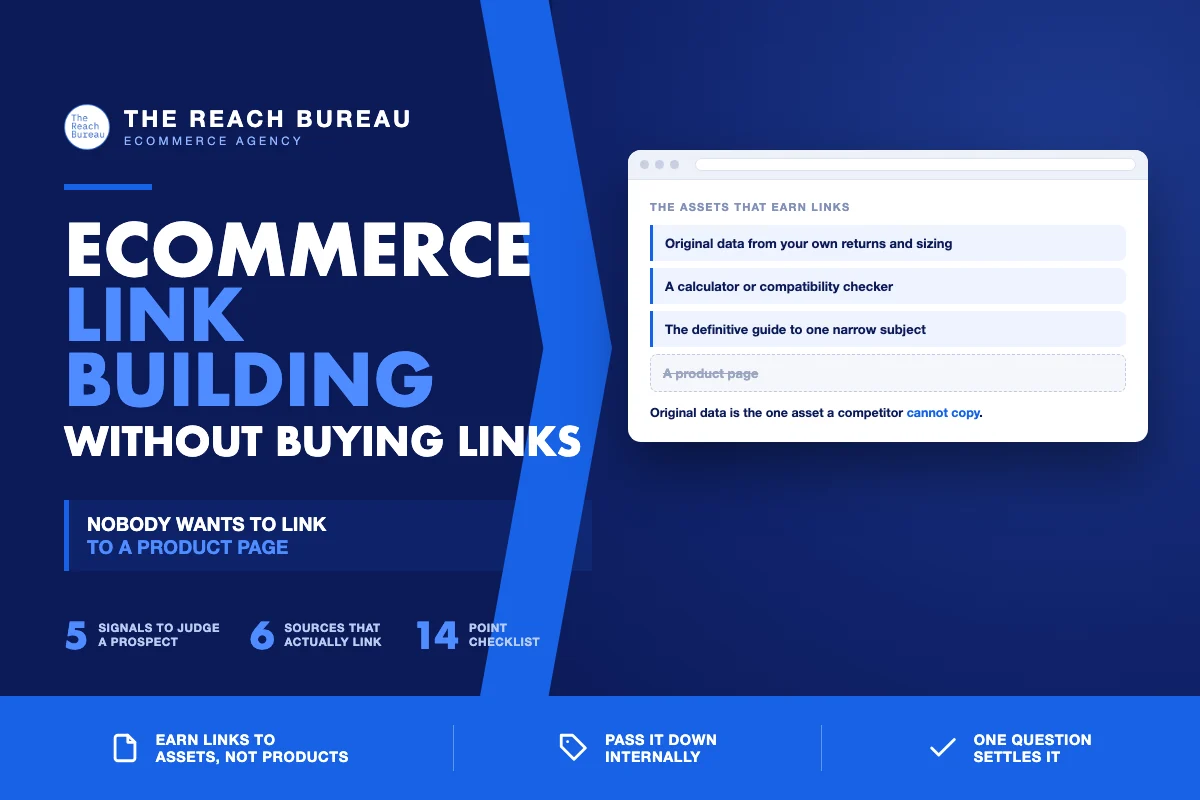
Ecommerce link building is harder than link building for anything else, for a reason nobody says out loud: nobody wants to link to a product page.
Blogs earn links because people cite ideas. Tools earn links because people share utilities. A product page exists to sell one item to one buyer, and there is no natural reason for a third party to reference it. Which is why so much ecommerce link building degenerates into buying links — the honest routes look slow, and the slow routes get skipped.
They are slow. They are also the only ones that survive, and a store with a toxic link profile spends more time cleaning it up than it would have spent earning links properly.
Why product pages are hard to link to
Understanding this shapes everything else.
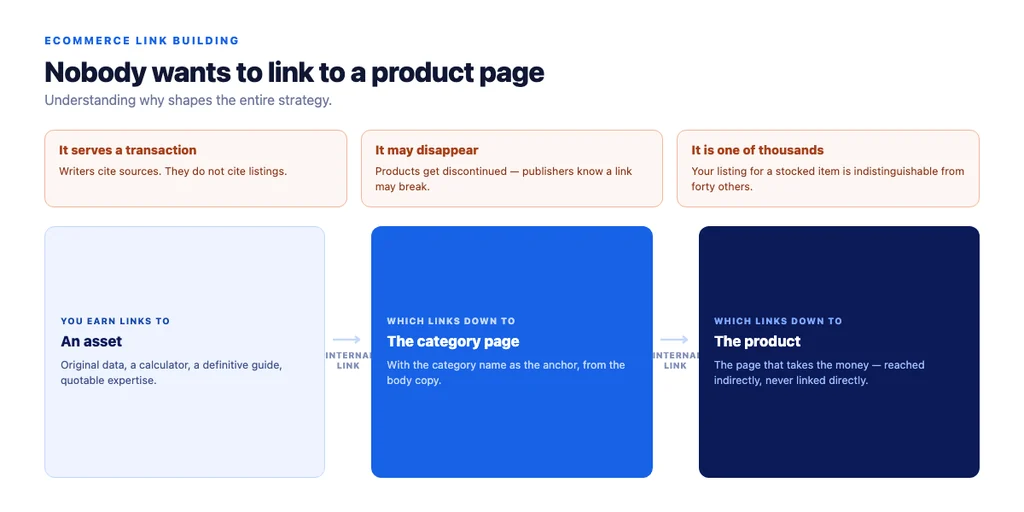
A product page serves a transaction, not a reference. Writers cite sources; they do not cite listings.
It changes or disappears. Products get discontinued, and a link to something no longer sold is a broken reference. Publishers know this.
It is one of thousands like it. Your listing for a widely-stocked item is not distinguishable from forty others.
The consequence: you rarely earn links *to* product pages. You earn them to something else and pass the authority down through internal links. That indirection is the whole game, and it is why internal linking matters more on a store than on any other site type.
The assets that actually earn links
Original data. The strongest asset a store has and the one almost none use. You have transaction data, return-rate data, sizing data, seasonality data. An honest analysis of "what percentage of boots get returned for fit, by width" is genuinely novel, genuinely citable, and impossible for a competitor to copy.
Tools and calculators. Sizing calculators, cost comparisons, compatibility checkers. Utilities get linked because they save the reader work.
Genuinely comprehensive guides. Not another "ultimate guide" — the definitive resource for a narrow subject where your store has real expertise. Narrow and complete beats broad and shallow.
Expert commentary in your category. If you know something about your products that a journalist writing about the category needs, being reachable and quotable earns mentions.
Comparison and buying resources that include products you do not sell. Counter-intuitive and effective: a resource that recommends competitors where appropriate becomes something people cite.
Where the links come from
- Journalists and publications covering your category — usually via a data asset or a quotable expert.
- Bloggers and reviewers in your niche, through genuine relationships and product access.
- Suppliers and manufacturers with dealer or stockist pages. Free, underused, and easy to ask for.
- Industry associations and directories relevant to your category.
- Communities where your category is discussed. Participation, not link-dropping.
- Unlinked brand mentions — the fastest available win: find where you are named without a link and ask.
Judging a link before you pursue it
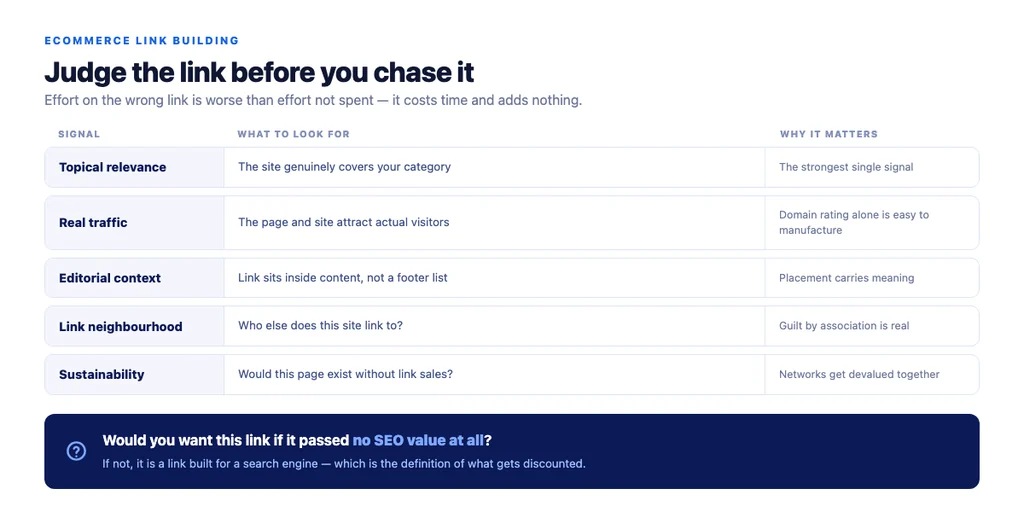
Effort spent on the wrong link is worse than effort not spent, because it costs time and adds nothing.
| Signal | What to look for | Why |
|---|---|---|
| Topical relevance | Site genuinely covers your category | The strongest single signal |
| Real traffic | The page and site attract actual visitors | Domain rating alone is easy to manufacture |
| Editorial context | Link sits inside content, not a footer list | Placement carries meaning |
| Link neighbourhood | Who else does the site link to? | Guilt by association is real |
| Sustainability | Would this page exist without link sales? | Networks get devalued together |
The test that catches most bad links: would you want this link if it passed no SEO value at all — purely for the referral traffic and the association? If not, it is a link built for a search engine, which is the definition of what gets discounted.
What to avoid
- Buying links. Genuinely common on stores at DR 0 desperate to move, and it produces exactly the toxic profile that then takes months to disavow.
- Mass guest posting on sites that exist to publish guest posts.
- Directory blasts. Anything offering hundreds of listings.
- Exact-match anchor text at scale. Natural profiles are dominated by brand and URL anchors.
- Reciprocal link schemes dressed up as partnerships.
Worth being specific about the damage: an unnatural profile is not just wasted money. It requires a disavow file and a recovery period, during which genuine work produces less than it should.
The internal linking half
Because you earn links to guides and data rather than to products, internal linking is what converts those links into product-page authority.
- Every earned asset links down to the relevant category and to two or three specific products, with descriptive anchors.
- Category pages link to key products from the descriptive copy, not only through the grid.
- Product pages link up to their category with the category name as the anchor.
- Related categories cross-link where a shopper might reasonably switch.
A store that earns ten good links and has no internal linking strategy has wasted most of them.
The checklist
- Accepted that links come to assets, not to product pages
- Original data reviewed for anything publishable
- At least one tool, calculator or genuinely definitive resource planned
- Supplier and manufacturer stockist pages requested
- Relevant industry directories and associations identified
- Unlinked brand mentions found and outreach sent
- Every prospect checked for topical relevance
- Every prospect checked for real traffic, not just domain rating
- Link neighbourhood reviewed before outreach
- "Would I want this link with no SEO value?" applied to each prospect
- No purchased links, guest post networks or directory blasts
- Anchor profile dominated by brand and URL anchors
- Earned assets link down to categories and specific products
- Product pages link up to categories with descriptive anchors
Sources
- Google Search Essentials — Google Search Central
- Spam Policies for Google Web Search — Google Search Central
- Creating Helpful, Reliable, People-First Content — Google Search Central
- SEO Best Practices for Ecommerce Sites — Google Search Central
- Ecommerce Product Data and Content on Google — Google Search Central
Frequently Asked Questions
Want this run against your store? Book a call with The Reach Bureau.