Monitoring catches breaks. A page that 404s, a stray noindex, a robots rule that removes a directory — all of those trip an alert on the day they happen.
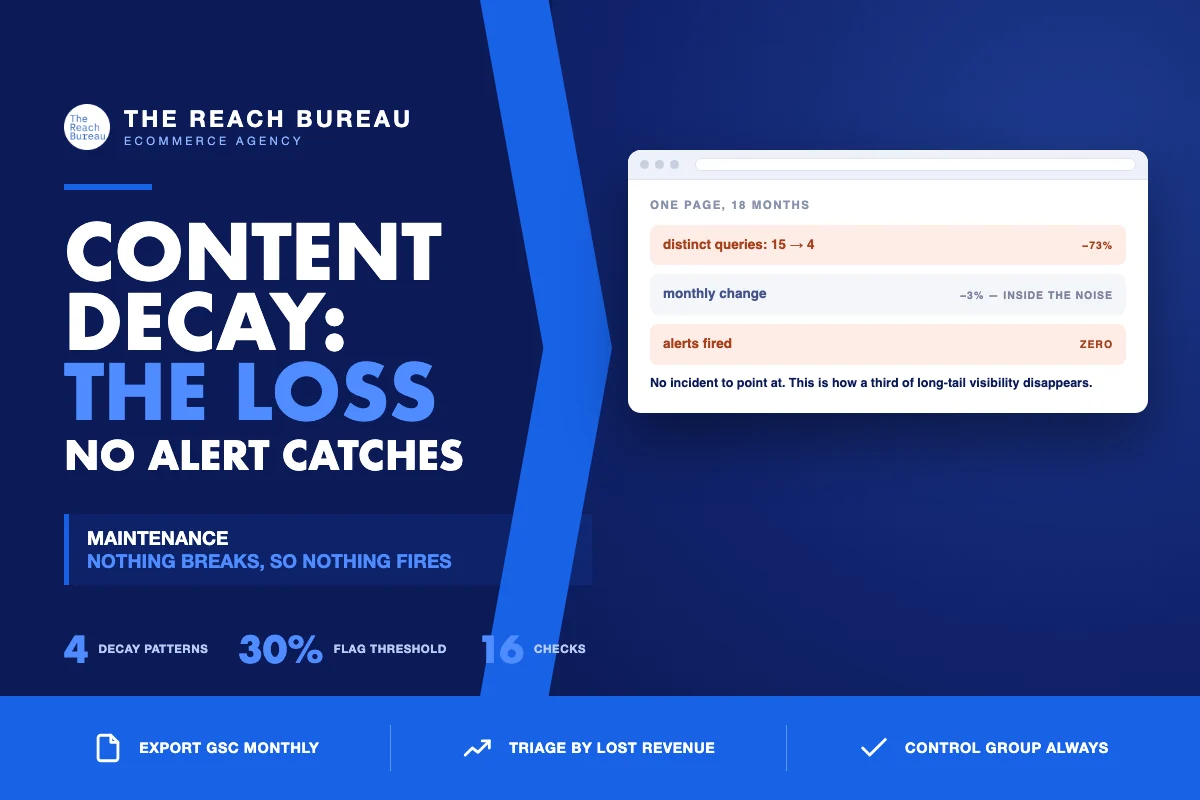
Decay is different. A page loses two queries a month for eighteen months. Nothing breaks, no threshold is crossed, no alert fires. By the time anyone looks, a third of the catalogue's long-tail visibility has gone and there is no incident to point at. This is the most common way an ecommerce site loses organic revenue, and it is almost entirely invisible to the tooling most teams have.
Why nothing fires
- Every individual change is inside the noise. A 3% monthly decline on one page never crosses a threshold set for a 25% site-wide drop.
- The aggregate hides it. New pages and seasonal peaks mask the erosion underneath.
- Alerts are page-agnostic. Site-level monitoring cannot see that page 4,112 has lost eleven of its fifteen queries.
- Nobody owns old pages. Publishing has an owner. Maintenance usually does not.
- The decline is real, not a measurement artefact — which makes it worse, and easier to dismiss as "consent changes".
What decay actually looks like
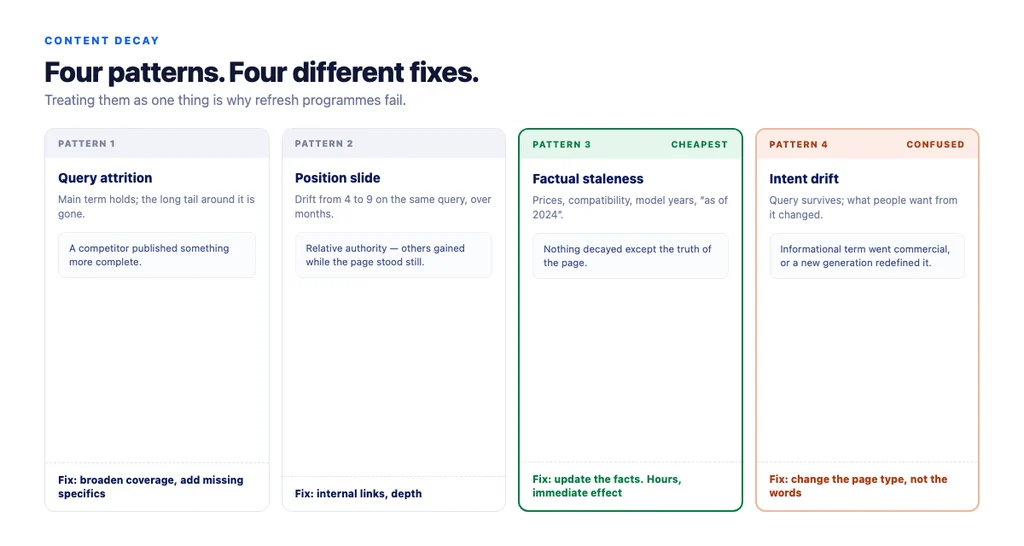
Four distinct patterns, with different fixes. Treating them as one thing is why refresh programmes fail.
1. Query attrition. The page still ranks for its main term but has lost the long tail around it. Usually a competitor published something more complete. Fix: broaden coverage, add the specifics that are missing.
2. Position slide. Slow drift from 4 to 9 on the same query. Usually relative authority — others gained links and depth while the page stood still. Fix: internal links, depth, freshness of substance.
3. Factual staleness. Prices, compatibility, model years, "as of 2024" statements. Fix: update the facts. This is the cheapest and most neglected category.
4. Intent drift. The query still exists but what people want from it changed — a term that was informational is now commercial, or a new product generation redefined it. Fix: change the page type or the framing, not just the words.
Detecting it deliberately
You have to go looking. This is a scheduled comparison, not an alert.
1. Export Search Console query-by-page data monthly. Keep the exports; you need history beyond sixteen months, and this is the only way to get it. 2. For each page, count distinct queries with impressions. Compare against the same page twelve months ago. 3. Flag any page that lost more than 30% of its distinct queries. That threshold catches real decay without drowning you. 4. Separately, flag pages whose average position worsened by more than three places on their top query. 5. Cross-reference with revenue. A decaying page that never converted is a lower priority than a decaying category page. 6. Check publication date. Pages 18–36 months old are the usual cohort.
Note step 1. Without stored exports you cannot do this at all, and most stores discover that when they first try.
The refresh programme
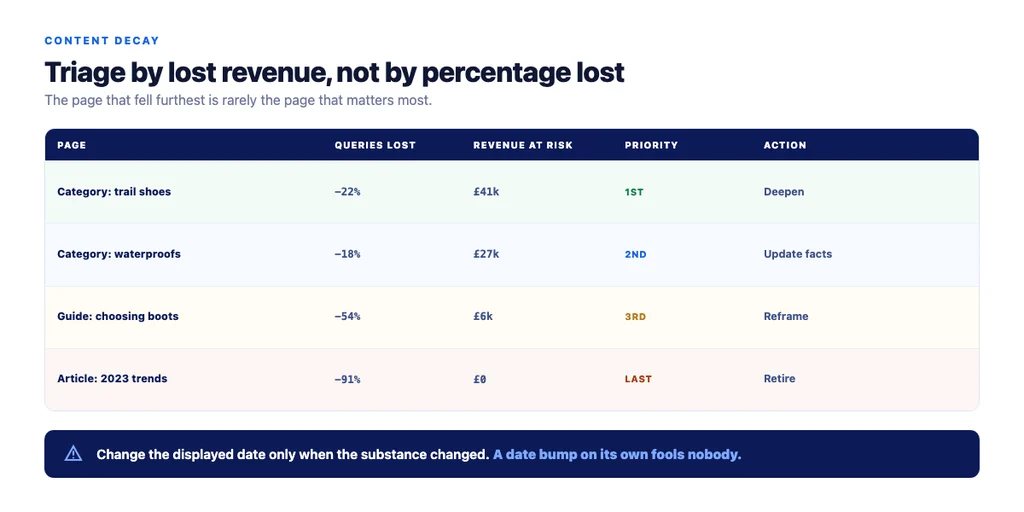
Refresh is not rewriting everything. It is a triage.
Rank candidates by lost revenue potential, not by percentage lost. A category page down 20% matters more than an article down 80%.
Then classify each into one of four actions:
- Update the facts — prices, compatibility, dates, model references. Hours of work, immediate effect.
- Deepen — add the missing specifics a competitor covers. Days of work, weeks to effect.
- Reframe — change the page type or angle because intent moved. Days, and needs judgement.
- Consolidate or retire — where the page never had a job, or two pages split one topic. Requires care with links and redirects, and is the only action that is hard to reverse.
Update the date only when the content actually changed. Changing a displayed date without changing substance is the most common cargo-cult move in refresh work, and it fools nobody.
Measure against a control group. Refresh some pages, leave comparable ones alone, compare at six to twelve weeks. Otherwise you cannot tell refresh from seasonality.
What makes decay worse
- Publishing without a maintenance budget. Every new page is a future maintenance liability, and most content plans price only the writing.
- No page-level ownership. Nobody's job includes page 4,112.
- Thin pages at scale. They decay fastest because they had the least reason to rank.
- Discontinued products left as-is. Neither redirected nor updated, they accumulate.
- Facts embedded in prose rather than in fields. A price in a sentence is invisible to any bulk update.
- Reporting only on aggregate traffic, which is where this whole problem hides.
That last one connects decay to reporting: a store watching only site-level organic sessions will see decay as "flat traffic" for two years, then as a problem with no cause.
Building maintenance in
- Budget maintenance as a fixed share of content spend — a quarter is a reasonable starting point.
- Give every page an owner by category, not individually.
- Store facts in fields, not prose, so bulk updates are possible.
- Put a review date on every page at publication.
- Redirect discontinued products to the closest live equivalent, as part of the discontinuation process rather than as an SEO project.
- Run the decay report quarterly. Any less and the cohort gets too large to triage.
The checklist
- Search Console query-by-page data exported monthly and stored
- Distinct query counts compared year on year, per page
- Pages losing over 30% of distinct queries flagged
- Pages down more than three positions on their top query flagged
- Decay candidates cross-referenced with revenue
- Candidates ranked by lost revenue, not percentage lost
- Each candidate classified: update facts, deepen, reframe, or retire
- Dates changed only when substance changed
- Control group of comparable untouched pages kept
- Results read at six to twelve weeks
- Maintenance budgeted as a share of content spend
- Page ownership assigned by category
- Facts stored in fields rather than prose
- Review date set at publication
- Discontinued products redirected as part of discontinuation
- Decay report run quarterly
Sources
- Google Search Console Help — Google
- Creating Helpful, Reliable, People-First Content — Google Search Central
- SEO Best Practices for Ecommerce Sites — Google Search Central
- Consolidate Duplicate URLs with Canonicals — Google Search Central
- Google Search Essentials — Google Search Central
Frequently Asked Questions
Want this run against your store? Book a call with The Reach Bureau.