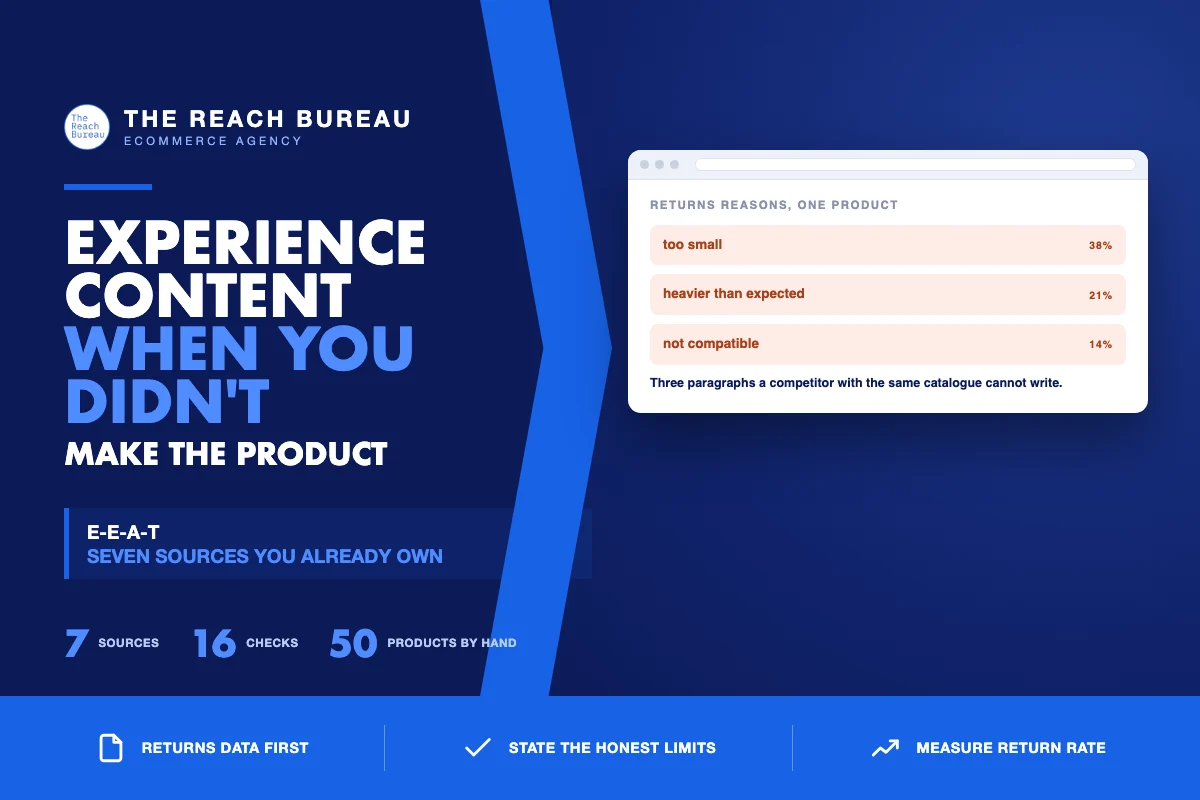
Google's guidance asks for evidence of first-hand experience. That is straightforward advice for a manufacturer and awkward advice for a store that resells other people's products — which is most ecommerce.
The good news is that resellers hold experience nobody else has. It is just filed as operational data rather than content: returns reasons, support tickets, warehouse observations, what your staff actually recommends. This is about turning that into pages a competitor with the same catalogue cannot replicate.
Why it matters more than it used to
A generated summary can restate anything general. It cannot restate what only you know. So the parts of your page that are general knowledge are increasingly answered before the click, while the parts that are yours are the reason the click still happens — and the reason you get cited rather than paraphrased.
The same content is also what a human buyer wants. This is one of the rare cases where the SEO incentive and the shopper's interest are identical.
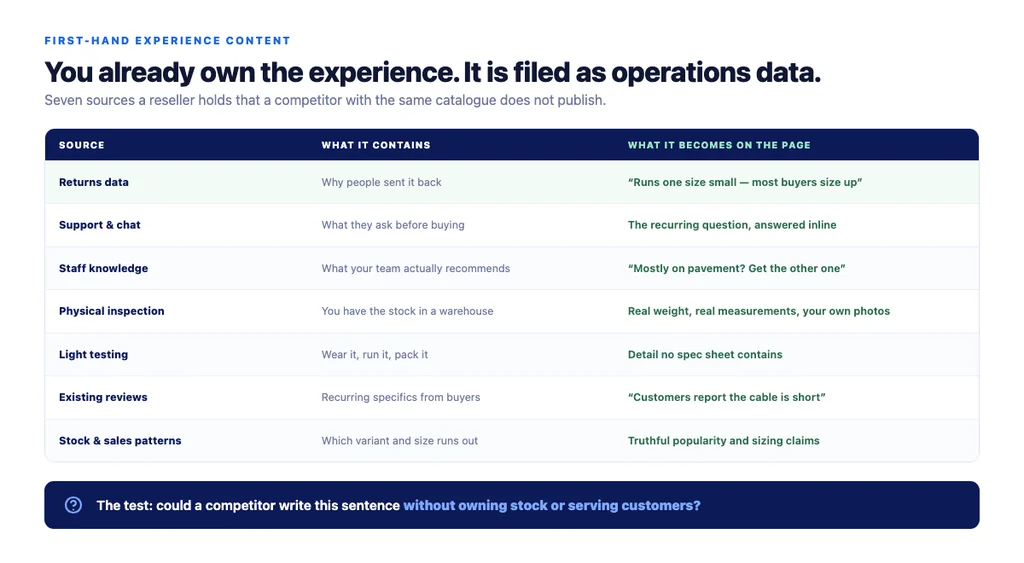
The seven sources you already own
1. Returns data. The single most valuable and least used. Why do people send this back? "Runs one size small" and "the cable is shorter than people expect" are facts you know and your competitors do not publish. Every recurring return reason is a paragraph that prevents the next one.
2. Support tickets and chat transcripts. What shoppers ask before buying, in their words. Product-dependent questions belong on the product page.
3. Staff knowledge. Your team recommends products all day. "If you're mostly on pavement, get the other one" is expertise; ask them and write it down.
4. Physical inspection. You have the stock. Weigh it, measure it, photograph the actual item on a plain background next to something for scale, note the finish. Manufacturer photos are on a hundred sites; yours are not.
5. Genuine testing, where feasible. Not a lab. Wear the boots, run the blender, put the case in a bag. Even light testing produces detail no spec sheet contains.
6. Reviews you already have. Mine them for recurring specifics and surface those in the description — attributed honestly as what customers report.
7. Sales and stock patterns. Which variant sells out, which size runs out first, what people buy together. "Most buyers size up" is a claim you can make truthfully because you can see it.
Turning it into content
The mistake is writing an essay. Product pages are scanned. The experience should appear as specifics in the places a shopper is already looking.
Add a "what to know" block with three to five specifics: how sizing runs, what is in the box, what it does not do, the thing people most often get wrong.
State the limits plainly. "Not suitable for continuous outdoor use." This is the single most trust-building sentence type available and almost nobody writes it. It also reduces returns.
Give real measurements alongside the manufacturer's, particularly where they differ from expectation.
Answer the recurring question inline, not in a separate FAQ nobody reaches.
Use your own photographs with something in frame for scale.
Say who it is for and who it is not for. A page that helps someone decide *not* to buy earns more trust than one that pushes everyone.
Doing it at catalogue scale
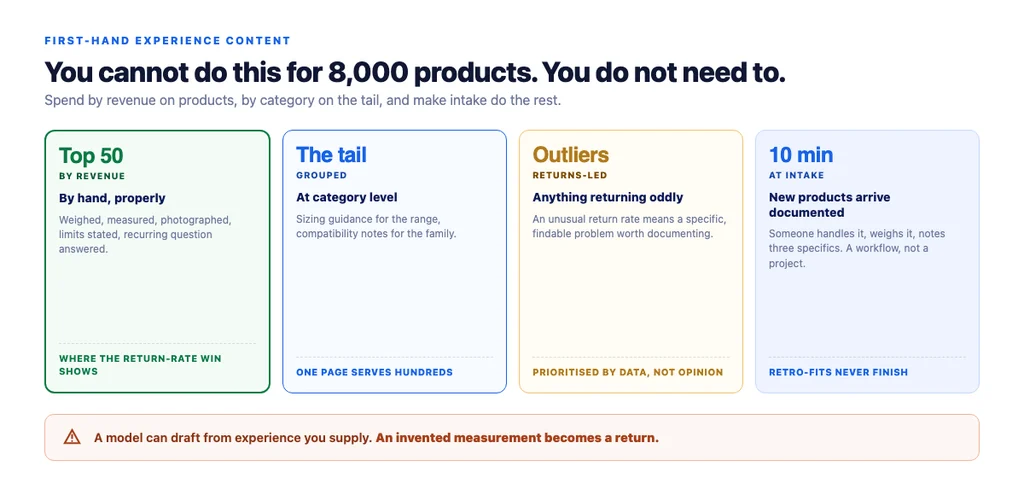
You cannot do this for 8,000 products. You do not need to.
1. Rank products by revenue and take the top 50. Do those properly, by hand. 2. Group the rest by category and write experience content at category level — sizing guidance for the whole range, compatibility notes for the family. 3. Use returns data to prioritise beyond the top 50: any product with an unusual return rate has a specific, findable problem worth documenting. 4. Make it a workflow, not a project. New product added → someone handles it, weighs it, notes three specifics. Ten minutes at intake beats a retro-fitting project nobody finishes. 5. Let AI assist the transformation, not the knowledge. Give a model your returns reasons and staff notes and ask it to draft the block. It cannot invent the input, and every claim still gets checked against the item.
What does not count
Worth being blunt, because a lot of "experience-led content" is neither.
- Rewriting the manufacturer description in different words. Same information, no experience.
- "Our team loves this product." Says nothing checkable.
- Adjectives. "Premium", "high-quality", "durable" — a shopper skips all of these.
- A generated paragraph of general advice about the category.
- Stock photography presented as your own.
- Invented specifics. The worst option: a fabricated measurement reaches a customer, becomes a return, and costs more than the content saved.
The test is simple: could a competitor with the same catalogue write this sentence without owning stock or serving customers? If yes, it is not experience.
How to tell whether it worked
- Return rate on the products you documented, against the ones you did not. This is the fastest, clearest signal and it is a commercial one.
- Conversion rate on those product pages versus a control group.
- Support ticket volume for the questions you answered on the page.
- Whether the specifics get quoted when you ask an assistant about the product.
- Time on page and scroll depth — slower, softer, but honest.
The return-rate check is the one to lead with internally. It turns a content project into an operations improvement, which is a much easier thing to fund.
The checklist
- Returns reasons pulled and grouped by product
- Support and chat questions collected, product-dependent ones separated
- Staff asked what they actually recommend and why
- Top products physically weighed, measured and photographed
- Light testing done where feasible
- Existing reviews mined for recurring specifics
- Stock and sales patterns used for truthful claims
- "What to know" block with three to five specifics
- Honest limits stated plainly on every documented product
- Own photographs with something for scale
- Who it is not for, said explicitly
- Top 50 products by revenue done by hand
- Tail handled at category level
- Intake workflow so new products arrive documented
- Every claim verified against the physical item
- Return rate compared against an undocumented control group
Sources
- Creating Helpful, Reliable, People-First Content — Google Search Central
- Search Quality Rater Guidelines: An Overview — Google Search Central Blog
- SEO Best Practices for Ecommerce Sites — Google Search Central
- Intro to Product Structured Data on Google — Google Search Central
- Google Search Essentials — Google Search Central
Frequently Asked Questions
Want this run against your store? Book a call with The Reach Bureau.