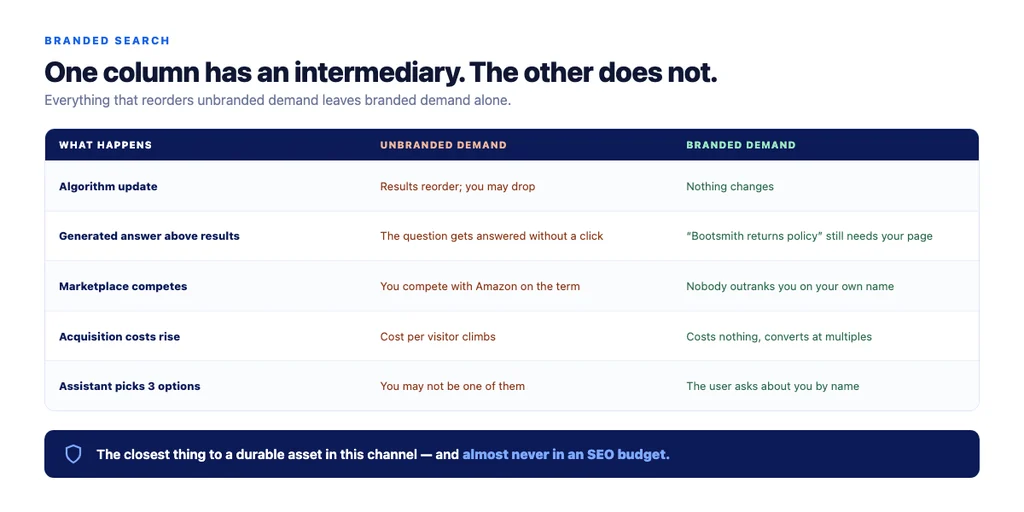
Every change in how people find products has the same effect on unbranded demand: an intermediary gets between you and the shopper. A search engine ranks you. A marketplace ranks you. An assistant summarises you. Each one can change its mind next quarter.
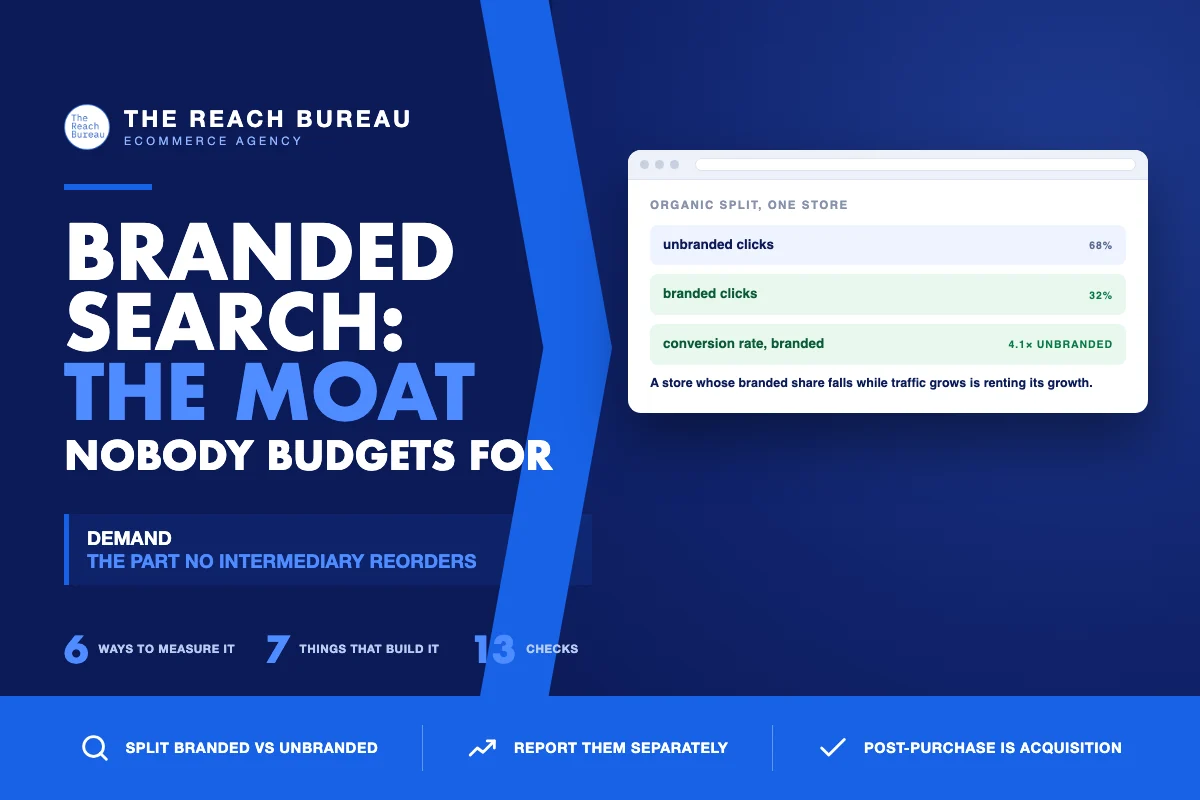
Branded demand is the exception. When someone searches your name, or types your domain directly, no intermediary decides whether you appear. That is why branded search is the closest thing to a durable asset in this channel — and why it is almost never in an SEO budget.
What branded demand protects you from
- Algorithm updates. They reorder unbranded results. They do not reorder someone looking for you specifically.
- Answers appearing above the results. A generated summary can absorb "how do I clean suede boots". It cannot absorb "Bootsmith returns policy".
- Marketplace competition. On unbranded terms you compete with Amazon. On your own name you do not.
- Rising acquisition costs. Branded traffic converts at multiples of unbranded and costs nothing per click.
- Being left out of an assistant's answer. Someone who knows your name asks about *you*, not about the category.
That last point is the one that has changed recently. As more discovery is mediated by systems that pick a small number of options, being the option people name matters more than being the option an algorithm picks.
How to measure it honestly
Most stores do not know their branded share, and the number is usually surprising.
1. Split Search Console queries into branded (containing your brand or an obvious misspelling) and unbranded. Build the misspelling list from the data itself. 2. Track branded impressions and clicks over time. Growth here is demand growth, independent of ranking. 3. Track direct traffic alongside it. Direct and branded search move together and tell the same story. 4. Compare conversion rates. Branded and direct almost always convert far better; this is the argument for funding brand work out of a performance budget. 5. Watch the ratio. Branded as a share of total organic. A store whose branded share is falling while total traffic grows is renting its growth. 6. Segment new versus returning on branded traffic. Rising branded from *new* visitors means demand is being created, not just retained.
Two cautions. Your brand name may be a real word, in which case some "branded" queries are not about you at all — check the pages they land on. And branded search rises after any advertising, so attribute increases to the campaign that caused them, not to SEO.
What actually builds it
Not "content marketing" in the abstract. Specific things, in rough order of reliability for a store.
A product or range worth naming. The unglamorous prerequisite. Nobody searches the name of a store that sells the same catalogue as forty others at the same price.
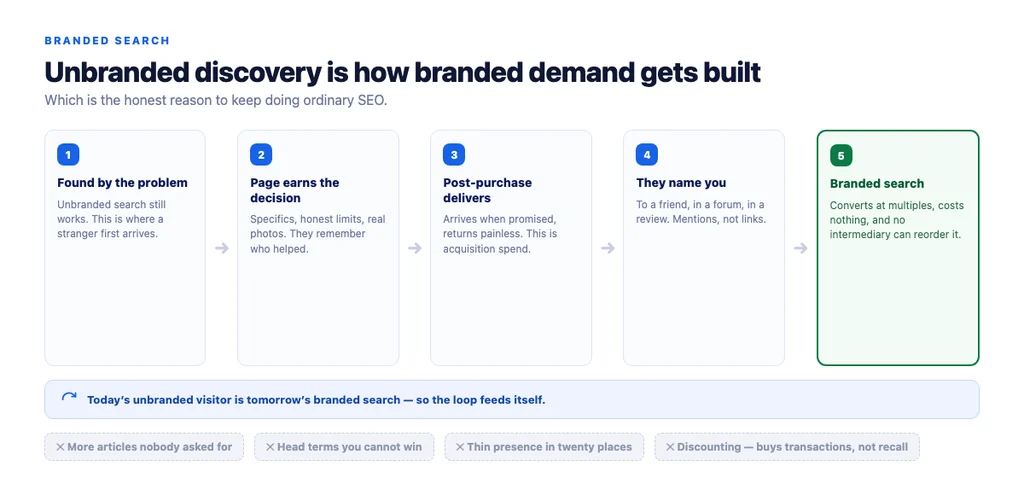
Being findable by the problem you solve while unbranded discovery still works. Today's unbranded visitor is tomorrow's branded search — which is the honest argument for continuing to do ordinary SEO.
Post-purchase experience. Delivery that arrives when promised, returns that are painless, packaging someone photographs. This produces named recommendations, which produce branded searches.
Being cited where your buyers already are. Reviews, forums, comparison content, communities. Not link building — mention building. An assistant summarising a category names the brands it sees named.
Consistent identity. The same name, spelling and positioning everywhere. Fragmented naming splits your own demand.
Email and owned channels. The only audience nobody can reorder.
Advertising, honestly counted. Paid does build branded demand. Measure the lift so it can be justified rather than assumed.
What does not build it
- Publishing more articles nobody asked for. Volume does not create recall.
- Chasing head terms you cannot win. Losing visibly to a marketplace teaches nobody your name.
- Being everywhere cheaply. Thin presence in twenty places is less use than being genuinely useful in two.
- Discounting. It buys transactions, not recall. Customers acquired on price search for the price next time.
How this changes the plan
It does not mean stopping unbranded SEO. It means changing what you consider the outcome.
- Report branded and unbranded separately. Blended organic traffic hides which one is growing.
- Count assisted branded search as an outcome of content work, not just last-click revenue.
- Fund the post-purchase experience from the acquisition budget, because it is acquisition — it produces the next branded search.
- Judge category and product pages on whether they convert a first-time unbranded visitor into someone who remembers you.
- Accept the timeline. Branded demand compounds slowly and cannot be bought quickly, which is precisely why it holds its value.
The checklist
- Search Console queries split into branded and unbranded
- Misspelling list built from the query data itself
- Branded impressions and clicks tracked over time
- Direct traffic tracked alongside branded search
- Conversion rate compared: branded, direct, unbranded
- Branded share of total organic monitored for direction
- New versus returning split on branded traffic
- Generic-word brand names checked against landing pages
- Advertising-driven branded lift attributed to the campaign
- Post-purchase experience treated as acquisition spend
- Mentions tracked where buyers actually are, not just links
- Name, spelling and positioning consistent everywhere
- Branded and unbranded reported separately, never blended
Sources
- Google Search Console Help — Google
- SEO Best Practices for Ecommerce Sites — Google Search Central
- Creating Helpful, Reliable, People-First Content — Google Search Central
- Google Search Essentials — Google Search Central
- Ecommerce Product Data and Content on Google — Google Search Central
Frequently Asked Questions
Want this run against your store? Book a call with The Reach Bureau.