"Helpful content" has become the vaguest phrase in ecommerce SEO. Everyone agrees pages should be helpful. Almost nobody can say what that means on a page whose job is to sell one product.
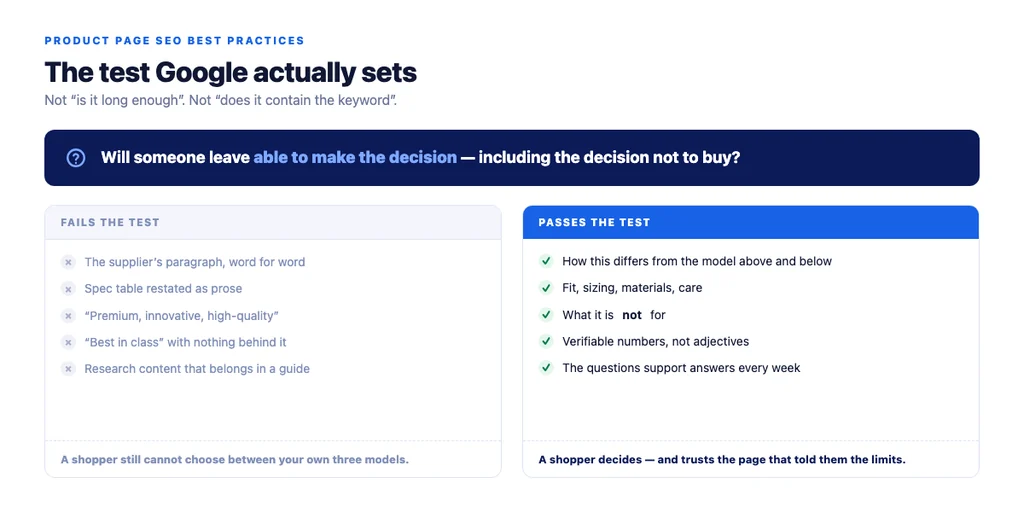
Google's own guidance is more concrete than the summaries of it. The test it sets is specific: after reading, will someone leave feeling they learned enough about the topic to help achieve their goal? On a product page, the goal is a purchase decision — so a helpful product page is one that lets a shopper decide, including deciding not to buy.
That reframing does most of the work. These are the best practices that follow from it.
Start with the test Google actually sets
Before the tactics, the standard. Google's guidance on creating helpful, reliable, people-first content asks a set of self-assessment questions. Three of them translate directly to product pages:
- Does the content demonstrate first-hand expertise and depth of knowledge? On a product page that means you have handled the product, not paraphrased the supplier.
- Would someone leave feeling they learned enough to achieve their goal? The goal is deciding, not browsing.
- Do you have an existing or intended audience who would find this useful if they came to you directly? If the page only makes sense to a search engine, that is the answer.
Google also notes, in its guidance on product reviews, that trust is built when readers can see how many products were tested, what the results were, and how the testing was done — with evidence of the work, such as photographs. That principle scales down to a product page: show the work.
Best practices that actually move the needle
Answer the decision, not the specification
The spec table lists what the product is. The description exists to say who it is for and how it differs from the alternatives — including your own alternatives. A page that says "the Pro model adds a metal gear housing, worth it for masonry, unnecessary for flat-pack furniture" is helpful. A page that repeats the gear housing in prose is not.
Include what the product is not for
The single fastest trust signal on a product page, and the one almost no store publishes. Saying "not the right saw for hardwood" costs a sale you would have refunded and makes every other claim on the page credible. Google's guidance repeatedly rewards content that reads as written for people rather than to capture traffic; honest limits are the clearest evidence of that.
Answer support questions on the page
Your support inbox is a ranked list of what the page fails to explain. If three customers a week ask whether it runs small, that answer belongs in the description — not only in a reply.
Use specifics that can be verified
"IPX7, tested at one metre for thirty minutes" beats "premium water resistance." Concrete figures serve the shopper, and they are the only kind of content an AI search engine can quote in a comparison. Vague marketing language is unusable in both directions.
Let customers add the content you cannot write
Reviews and public Q&A add unique text, answer objections, and accumulate the vocabulary real buyers use. They also make the page eligible for rating markup. The rule is simply that they must be real — Google's structured data policies treat fabricated reviews and unearned rating markup as spam, and rating markup is actively policed.
Keep the page focused on one product
Product rich results support pages focused on a single product or its variants, per Google's Product structured data documentation. A page trying to be a product page, a category page and a buying guide at once satisfies none of the three.
What to cut
Most product pages get more helpful by deletion than by addition.
| Cut this | Why |
|---|---|
| The manufacturer's paragraph | Identical on every competitor's page; Google filters all but one |
| Restated spec prose | The table already says it, better |
| Research content | Belongs in a buying guide that links down to the product |
| Repeated keywords | Reads badly, converts worse, helps nothing |
| Adjective stacks | "Premium, innovative, high-quality" carries no information |
| Auto-generated filler | Text that could describe any product describes none |
The test for every block on the page: does removing it make the decision harder? If not, it is padding.
A page structure that satisfies the test
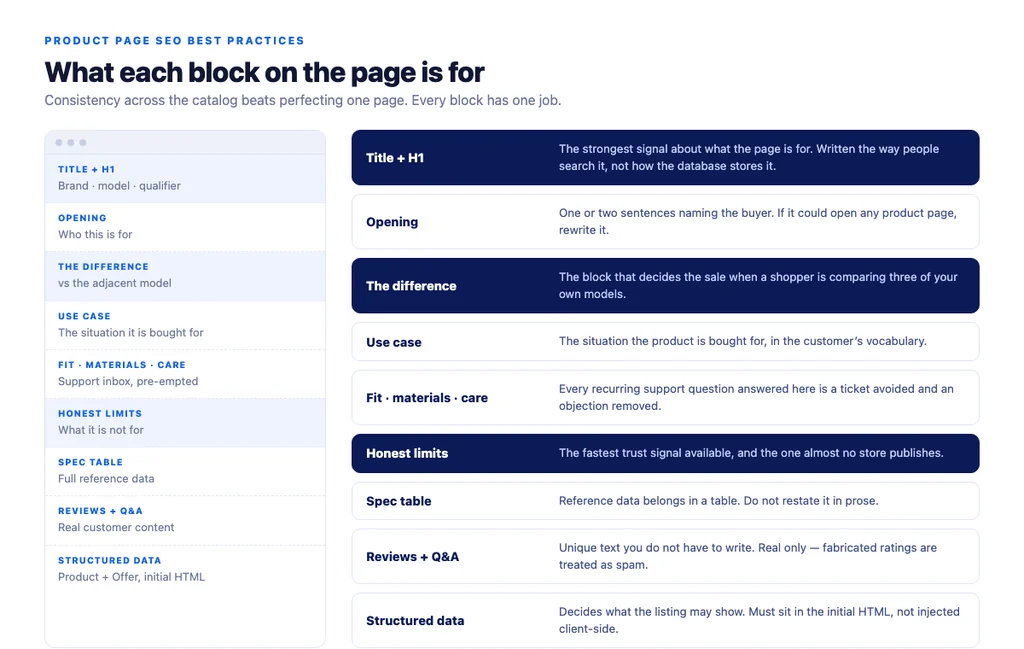
Consistency across a catalog matters more than perfecting one page.
| Block | What it does |
|---|---|
| Title and H1 | Brand, model, distinguishing qualifier — as people search it |
| Opening | Who this is for, in one or two sentences |
| The difference | How it compares to the adjacent model in your own range |
| Use case | The situation it is bought for |
| Fit, materials, care | The support inbox, pre-empted |
| Honest limits | What it is not for |
| Spec table | The full reference data |
| Reviews and Q&A | Real customer content |
| Structured data | Product + Offer, in the initial HTML |
Auditing an existing page
Run this on your top twenty products before touching the tail.
1. Read the page as a shopper who is deciding between three options. Can you decide? If not, what is missing — that is your first fix. 2. Search a distinctive sentence from your description in quotes. If other retailers appear, that text is supplier copy and it is why the page is invisible. 3. Open your last twenty support tickets for that product. Every recurring question that is not answered on the page is a gap. 4. Count the verifiable facts. Numbers, measurements, materials, tested conditions. Fewer than five on a considered purchase is thin. 5. Check what you claim without evidence. "Best in class" with nothing behind it is the kind of unsupported claim Google's guidance names directly. 6. Look at the page on a phone. Most ecommerce traffic is mobile, and most product pages are designed on a desktop.
Where this meets AI search
The overlap is larger than most stores expect and requires no separate strategy.
An assistant answering "waterproof hiking boot for wide feet under $150" needs facts it can assemble: fit, materials, price, availability, measured performance. That is precisely the content the helpful content test asks for. Pages written to help a human decide are the pages that get cited; pages written to capture a keyword have nothing quotable in them.
The corollary is worth stating plainly: there is no AI-specific content trick that outperforms writing a genuinely useful product page and marking it up properly.
The best practices checklist
- Description original to your store, not the manufacturer's
- Difference from the adjacent model stated explicitly
- Use case described in the shopper's language
- Fit, sizing, materials and care covered
- Honest limits included — what it is not for
- Recurring support questions answered on the page
- At least five verifiable, specific facts
- No unsupported superlatives
- Research content moved to a guide and linked down
- Real reviews collected; rating markup only where they exist
- Public Q&A enabled and answered
- Page focused on one product or its variants
Product+Offermarkup in the initial HTML- Title and H1 lead with brand, model and qualifier
- Checked on a phone, not only a desktop
Sources
- Creating Helpful, Reliable, People-First Content — Google Search Central
- Google Search Essentials — Google Search Central
- Intro to Product Structured Data on Google — Google Search Central
- SEO Best Practices for Ecommerce Sites — Google Search Central
- Ecommerce Product Data and Content on Google — Google Search Central
FAQs
Want this run against your store? Book a call with The Reach Bureau.