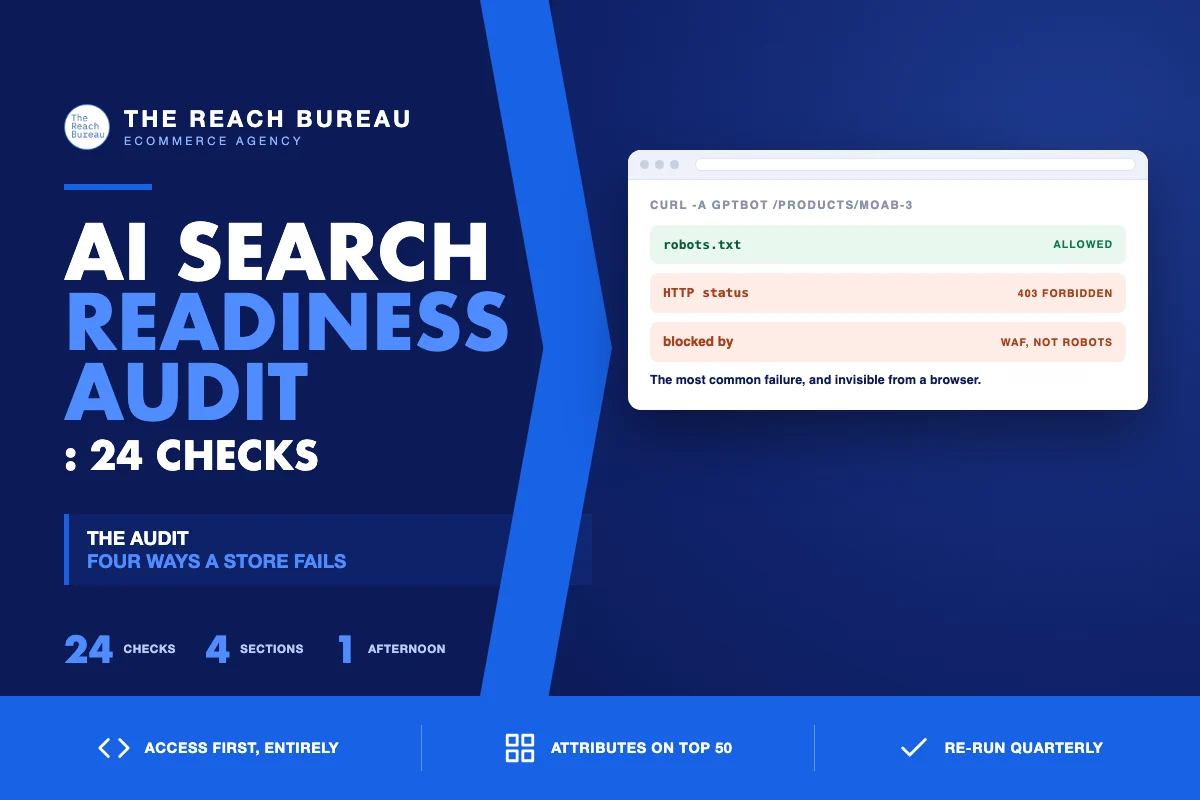
Most advice about AI search ends at principles. This is the audit — a fixed list you can run against a real store in an afternoon, where every item has a way to check it and a reason it matters.
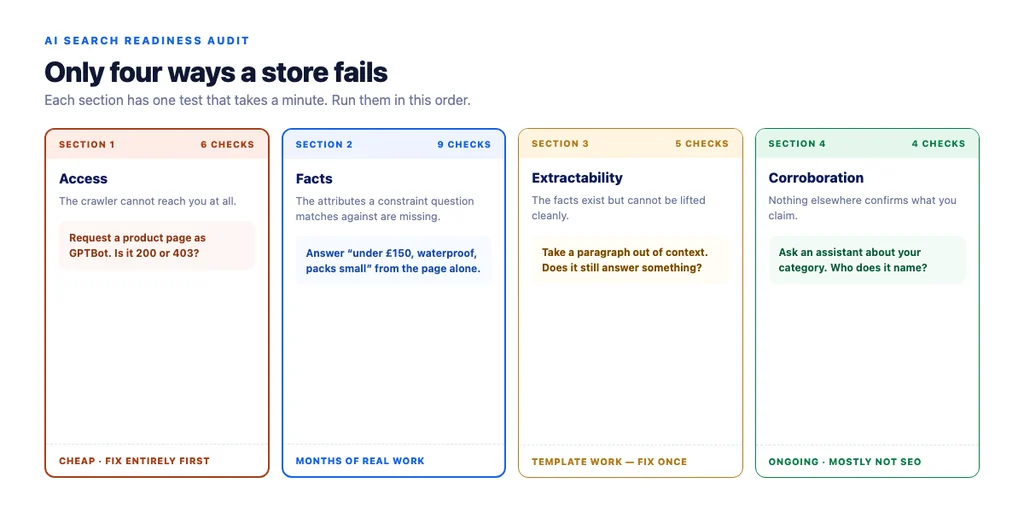
Four sections, because there are only four ways a store fails here: the crawler cannot reach you, the facts are not there, the answer cannot be extracted, or nothing corroborates you.
Section 1 — Access
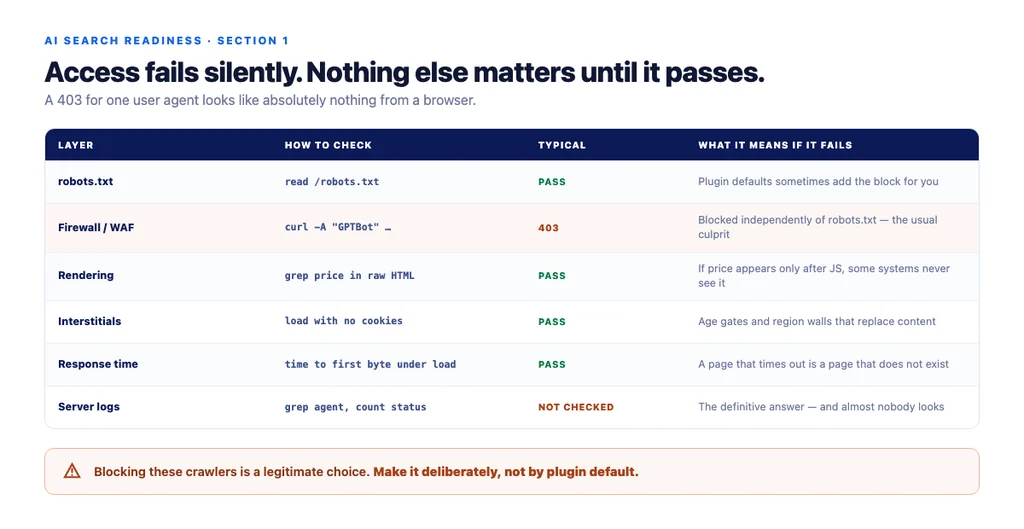
If a crawler cannot fetch the page, nothing else in this audit matters. This section is also where the most common and most invisible failure lives.
1. AI crawlers not blocked in robots.txt. Check for GPTBot, OAI-SearchBot, ClaudeBot, PerplexityBot, Google-Extended. *How to check:* read /robots.txt directly. Blocking these is a legitimate choice — but make it deliberately, not because a plugin default did it.
2. No server-level blocking. Firewalls, WAF rules and bot-protection services block these agents independently of robots.txt. *How to check:* request a product page with the crawler's user agent and confirm a 200, not a 403.
3. Content present without JavaScript. *How to check:* fetch the page and search the raw HTML for your price and a specification. If they only appear after scripts run, some systems will not see them.
4. No login or interstitial in the way. Age gates, region selectors and cookie walls that block content rather than sit above it.
5. Reasonable response times under crawl. A page that times out is a page that does not exist.
6. Canonicals self-referencing on pages you want retrieved.
Section 2 — Facts
An assistant answering a shopping question needs facts it can rely on. Missing attributes are the reason you are not in a constraint-matched answer.
7. Price present in the HTML and in Product structured data, and the two agree.
8. Availability accurate, and updated when stock changes.
9. Dimensions and weight where they matter to the decision.
10. Materials and composition.
11. Compatibility — what it fits, works with, or replaces. The single most common gap on parts and accessories.
12. What is included in the box.
13. What it does not do. Honest limits are rare, useful, and disproportionately quotable.
14. Delivery cost and timeframe, reachable from the product page.
15. Returns window and conditions, stated in plain language.
*How to check sections 7–15:* pick ten products a shopper would compare and try to answer three constraint questions using only the page — "under £150, waterproof, packs small". If you cannot, an assistant cannot.
Section 3 — Extractability
The facts exist. Can a machine lift the answer without pulling in three unrelated paragraphs?
16. One question per heading, phrased the way a shopper would ask it.
17. Answers that stand alone. A paragraph that makes sense lifted out of the page, without needing the sentence before it.
18. Specifications in a table or list, not buried mid-paragraph.
19. Comparisons stated explicitly rather than implied across sections.
20. No critical fact only in an image. Alt text is not a substitute for the value being in the text.
*How to check:* take a paragraph out of context and read it. Does it still answer something?
Section 4 — Corroboration
Assistants cross-check. A claim only you make is weaker than one that matches elsewhere.
21. Specifications match manufacturer listings.
22. Business name, address and phone consistent across your site, listings and profiles.
23. Reviews exist and read as genuine — a range of ratings, specific detail, not all posted the same week.
24. You are mentioned where your category is discussed — reviews, forums, comparison content. Mentions, not links.
*How to check:* search your brand plus a product and read what a stranger would find. Then ask an assistant about your category and see who it names.
How to run it
1. Score each item pass, fail or partial on ten representative products and your five biggest categories. 2. Fix Section 1 first, entirely. It is cheap, and everything else depends on it. 3. Then Section 2 on your top 50 products by revenue. This is the section with the real work in it — months, not days. 4. Section 3 is template work. Fix it once in the template and it applies catalogue-wide. 5. Section 4 is ongoing and mostly not an SEO task — it is product, service and PR. 6. Re-run quarterly, and after any replatform, feed change or bot-protection change.
What to measure afterwards
There is no ranking to track here, and any product claiming otherwise is sampling. Measure these instead:
- Referral sessions from assistant domains, as their own analytics channel.
- A fixed list of twenty prompts relevant to your category, run manually each month, recording whether you appear.
- Brand mention volume where your buyers are.
- Server logs for AI crawler activity — are they fetching, and getting 200s?
That last one is the most under-used check on this list. Your logs answer definitively whether these systems can reach you, and almost nobody looks.
The checklist
robots.txtchecked for AI crawler directives, decision made deliberately- Crawler user agents get 200, not 403, at server level
- Price and specs present in raw HTML without JavaScript
- No interstitial or gate blocking content
- Self-referencing canonicals on retrievable pages
- Price in HTML and structured data, agreeing
- Availability accurate and updated with stock
- Dimensions, weight, materials present where they matter
- Compatibility stated for parts and accessories
- What is included, and what it does not do
- Delivery and returns reachable from the product page
- Three-constraint test passed on ten comparable products
- One question per heading, in shopper language
- Answers readable lifted out of context
- Specifications in a table, not mid-paragraph
- No critical fact living only in an image
- Specs match manufacturer listings
- Name, address, phone consistent everywhere
- Reviews varied, specific and not date-clustered
- Mentions present where the category is discussed
- Assistant referrals visible as their own channel
- Twenty prompts checked manually each month
- Server logs reviewed for AI crawler status codes
- Audit re-run quarterly and after any replatform
Sources
- Introduction to robots.txt — Google Search Central
- Google Crawlers and Fetchers Overview — Google Search Central
- Intro to Product Structured Data on Google — Google Search Central
- SEO Best Practices for Ecommerce Sites — Google Search Central
- Creating Helpful, Reliable, People-First Content — Google Search Central
Frequently Asked Questions
Want this run against your store? Book a call with The Reach Bureau.