
Freshness is the most misapplied idea in SEO. It produces two opposite errors on the same site: articles whose dates get bumped monthly with no change to the content, and product pages showing a price that has been wrong for six weeks.
The second is the expensive one. Freshness in ecommerce is overwhelmingly about data accuracy rather than publication recency, and separating those two ideas is most of the work.
Two different things called freshness
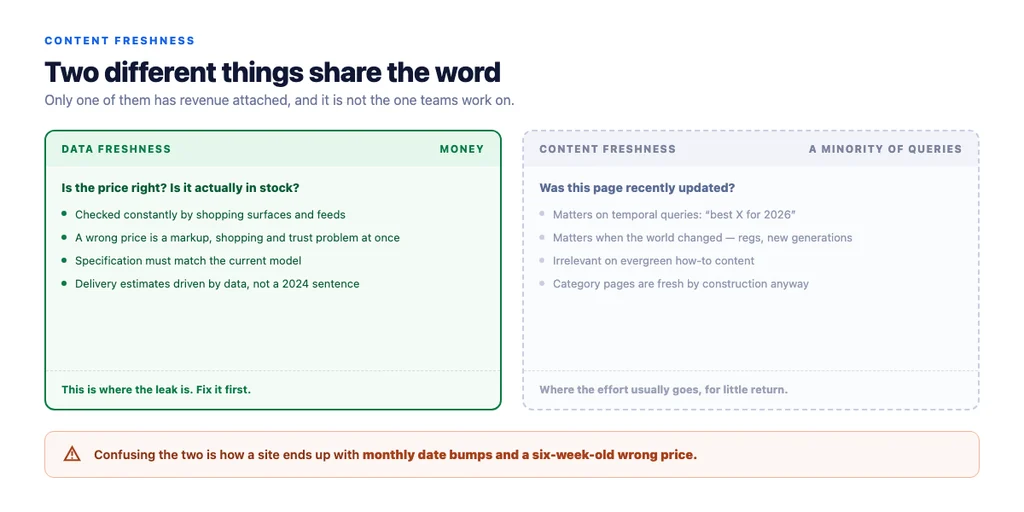
Data freshness. Is the price right, is it actually in stock, is the delivery estimate current, does the specification match the current model. This is checked constantly by shopping surfaces, feeds and assistants, and it has direct commercial consequences.
Content freshness. Was this page recently updated, and does that matter for the query. This is a ranking consideration on a minority of queries and irrelevant on most.
Confusing them is why teams spend effort on the second and leak money through the first.
Where recency genuinely matters
- Queries with a temporal element — "best X for 2026", "new model", "current price". The query itself asks for current information.
- Anything the world changed. Regulations, compatibility with a new device generation, discontinued models.
- Price and availability, always. A wrong price is a structured data problem, a shopping surface problem, and a trust problem simultaneously.
- Fast-moving categories. Electronics, anything with annual model cycles, anything with seasonal availability.
- Delivery promises, especially around peak periods when they change.
Where it does not
- Evergreen how-to content. "How to measure a door frame" was correct ten years ago.
- Category pages, which are fresh by construction — the product list changes as the catalogue does.
- Comparison pages between stable options — materials, types, formats. Review when a model changes, not on a calendar.
- Reference and specification content, unless the specification changed.
- Brand and about pages.
Bumping dates on any of these achieves nothing. Worse, it makes your genuine updates indistinguishable from cosmetic ones, both to a reader and to anything reading the page.
Getting data freshness right
This is the part with money in it.
Price and stock in one place. If the price is in the page, the feed and the structured data separately, they will disagree. One source, rendered into all three.
Structured data updated with the page. A stale price or availability in Product markup is worse than none, because it is presented as authoritative.
Feed sync frequency matched to your change rate. Daily is fine for stable catalogues, insufficient for anything with frequent price changes.
Out-of-stock handled deliberately. Keep the page, mark availability accurately, show alternatives. Do not 404 it, do not silently hide it, do not leave it claiming to be in stock.
Discontinued products redirected to the nearest live equivalent, as part of the discontinuation process.
Delivery estimates driven by data, not a hard-coded sentence written in 2024.
A staleness report. Products not updated in N days, prices differing between page and feed, availability contradicting the warehouse. This is a monitoring job, and it catches revenue problems rather than SEO ones.
Getting content freshness right
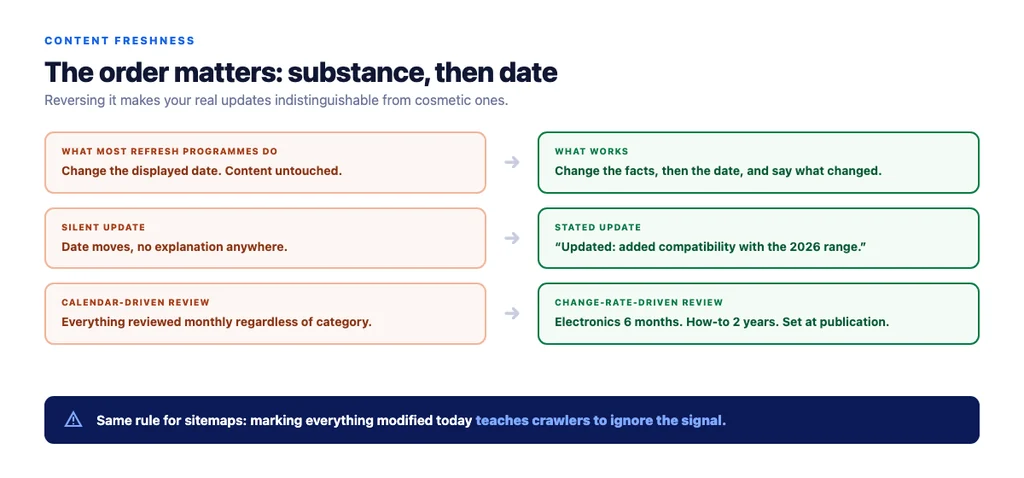
Change the content, then change the date. Never the reverse. A date bump with no substantive change is the clearest signal that a refresh programme is being performance-managed rather than run.
Say what changed. A short "updated: added compatibility with the 2026 range" is more useful to a reader and more credible than a silent date change.
Set review dates at publication, based on the category's real change rate. Electronics: six months. How-to: two years.
Distinguish the two dates. Published and updated are different facts, and readers use both.
Do not remove the original date. Hiding when something was written reads as evasive.
What "real-time" actually means here
Search indexes update continuously, and shopping surfaces read feeds on their own schedule. What that means practically:
- A price change reaches shopping surfaces on your feed's schedule, not instantly. Know what that schedule is.
- An organic result can lag a page change by hours to weeks depending on crawl frequency for that URL.
- Assistants may be working from older retrieved content. You cannot control this; you can make sure the current page is unambiguous.
- Sitemap
lastmodshould be honest. Marking everything as modified today teaches crawlers to ignore the signal.
There is no configuration that makes you update in real time everywhere. What you can control is that your own data is internally consistent, so whichever version is read is correct at the time it was read.
The checklist
- Data freshness and content freshness treated as separate programmes
- Price held in one source, rendered to page, feed and structured data
- Structured data updated whenever the page updates
- Feed sync frequency matched to real change rate
- Out-of-stock pages kept with accurate availability and alternatives
- Discontinued products redirected as part of discontinuation
- Delivery estimates generated from data, not hard-coded
- Staleness report running — untouched products, price mismatches
- Content dates changed only when substance changed
- What changed stated briefly on updated pages
- Review dates set at publication per category change rate
- Published and updated dates both shown
- Sitemap
lastmodreflects genuine modification - Evergreen content left alone unless the facts moved
Sources
- Intro to Product Structured Data on Google — Google Search Central
- Build and Submit a Sitemap — Google Search Central
- SEO Best Practices for Ecommerce Sites — Google Search Central
- Creating Helpful, Reliable, People-First Content — Google Search Central
- Google Search Essentials — Google Search Central
Frequently Asked Questions
Want this run against your store? Book a call with The Reach Bureau.