"Staying ahead of trends" is the wrong goal. Most SEO trends are noise — a repackaged tactic, a vendor's positioning, or an over-reading of one algorithm update. Chasing them costs you the quarter and produces nothing.
What is worth building instead is a filter: a way to look at any claim and decide quickly whether it changes what you do. That filter outlives every trend it evaluates.
The five questions
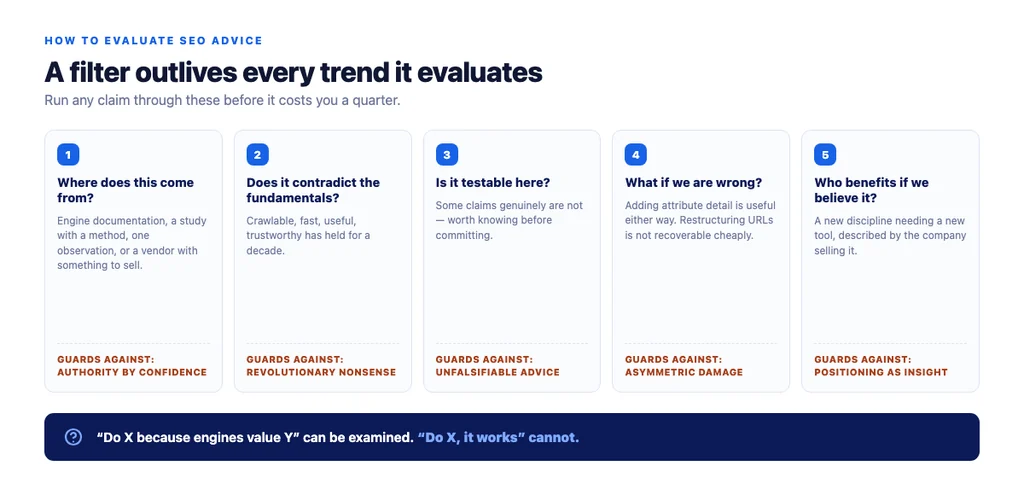
Run any SEO claim through these before acting.
1. Where does this come from? A documented change from a search engine, a study with a published methodology, one person's observation, or a vendor with something to sell. These are not the same weight, and the difference is usually visible in one click.
2. Does it contradict the fundamentals? Crawlable, fast, useful, trustworthy has held for over a decade. A claim that quietly contradicts one of these is more likely wrong than revolutionary.
3. Is it testable on our site? A claim you cannot test is a claim you cannot verify. Some are genuinely untestable, which is worth knowing before you commit a quarter to one.
4. What is the cost of being wrong? Adding attribute detail to product pages is useful even if the theory behind it is nonsense. Restructuring your URLs on a theory is not recoverable cheaply. Asymmetric risk should drive asymmetric caution.
5. Who benefits if we believe this? Not cynicism — just noticing. A claim that a new discipline requires a new tool, sold by the company describing the discipline, deserves the extra second.
Where to actually read
The primary sources are fewer than people assume, and reading them directly beats reading interpretations.
- Search engine documentation. Google Search Central, Bing Webmaster docs. Dry, and the only authoritative statement of what a system does.
- Official blogs and changelogs. Where updates are announced, in the vendor's own words.
- Your own Search Console data. The only source specific to your site. An observed change here outranks any general claim.
- Your own tests. A change on a controlled set of pages, measured against a control group.
- Practitioners who publish their method. Not conclusions — the method, so you can judge whether it supports the conclusion.
That is the list. Newsletters and conference talks are useful for noticing what to go and read; they are not the reading.
How to tell a real change from noise
A real change is documented by the engine or reproducible across many sites, affects a mechanism rather than a tactic, and persists over months.
Noise appears as a single dramatic case study, a term coined by a vendor for something that already had a name, a ranking-factor claim with no mechanism, or advice that changes every few months.
The clearest signal is whether the claim names a mechanism. "Do X because search engines value Y" can be examined. "Do X, it works" cannot.
Correlation studies deserve particular scepticism. Sites that rank well share many traits, most of which are consequences of ranking rather than causes. That word counts correlate with rankings does not mean longer content ranks better — it means pages that thoroughly cover a topic tend to be longer and also tend to rank.
Running a test that means something
If a claim passes the filter, test it rather than adopting it.
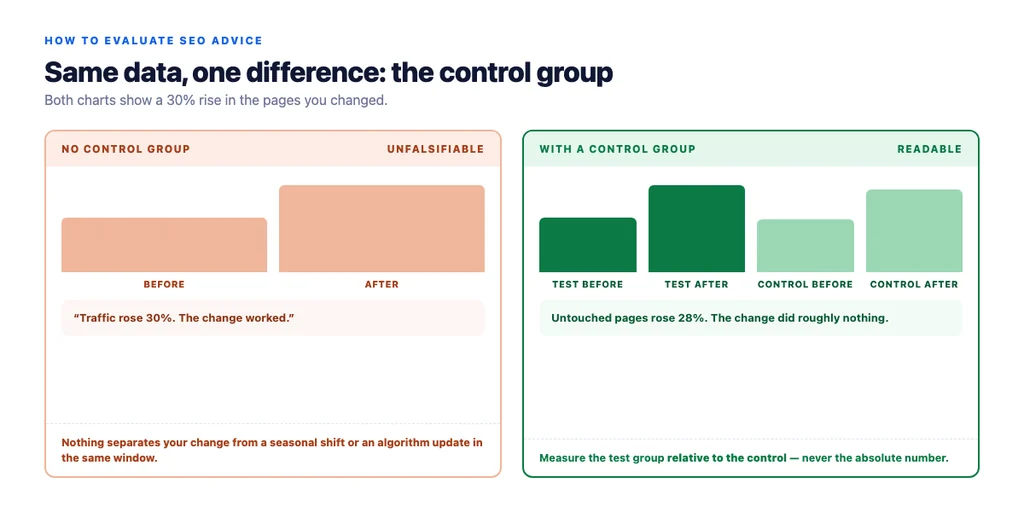
1. Pick a controlled set — 20 to 50 comparable pages. 2. Keep a control group of similar pages you do not touch. Without it, you cannot separate your change from a seasonal or algorithmic shift. 3. Change one thing. 4. Wait long enough. Six to twelve weeks for most on-page changes. Reading results after two weeks is reading noise. 5. Measure what matters — the change in the test group relative to the control, not the absolute number. 6. Write down the result, including when it did nothing. Null results save you from re-testing the same idea next year.
Most teams skip the control group, which makes the whole exercise unfalsifiable.
What genuinely changed recently, and what did not
Genuinely different: AI assistants as a discovery route, with different requirements — constraint matching, extractable answers, off-site corroboration. This is a real change with a real mechanism.
Genuinely different: the reduction in rich result types. FAQ rich results were restricted to government and health sites in 2023, and Google has since wound the feature down further, removing reporting and API access during 2026. Structured FAQ content still has value for other systems; the snippet payoff is gone.
Not different: the fundamentals. Crawlability, speed, useful content, trust evidence, accurate structured data. Every list of "what matters now" for the last decade has been these with new vocabulary.
Not different: the tactics that never worked. Keyword density, thin pages at scale, link schemes. They resurface with new names roughly every two years.
A cadence for staying current
- Weekly: ten minutes on search engine documentation changes and official blogs.
- Monthly: your own Search Console data, looking for shifts you did not cause.
- Quarterly: one test of one claim that passed the filter.
- Annually: re-read the fundamentals documentation. It changes less than the commentary about it, and re-reading it recalibrates you.
That is roughly an hour a month, and it beats any amount of trend-following.
The checklist
- Source identified — engine, study, observation or vendor
- Claim checked against the fundamentals for contradiction
- Mechanism named, not just an assertion of results
- Testability assessed before committing effort
- Cost of being wrong estimated
- Beneficiary of the belief noticed
- Correlation not read as causation
- Test run on 20–50 pages with a control group
- One variable changed at a time
- Six to twelve weeks allowed before reading results
- Result recorded, including null results
- Primary documentation read directly, not via interpretation
Sources
- Google Search Essentials — Google Search Central
- Creating Helpful, Reliable, People-First Content — Google Search Central
- Google Search Central Blog — Google Search Central
- SEO Best Practices for Ecommerce Sites — Google Search Central
- Spam Policies for Google Web Search — Google Search Central
Frequently Asked Questions
Want this run against your store? Book a call with The Reach Bureau.