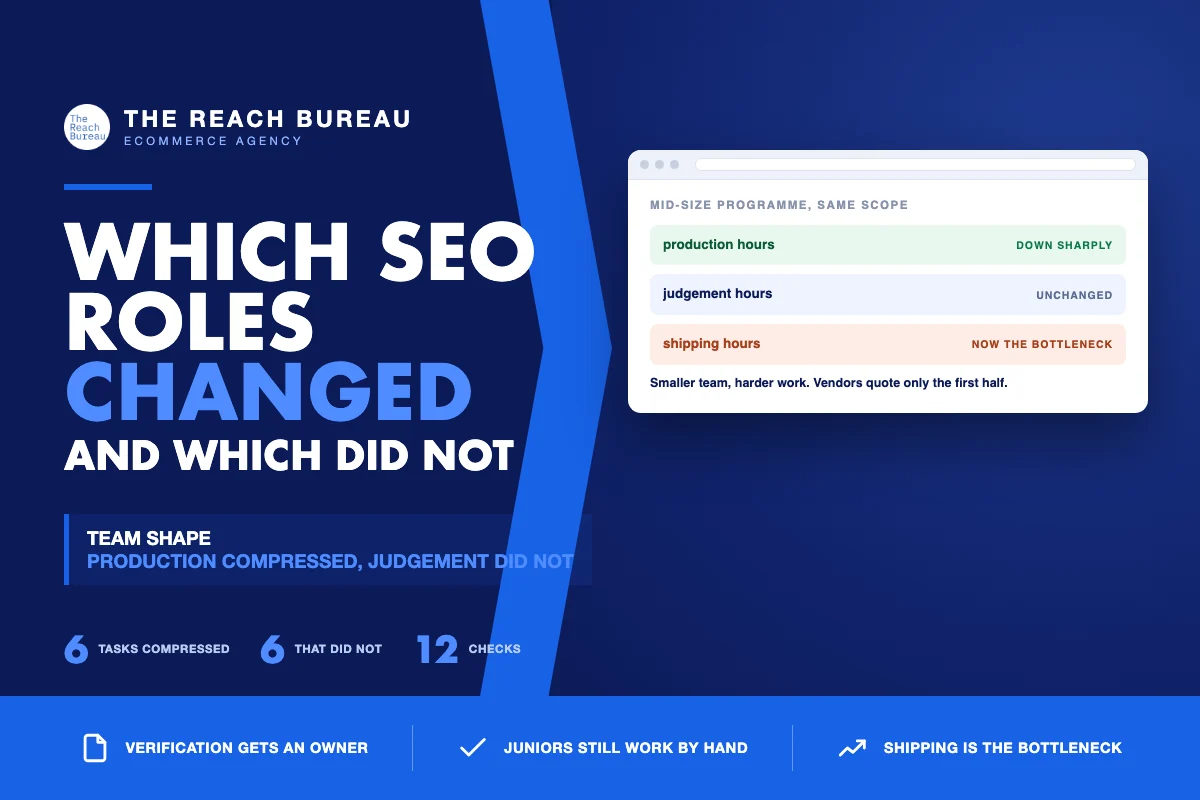
The honest version of this story is not "SEO roles are disappearing". It is that the balance inside the role has shifted: the production half compressed, the judgement half did not, and teams built mostly around production are now badly shaped.
That has practical consequences for hiring, for what juniors do, and for which agency proposals are worth reading.
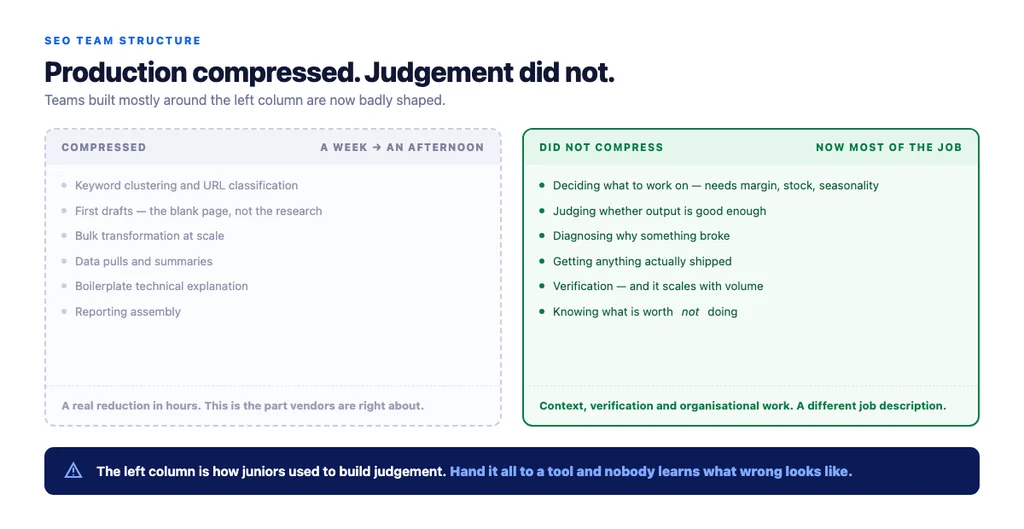
What compressed
Tasks that used to fill a week and now fill an afternoon.
- Keyword clustering and classification. A day of spreadsheet work, now minutes with a spot-check.
- First drafts. Not the research, not the brief, not the verification. The blank page.
- Bulk transformation. Meta descriptions at scale, spec tables into prose, attribute gap-filling.
- Data pulls and summaries. Exporting, joining, describing what moved.
- Boilerplate technical explanation. What a schema block or a redirect rule does.
- Reporting assembly. Numbers into a template.
Add it up and it is a real reduction in the hours a mid-size ecommerce programme needs. That is the part vendors are right about.
What did not compress
- Deciding what to work on. Requires knowing margin, stock, seasonality and what the business is trying to sell this quarter.
- Judging whether output is good enough. Someone has to read it, and reading is not faster than it was.
- Diagnosing why something broke. Needs the deployment history, the feed, and who changed what.
- Getting anything shipped. Persuading a developer, a merchandiser and a brand reviewer that a change is worth their sprint.
- Verification. The step that makes generated work safe, and it scales linearly with volume.
- Knowing what is worth not doing. The most valuable and least visible skill in the role.
Notice the pattern: what compressed is production, what remains is judgement, context and organisational work. That is a different job description from three years ago.
What this does to team shape
The junior role got harder, not easier. The tasks juniors used to learn on — clustering, drafting, pulling data — are now the tasks a model does. But those tasks were how people built judgement. A team that hands all of them to a tool produces juniors who cannot tell good output from bad, which is exactly the skill the role now needs most.
The fix is deliberate: juniors still do some of the work by hand, specifically so they learn what wrong looks like. Then they verify machine output, which is genuinely useful work and a real apprenticeship.
Verification became a named responsibility. Left implicit, it does not happen. Someone owns "nothing gets published without a check", or the batch nobody read goes live.
The technical-implementation gap got wider. Analysis got cheap; shipping did not. Teams that cannot get changes deployed now have a bigger backlog of known-good work than before, which is a worse problem than not knowing what to do.
Merchandising and SEO overlap more. Attribute completeness is both a findability question and a catalogue-management question. On most stores, that data sits with someone who does not report to SEO.
Hiring: what to look for now
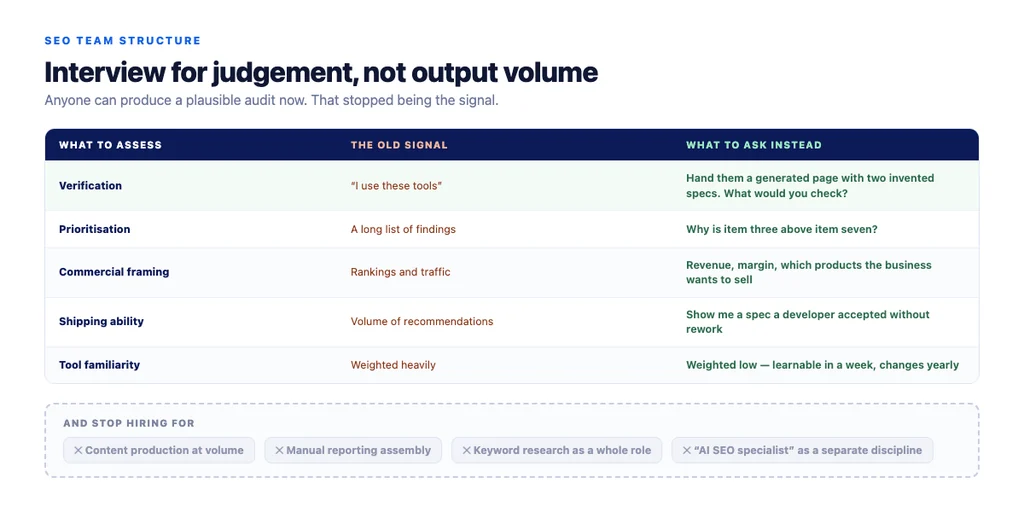
Ask for the reasoning, not the output. Anyone can produce a plausible audit. Ask why they prioritised item three above item seven.
Test verification. Give a candidate a generated page with two invented specifications and one wrong claim. Ask what they would check. This single exercise separates people faster than any portfolio.
Look for commercial framing. Do they talk about revenue and margin, or about rankings and traffic? On an ecommerce store the second one is a proxy for the first, and treating it as the goal is the most common failure.
Value the ability to get things shipped. Someone who can write a spec a developer accepts is worth more than someone with a longer list of findings.
Stop over-weighting tool familiarity. Tools change every year and are learnable in a week. Judgement is not.
What to stop hiring for
- Content production at volume. If the brief is good, drafting is no longer the constraint.
- Manual reporting assembly. Automate it and spend the hours on the commentary.
- Pure keyword research as a role. It is a task inside a role now.
- "AI SEO specialist" as a distinct discipline. Mostly this is standard SEO plus four specific practices. A separate hire usually means paying twice for the same work.
An honest team shape for a mid-size store
- One person who owns priorities and can say no. Non-negotiable, and often missing.
- One person who can ship — technical enough to write specs, credible enough with developers.
- Content capability with subject access — someone who can get to the product, the returns data and the staff who know things.
- Verification as an explicit duty, named and resourced, whoever holds it.
- Tooling budget for data, not for interfaces.
That is a smaller team than the same programme needed three years ago, doing harder work. Both halves of that sentence are true, and vendors tend to quote only the first.
The checklist
- Production tasks identified and compressed with tooling
- Judgement tasks explicitly kept with people
- Verification named as someone's responsibility
- Juniors still do some work by hand, to learn what wrong looks like
- Prioritisation owned by one person who can say no
- Someone on the team can get changes shipped
- Attribute and catalogue data ownership resolved with merchandising
- Hiring tests reasoning and verification, not output volume
- Candidates assessed on commercial framing, not ranking language
- Tool familiarity weighted below judgement
- No separate "AI SEO" hire for work the team already does
- Tooling budget spent on data rather than interfaces
Sources
- SEO Best Practices for Ecommerce Sites — Google Search Central
- Google Search and AI-Generated Content — Google Search Central Blog
- Creating Helpful, Reliable, People-First Content — Google Search Central
- Google Search Essentials — Google Search Central
- Intro to Product Structured Data on Google — Google Search Central
Frequently Asked Questions
Want this run against your store? Book a call with The Reach Bureau.