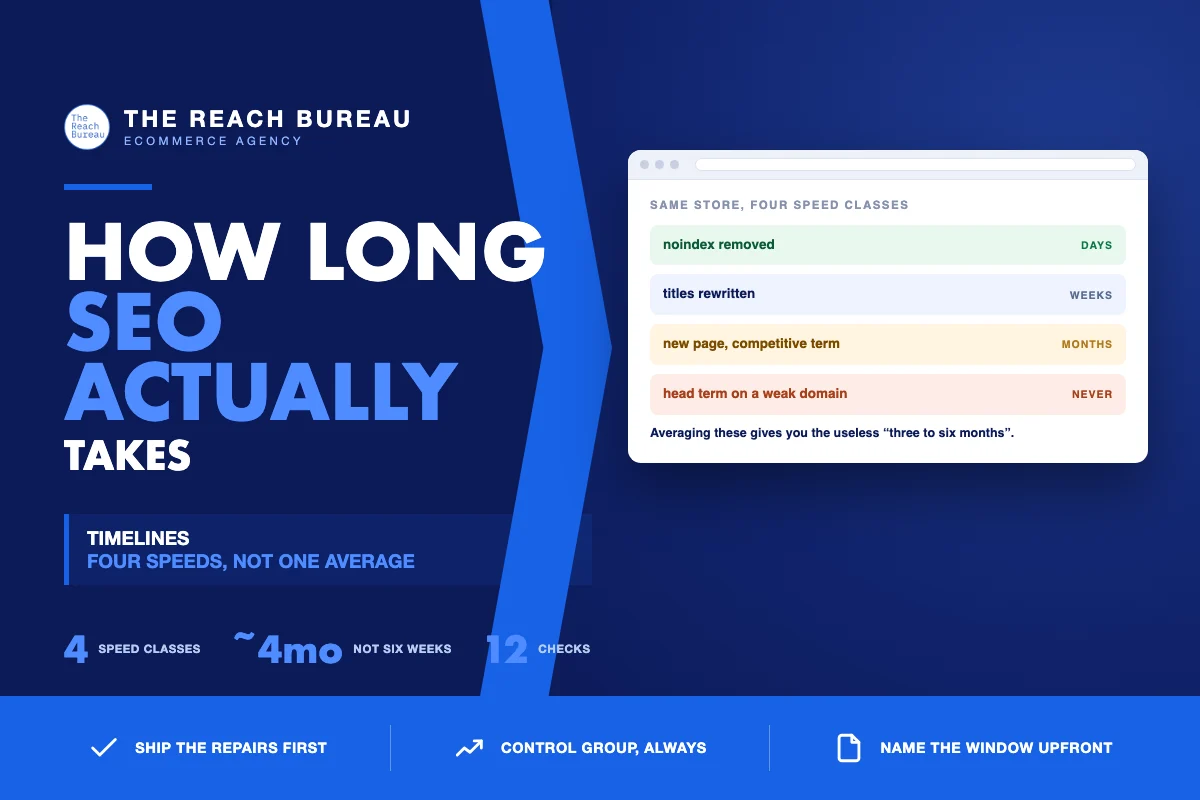
"How long until we see results" has one honest answer: it depends entirely on what you changed. A fixed technical error can recover in days. Earning the authority to rank for a competitive category term takes quarters.
Averaging those together produces the useless "three to six months" everybody quotes. Splitting them apart gives you something you can plan against — and shows exactly which parts of the work tooling can genuinely compress.
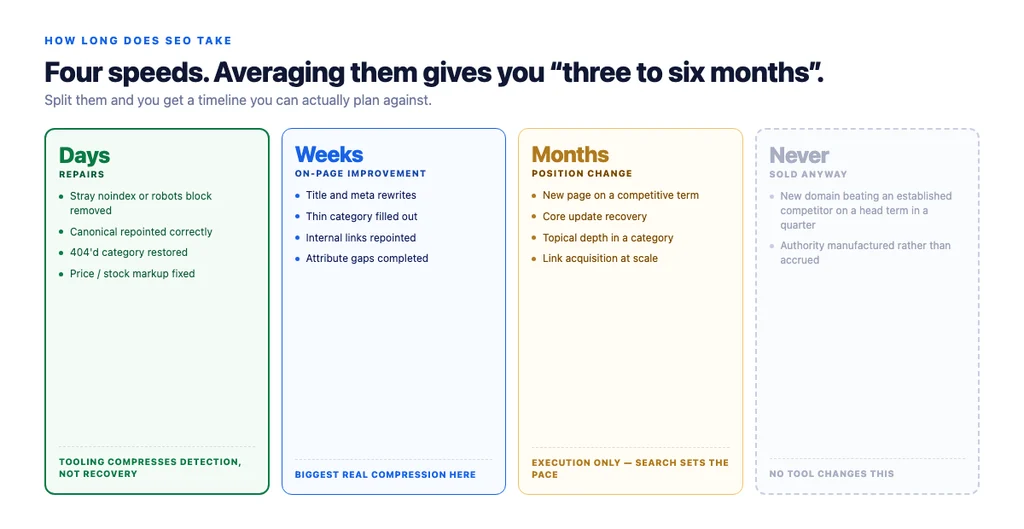
What moves in days
These are changes where the page was already qualified and something was in the way.
- Removing an accidental
noindexor robots block. Recrawl and recovery in days once found. - Fixing a broken canonical that pointed a category at its parent.
- Restoring a page that 404'd. Often same-week.
- Correcting price or availability in structured data. Rich result eligibility returns quickly.
- Fixing a redirect chain on a high-traffic path.
Notice these are all repairs, not improvements. The fastest SEO wins available to most stores are undoing damage, which is also the argument for monitoring: the recovery is fast, the detection is what takes six weeks.
What moves in weeks
- Title and meta rewrites on pages already ranking. Click-through change is visible in two to four weeks.
- Adding missing content to a category page that was thin. Four to eight weeks.
- Internal link changes pointing more authority at a target page. Four to eight weeks.
- Product attribute completion. Starts affecting long-tail matching within weeks.
- Speed improvements, where speed was genuinely the constraint.
What takes months
- Ranking a new page for anything with real competition. Three to nine months, longer on a weak domain.
- Recovering from a core update. The next update, at least, and only if the underlying quality problem was fixed.
- Building topical depth that makes a category credible.
- Earning links at a rate that changes your competitive position.
- Replatform recovery. Six to twelve weeks to stabilise even when the migration went well.
What never happens
Worth saying plainly, because it is often sold: no amount of tooling makes a new domain outrank an established competitor on a head commercial term in a quarter. Authority accrues slowly and cannot be manufactured. Anyone promising that timeline is describing an outcome they cannot produce.
Where AI actually compresses the timeline
It does not make Google rank you faster. It shortens the part of the calendar you control: how long it takes to find the problem and ship the fix.
Finding what to fix. Classifying thousands of URLs, clustering queries by intent, spotting which pages target the same term. Days of work into an afternoon.
Producing bulk changes. 400 meta descriptions, 200 category intros, attribute gaps filled from spec sheets. Weeks into days — with verification attached.
Drafting from a real brief. The blank page disappears; the research and the judgement do not.
Summarising your own data so a pattern is visible sooner.
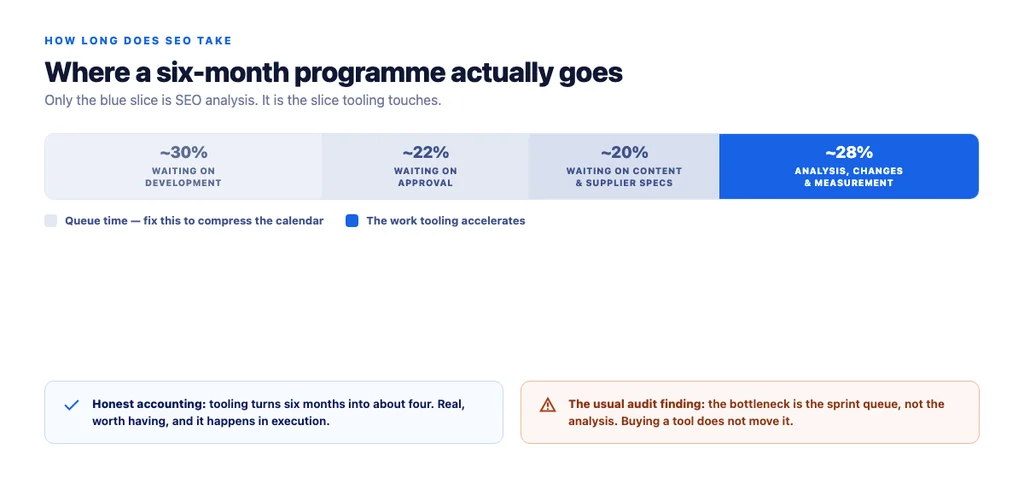
Add these up honestly: on a typical store, tooling compresses a six-month programme into perhaps four, not into six weeks. The compression is real and worth having. It happens in execution, not in how search responds.
Where the time actually goes
On most ecommerce projects, the calendar is dominated by things that are not SEO work at all.
- Waiting for development. A template change that takes an hour to specify sits in a sprint queue for three weeks.
- Waiting for approval. Copy review, legal review, brand review.
- Waiting for content. Photography, specifications from a supplier, someone who knows the product.
- Waiting for a decision. Whether to merge two categories, whether to change a URL structure.
This is the uncomfortable finding whenever a project is audited: the bottleneck is rarely the SEO analysis. Compressing the timeline usually means fixing the queue, not buying a tool.
Setting expectations you can defend
1. Split the plan by speed class — repairs, weeks-scale improvements, months-scale investments. Report on each separately. 2. Ship the repairs first. Fast, cheap, and they buy credibility for the slower work. 3. Name the measurement window before starting. Six to twelve weeks for on-page changes; reading results at two weeks is reading noise. 4. Keep a control group. Comparable pages you do not touch, so the result is attributable. 5. Report leading indicators in the interim — impressions, average position, indexed count — while revenue is still moving. 6. Say what will not happen. A plan that promises a head term in a quarter will fail regardless of execution quality.
The checklist
- Work split into repairs, weeks-scale, and months-scale
- Repairs shipped first
- Monitoring in place so repairs are found in days, not weeks
- Measurement window named before each change
- Control group of untouched comparable pages
- Leading indicators reported in the interim
- Development queue time measured as part of the timeline
- Approval and content bottlenecks named explicitly
- Tooling used on classification, bulk changes and drafting
- Every bulk change carries a verification step
- No head-term promise inside a quarter on a weak domain
- Results read at six to twelve weeks, not two
Sources
- Google Search Essentials — Google Search Central
- SEO Best Practices for Ecommerce Sites — Google Search Central
- Block Search Indexing with noindex — Google Search Central
- Creating Helpful, Reliable, People-First Content — Google Search Central
- Site Moves with URL Changes — Google Search Central
Frequently Asked Questions
Want this run against your store? Book a call with The Reach Bureau.