Last-click attribution systematically undervalues organic search, and everyone in SEO knows it. The trouble is that the usual response — arguing for a model that credits SEO more — is exactly as self-serving as it sounds, and rightly gets ignored by anyone holding a budget.
There is a better position. Different models answer different questions, no model is true, and the honest job is picking the one that fits the decision being made. That argument survives scrutiny; "please use a model that makes my channel look better" does not.
Why organic gets undercounted
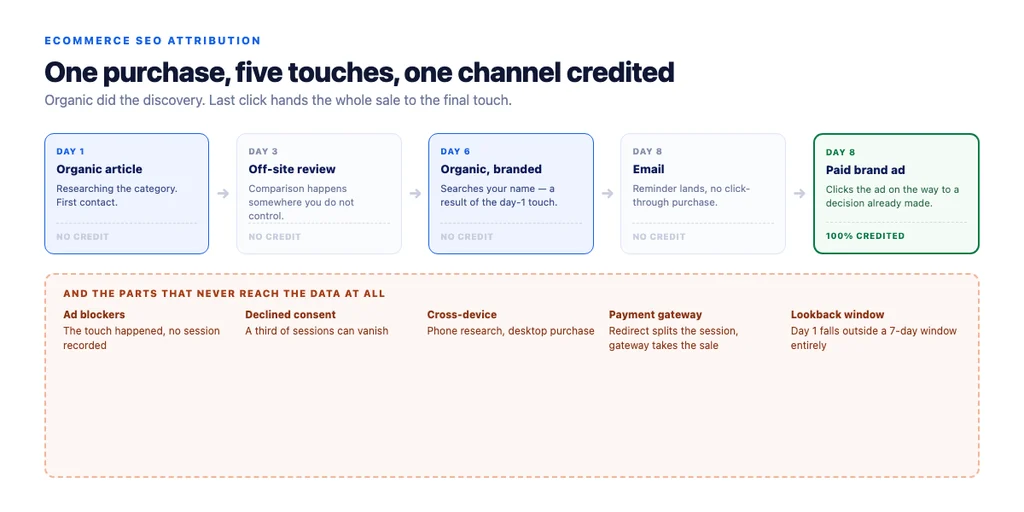
It appears early. Someone researches a category, finds you through an article, comes back a week later via a brand search or an ad, and buys. Last click gives the credit to the final touch.
Sessions are lost before the purchase. Ad blockers, declined consent and cross-device journeys break the chain. The organic touch happened; it is not in the data.
Branded search gets miscategorised. A visitor who found you through organic content later searches your name. That branded search is organic's result, but it looks like independent demand — or gets claimed by whichever channel touched last.
Assisted paths are not in the default report. You have to go looking for them, and most reporting never does.
Payment gateway redirects split sessions and hand the purchase to a referral source.
Some of that is fixable configuration. The rest is structural, and the right response is a reporting approach rather than a better tag.
The models, and what each is honestly for
| Model | Credits | Use it to decide |
|---|---|---|
| Last click | Final touch | Nothing on its own — it is a floor, not a measure |
| First click | Discovery touch | Whether a channel finds new customers |
| Linear | Every touch equally | Rough sanity check on how much assist exists |
| Time decay | Recent touches more | Short consideration cycles |
| Position-based | First and last most | Balanced view when both ends matter |
| Data-driven | Modelled from your own paths | Best available, needs volume to be stable |
The useful framing: last click for accountability, first click for discovery, position-based or data-driven for allocation. State which one you used and why, every time.
What to actually report
Rather than fighting over a single number, report three and let the pattern speak.
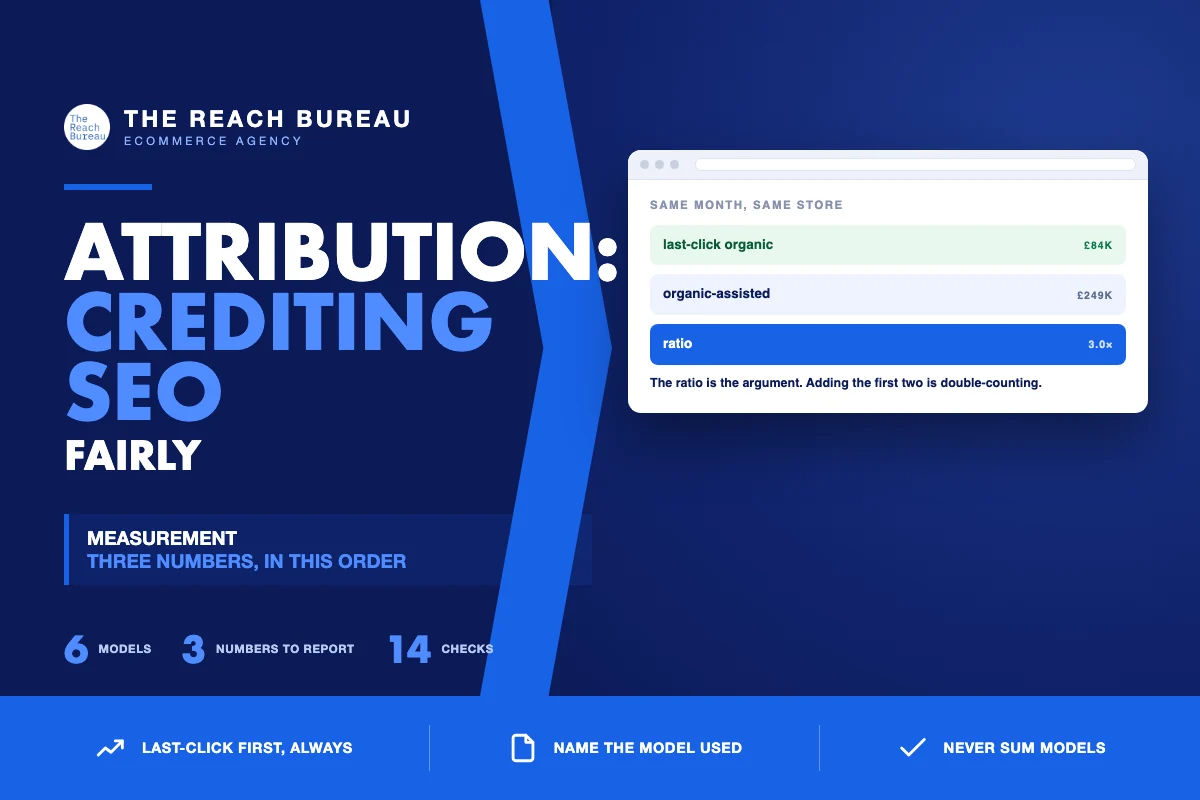
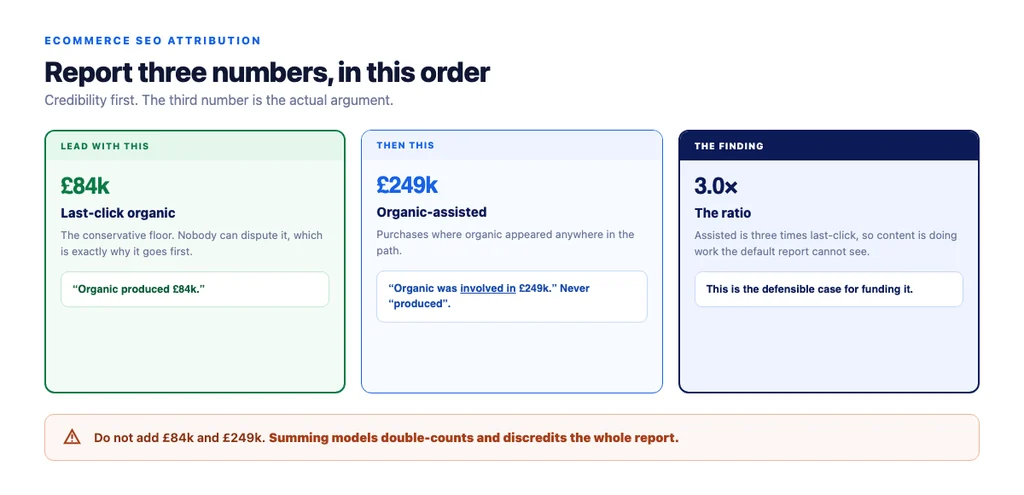
1. Last-click organic revenue. The conservative figure nobody can dispute. Lead with it — credibility first. 2. Organic-assisted revenue. Purchases where organic appeared anywhere in the path. Present it as "involved in", not "produced". 3. The ratio between them. This is the actual finding. If assisted is three times last-click, content is doing work the default report cannot see, and that is a defensible argument for funding it.
Then two supporting cuts:
- By page type. Category and product pages usually convert last-click; articles usually assist. Reporting them together hides both.
- New versus returning. Organic bringing new customers is a different business case from organic serving people who already know you.
Traps that discredit an SEO report
Each of these is common, and each one costs you the argument.
- Summing models. Last-click plus assisted is not total revenue; it double-counts.
- Claiming assisted revenue as produced revenue. Say "involved in £X of purchases". The moment you overclaim, everything else you report gets discounted.
- Comparing across models between periods. Switching model mid-year makes a trend meaningless.
- Ignoring paid overlap. If someone saw an ad and clicked organic, both channels reasonably claim involvement. Acknowledge it before someone else points it out.
- Reporting a lookback window silently. A 30-day and a 90-day window produce very different assist numbers.
- Blaming attribution for a real decline. If revenue fell across every model, the model is not the problem.
That last one matters most. Attribution arguments are most persuasive when the news is good and most suspicious when the news is bad — so make the case while things are working.
Fixing what is actually fixable
Before changing models, fix the plumbing. Some of the "attribution problem" is just configuration.
- Exclude your own domain and payment gateways from referral traffic, so the gateway does not steal the purchase.
- Check consent configuration. Declined consent removing a third of sessions is an attribution problem you can partly solve.
- Separate AI assistant referrals into their own channel rather than a generic referral bucket.
- Tag email and social properly, so their traffic stops being credited to direct or organic.
- Reconcile analytics revenue against store admin revenue. If they disagree, no attribution model will help.
- Set the lookback window deliberately and record it in the report.
Do all six and a meaningful part of the perceived undercounting disappears without any model change at all.
A defensible reporting routine
- Monthly: last-click organic revenue by landing page group, with assisted alongside and the ratio stated.
- Monthly: conversion rate by page type and device.
- Quarterly: first-click organic, to show discovery contribution.
- Quarterly: a single named model for budget allocation, used consistently.
- Always: the model and lookback window written on the report.
- Never: a change of model without saying so.
The checklist
- Own domain and payment gateways excluded from referrals
- Consent configuration checked and documented
- AI assistant referrals in their own channel
- Email and social tagged correctly
- Analytics revenue reconciled with store admin
- Lookback window set deliberately and recorded
- Last-click organic reported first, as the floor
- Assisted revenue reported as "involved in", never "produced"
- Ratio between the two stated explicitly
- Split by page type — category, product, article
- New versus returning split
- Models never summed
- Model named on every report, unchanged between periods
- Real declines not explained away as attribution
Sources
- SEO Best Practices for Ecommerce Sites — Google Search Central
- Google Search Console Help — Google
- Google Search Essentials — Google Search Central
- Ecommerce Product Data and Content on Google — Google Search Central
- Creating Helpful, Reliable, People-First Content — Google Search Central
Frequently Asked Questions
Want this run against your store? Book a call with The Reach Bureau.