# Why Your Ecommerce Site Is Not Ranking: A Diagnostic Order
A store that is not ranking has one of about six problems, and they are not equally likely. The reason this question is so frustrating is that everybody answers it with their speciality: the developer says speed, the content person says blog posts, the link builder says backlinks. Usually all three are wrong, because the page is not in the index or it is answering a question nobody asked.
Here is the order to check, cheapest first, with what each answer means.
First: is the page indexed at all
Not “is it in the sitemap”. Indexed. Search for the exact URL in Search Console’s URL inspection, or search a distinctive sentence from the page in quotation marks.
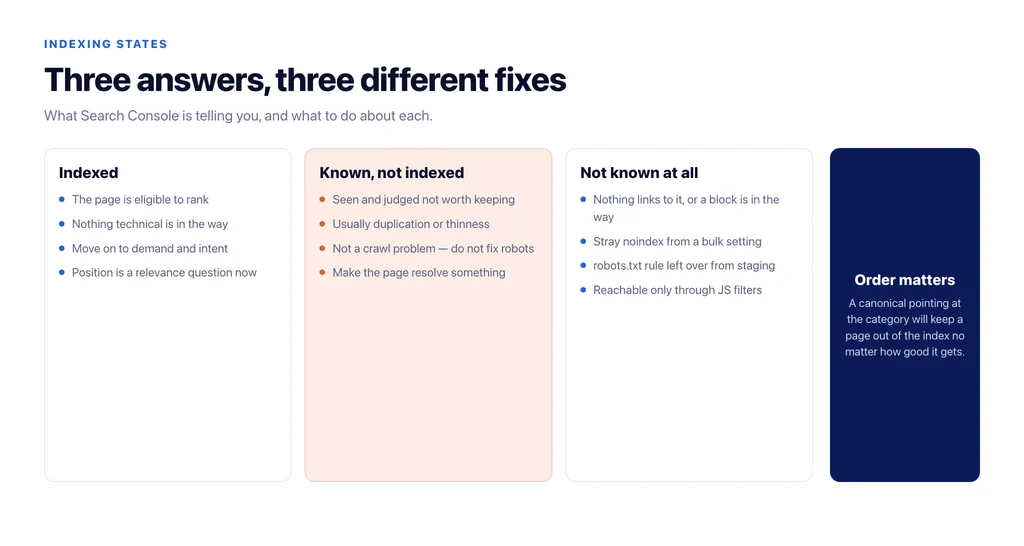
Three outcomes. If the page is indexed, skip to the next section. If it is known but not indexed, the page was seen and judged not worth keeping — that is a quality or duplication signal, not a technical fault. If it is not known at all, nothing links to it, or a crawl block is in the way.
Most store URLs that vanish do so for a mundane reason: an accidental `noindex` from an SEO plugin’s bulk setting, a `robots.txt` rule left from staging, a canonical tag pointing everything at the category, or a page that is only reachable through a JavaScript-rendered filter no crawler follows.
Second: does the query you want actually exist
This is the cause nobody wants to hear. Plenty of stores are not ranking for a phrase that has almost no search volume, or they are targeting a phrase in the wrong language of commerce — the manufacturer’s term rather than the shopper’s.
Check the phrase you believe you should rank for. If it has meaningful volume, continue. If it does not, you do not have a ranking problem, you have a keyword-selection problem, and the fix is to find the phrase people actually type for what you sell.
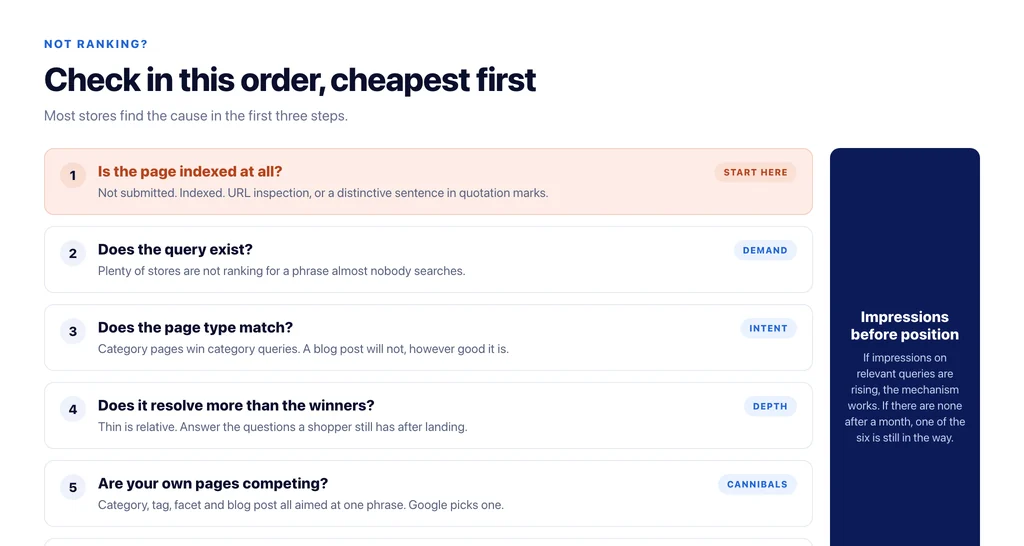
Third: does the page match the intent of the query
Search results tell you what kind of page wins a query. Look at the top ten. If they are all category pages and you are offering a blog post, you will not rank, no matter how good the post is. If they are all comparison articles and you are offering a product page, same outcome.
This is the single most common cause after indexing, and it is free to fix: change the page type, not the copy. A query with commercial intent needs a page you can buy from. A query phrased as a question needs a page that answers it.
Fourth: is the page thin against what is already ranking
Thin is relative. A four-hundred-word category page loses to a competitor’s page that answers the four follow-up questions a shopper has, not because of word count, but because it resolves less.
For a category page, ask what a shopper still needs to decide after landing: which variant, what fits, how it compares, what happens if it is wrong. For a product page, ask what the manufacturer’s description does not say. Filling those gaps is what changes rankings; adding paragraphs around the same information does not.
Fifth: are your own pages competing with each other
Stores generate competing pages by accident: a category, a tag archive, a filtered facet URL and a blog post all aimed at the same phrase. Google picks one, often not the one you want, and the signals split.
The check is quick. Search your site for the phrase with a `site:` query and see how many of your own URLs are plausible answers. If more than one is, decide which page owns the phrase, point the others at it with internal links, and give them their own distinct target. We covered the internal-link side of this in internal linking for ecommerce.
Sixth: authority, and only now
If the page is indexed, matched to real demand, correct in type, substantial, and not competing with itself, and it still sits on page three, then you are looking at a domain-strength problem. That is the expensive answer, which is exactly why it belongs last.
Two things to be honest about here. Authority is not built by publishing more; it is built by other sites having a reason to reference yours. And for a genuinely competitive head term, a new store will not win it this quarter regardless of what it spends. The workable move is to rank for the specific, lower-competition variants first and let those pages earn the links that make the head term possible later.
The timing question underneath all of this
A large share of “we are not ranking” is “we are not ranking yet”. A new page needs to be crawled, indexed, tested against real queries, and re-evaluated. That is weeks, not days, and for a new domain it is months.
The useful signal in the meantime is not position, it is impressions. If a page is accumulating impressions on relevant queries, the mechanism is working and position will follow. If it has none after a month, one of the six causes above is still in the way, and no amount of patience will resolve it.
Two things that look like the cause and usually are not
Site speed. A slow store loses conversions and, at the extremes, crawl efficiency. It very rarely keeps a page off page one on its own. If a page is not ranking and its competitors load in the same second range, speed is not the reason, and a performance sprint will produce a faster page in the same position.
Missing structured data. Markup changes how a result can be displayed, not whether the page deserves the position. Adding `Product` markup to a page that answers the wrong intent gets you a well-marked-up page that still does not rank. Fix the intent first; the markup is a display upgrade for pages already winning.
Both get blamed because both are measurable and neither requires anyone to admit the page is aimed at a query that does not exist. That is precisely why they come after the six causes above, not before.
The diagnostic checklist
- Indexed, or only submitted? Confirm in URL inspection.
- Does the target phrase have real search volume?
- Does the page type match what ranks for that query?
- Does the page resolve more than the pages beating it?
- Is anything else on your own site aiming at the same phrase?
- Is the query simply out of reach for the domain today?
- Are impressions rising even though position has not moved?
Work down that list and you will usually find the cause in the first three steps, which is why running it in order matters more than running it thoroughly.
Sources
- URL Inspection tool — Google Search Console Help
- Debugging drops in Google Search traffic — Google Search Central
- Block search indexing with noindex — Google Search Central
- Canonicalization — Google Search Central
- SEO best practices for ecommerce sites — Google Search Central
Frequently Asked Questions
Want this run against your store? Book a call with The Reach Bureau.