# Google Ads Strategy for Ecommerce: Deciding Before Spending
Most ecommerce ad accounts have tactics and no strategy. They have campaign types, bid adjustments and a monthly report, and no written answer to three questions: what is this account for, what return makes it worth running, and at what point do we stop scaling.
Those three answers are the strategy. Everything else is execution, and execution without them is how a store spends a year optimising toward a number nobody chose.
Question one: what is the account for
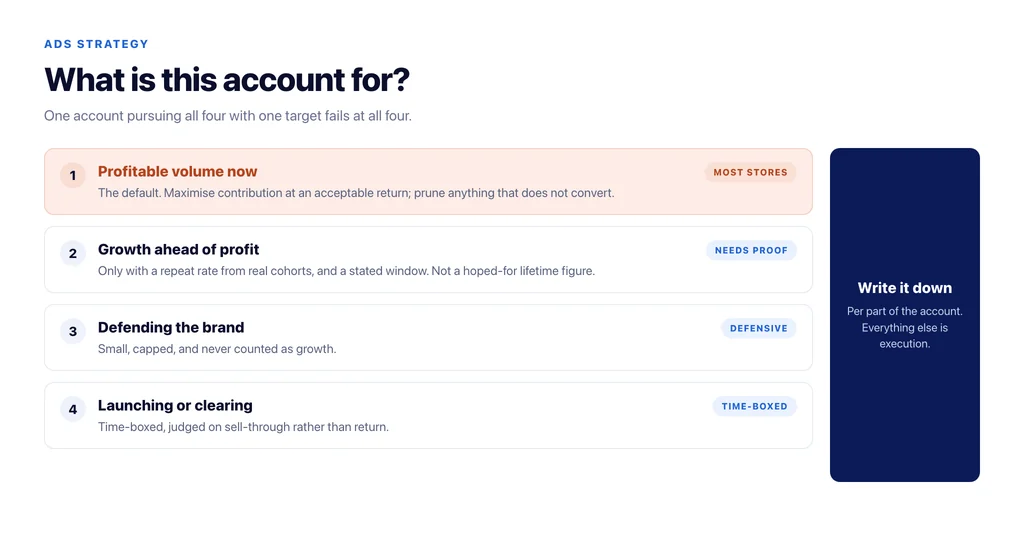
There are only a few honest answers, and they lead to different accounts.
Profitable volume now. The default. Maximise contribution at an acceptable return. Favours high-intent inventory, tight targeting, and ruthless pruning of anything that does not convert.
Growth ahead of profit, deliberately. Acceptable when there is a genuine repeat-purchase business and you know the repeat rate. Requires a lifetime figure you can defend, not a hoped-for one.
Defending the brand. Small, capped, not counted as growth.
Launching or clearing. Time-boxed campaigns for new lines or ageing stock, judged on sell-through rather than return.
Write down which one applies to each part of the account. A single account pursuing all four with one target will fail at all four.
Question two: what return actually works
A return target pulled from an industry article is not a target. Build it from your own numbers.
Start with contribution margin per order after cost of goods, payment fees, fulfilment and — the one everybody forgets — returns. That gives the break-even return on ad spend. Your target sits above it by whatever margin the business needs to keep.
Then split the target by product group, because a single account-wide number overspends on thin-margin products and underspends on profitable ones. Feed labels make this mechanical.
If you count repeat purchases, state the window and the repeat rate you are assuming, and revisit it with real cohort data rather than optimism.
Question three: when do you stop scaling
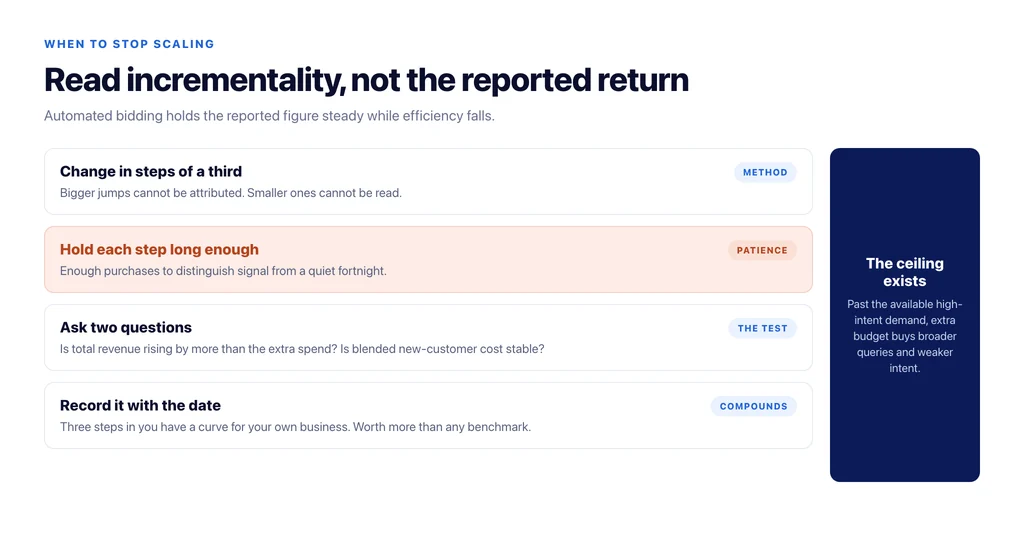
Every account has a point where additional spend buys demand that was going to arrive anyway, or demand that does not convert. Knowing it in advance prevents the argument later.
The signal is not the reported return, which automated bidding will hold roughly stable while efficiency deteriorates. It is incremental: as spend rises, is total revenue rising by more than the extra spend, and is the blended cost of acquiring a new customer stable?
The practical method is to change spend in steps, hold each step long enough to read, and record what happened. A store that has done this three times has a curve; a store that has not is guessing.
Structure follows the decisions
With those three answered, the account structure is almost implied.
Separate branded from everything else so its cheap conversions never flatter another campaign’s average. Separate product groups by margin band with their own targets. Separate prospecting from remarketing so you can see what is new demand and what is returning. Keep at least one campaign under manual control as a comparison against automated types.
That is four splits, and they exist for measurement rather than for tidiness. If a split does not change a decision, it does not need to exist.
The reporting that keeps it honest
Three numbers, monthly, and nothing else on the front page.
Contribution after ad spend, not revenue. Blended new-customer acquisition cost across the whole account. And the incremental result of the last spend change, with the date.
Then one annotation column for everything that changed: budgets, targets, tracking, site work, stock outages. Six months of annotations turn every question about a movement into a lookup.
The relationship between paid results and the store’s own conversion behaviour is where most of the misattribution lives, and the arithmetic for separating them is in what is a good conversion rate for ecommerce.
Where paid and organic should not overlap
Two rules save a lot of wasted spend.
Do not pay for queries you already own organically in the top positions unless there is a competitive reason. Test it: pause the paid coverage for a fortnight and see whether total revenue for those queries falls. Frequently it does not.
Do pay for queries where organic cannot win in a reasonable timeframe — the head commercial terms on a young domain. That is paid doing something organic cannot, which is the definition of a sensible split.
Where the strategy usually breaks
Three failure patterns account for most accounts that drift, and none of them is a bidding problem.
The target that nobody owns. A return target set once, never revisited, and now disconnected from margins that have moved. Prices rise, shipping costs change, the mix shifts, and the account is still optimising against last year’s break-even.
The channel judged in isolation. Paid gets credit for demand that organic and email created, or gets blamed for a checkout that leaks. Both are attribution failures and both are resolved by knowing the store’s own funnel numbers well enough to separate them.
Reporting that describes activity. A monthly deck of campaign changes, keyword additions and bid adjustments, with no answer to whether contribution rose. Activity reporting survives because it is easy to produce and impossible to argue with.
The fix for all three is the same: a short written strategy with dated numbers in it, reviewed quarterly, so someone can tell whether the account is still doing what it was funded to do.
The checklist
- Written purpose per part of the account, from the four options.
- Break-even return calculated from contribution after returns.
- Targets split by margin band with feed labels.
- Repeat-purchase assumptions stated, with a window, and checked against cohorts.
- Branded separated from everything else.
- Prospecting separated from remarketing.
- One manually controlled campaign retained as a comparison.
- Spend changed in steps, each read and recorded.
- Monthly reporting limited to contribution, blended acquisition cost, and incrementality.
Sources
- About Maximize conversion value bidding — Google Ads Help
- About Quality Score for Search campaigns — Google Ads Help
- Measure ecommerce (GA4) — Google for Developers
- What makes up a Shopping ad — Google Ads Help
Frequently Asked Questions
Want this run against your store? Book a call with The Reach Bureau.