# Should I Move From Shopify to WooCommerce? A Decision Test
Replatforming costs a quarter of somebody’s attention, carries real ranking risk, and is frequently done for reasons that will not survive the first review meeting. Sometimes it is clearly right. Here is how to tell which case you are in, before anybody quotes for the build.
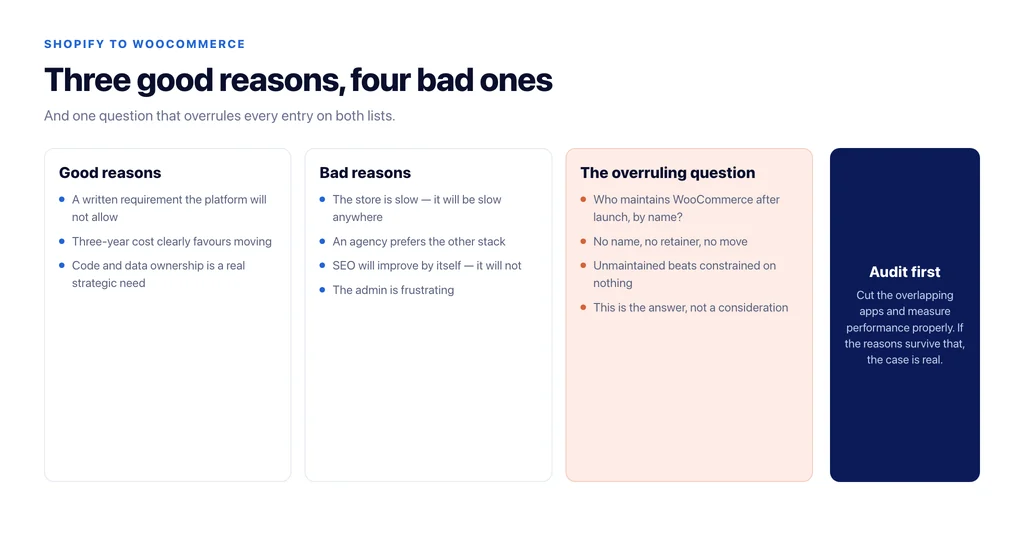
The three good reasons
A capability the platform structurally will not allow. A checkout requirement, B2B pricing logic, a data transformation, an integration that needs server access. Not “it is awkward” — genuinely not permitted. This is the strongest reason and the easiest to verify: write down the requirement and confirm the platform cannot do it, in writing, before proceeding.
Recurring cost that has overtaken the alternative. Plan, apps and transaction fees added up, compared against hosting, licences and a realistic maintenance retainer over three years. When app subscriptions carry a mature store’s capability, this comparison can genuinely favour moving — and when it does, the numbers are obvious rather than marginal.
Ownership of code and data. Being unable to leave, unable to read your own database, or dependent on a vendor’s roadmap is a legitimate strategic concern, particularly where the store is the business rather than a channel.
If none of those three applies, the honest answer is probably no.
The four bad reasons
The store is slow. A slow store is usually a slow store on any platform. Migrating carries the ranking risk on top of the performance work you would have had to do anyway.
An agency prefers the other stack. Sometimes reasonable, never sufficient. Ask what specifically becomes possible.
SEO will improve. It will not, materially, by itself. WooCommerce gives more control over permalinks, templates and server-level work, and that control is worth something only if someone uses it.
The admin is frustrating. Fix the workflow. Replatforming to escape an interface is the most expensive retraining programme available.
The question that overrules the rest
Who maintains WooCommerce after launch, by name?
WooCommerce is self-hosted, which means you own updates, backups, security, PHP versions and plugin conflicts. With a developer or a retained agency, that is an acceptable trade for the control you gain. Without one, you are moving from a maintained platform to an unmaintained one, and an unmaintained store is worse than a constrained store on every axis including SEO.
If you cannot name the person or the retainer, stop here. This is the answer.
What the move actually costs
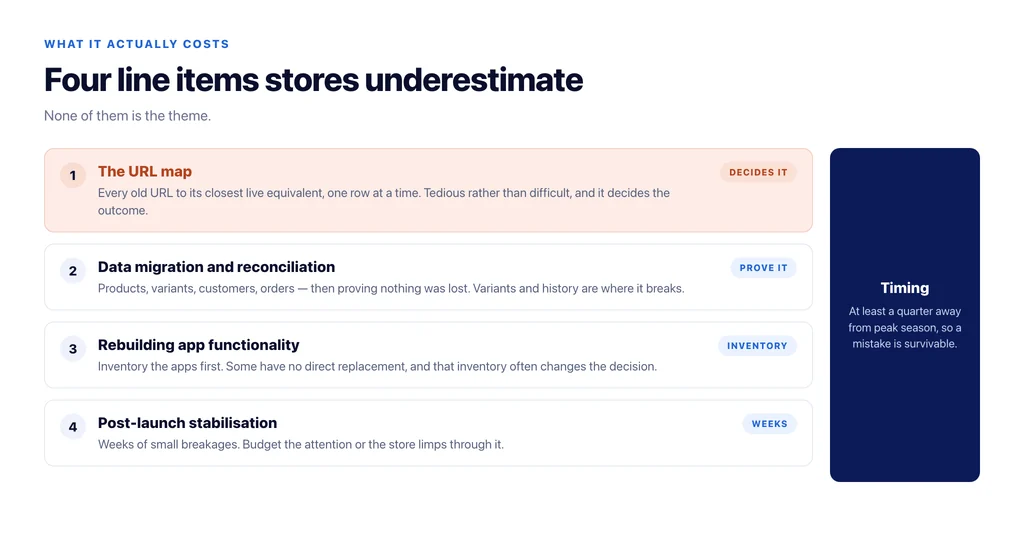
Four line items that get underestimated.
The URL map. Every old URL to its closest live equivalent, product by product, category by category, including the paths Shopify enforces. This is the single largest determinant of whether rankings survive, and it is tedious rather than difficult.
Data migration and reconciliation. Products, variants, customers, orders, and the reconciliation afterwards to prove nothing was lost. Variants and historical orders are where it goes wrong.
Rebuilding app functionality. Every app doing real work needs an equivalent, and some have no direct replacement. Inventory the apps first; that inventory is usually what changes the decision.
Post-launch stabilisation. Weeks, not days, of small breakages. Budget attention for it or the store limps.
The risk you are actually taking
Rankings do not fall because of the destination platform. They fall because of an incomplete redirect map, a staging site indexed by accident, canonical tags carried over pointing at the old domain, or a launch during peak season.
All four are avoidable and all four are common. The execution detail — mapping, testing, sequencing, what to monitor in the first fortnight — is a separate job, covered in shopify to woocommerce migration.
The middle path most stores should consider first
Before committing to a platform move, there is an option that solves a large share of the reasons people give for wanting one: keep the platform and remove the constraint.
If the frustration is app cost, audit the apps. Stores routinely pay for three that overlap and two that support a campaign that ended. Cutting that bill changes the three-year comparison materially, and it takes a week rather than a quarter.
If the frustration is performance, measure properly first — field data, logged out, per template. A store that is slow because of eleven third-party scripts will be equally slow after a migration that carries all eleven across.
If the frustration is a missing capability, check whether it can be met at the edge or through an integration rather than in the platform. A lot of what looks like a platform wall is a workflow that nobody has been asked to solve.
Do this audit first. If the reasons survive it, the case for moving is real and now well documented.
The decision test
Answer these before costing the project:
- Is there a written requirement the current platform cannot meet?
- Does the three-year cost comparison favour moving, clearly rather than marginally?
- Is code and data ownership a genuine strategic need for this business?
- Can you name who maintains the new stack, or the retainer that covers it?
- Have you inventoried every app and identified the replacement for each?
- Is there a window at least a quarter away from peak season?
Four yeses including number four, and the move is defensible. Fewer, and you are buying risk to solve a problem that has a cheaper answer.
The platform comparison itself, feature by feature and cost by cost, is in shopify vs woocommerce.
Sources
- Site moves with URL changes — Google Search Central
- Customize permalinks — WordPress
- Theme templates — Shopify
- Managing products — WooCommerce
Frequently Asked Questions
Want this run against your store? Book a call with The Reach Bureau.