There is no product ranking inside ChatGPT, which is the first thing worth being clear about — and understanding why explains everything you should actually do.
When someone asks an assistant for a product recommendation, it retrieves pages relevant to the request and then assembles a shortlist from what those pages state. There is no product index with positions. What exists is a matching problem: the request carries constraints, and the assistant needs pages containing facts that satisfy them.
So "ranking a product in ChatGPT" means two things. Being retrievable, and holding the facts that satisfy the constraints in the question.
The constraint-matching model
A shopping request to an assistant does not look like a search query. It looks like this:
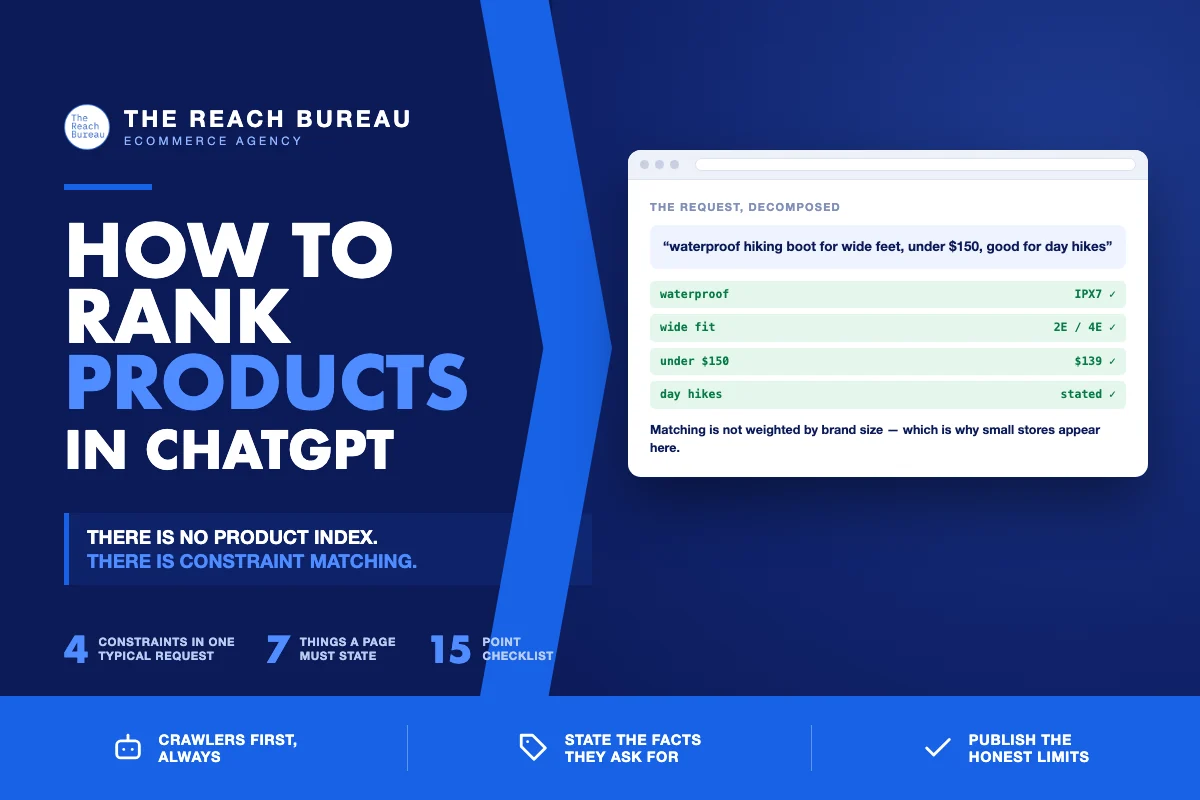
> "waterproof hiking boot for wide feet, under $150, good for day hikes"
Four constraints. The assistant checks each against candidate pages. A page satisfying all four gets shortlisted; one satisfying two does not.
Now consider two product pages for the same boot.
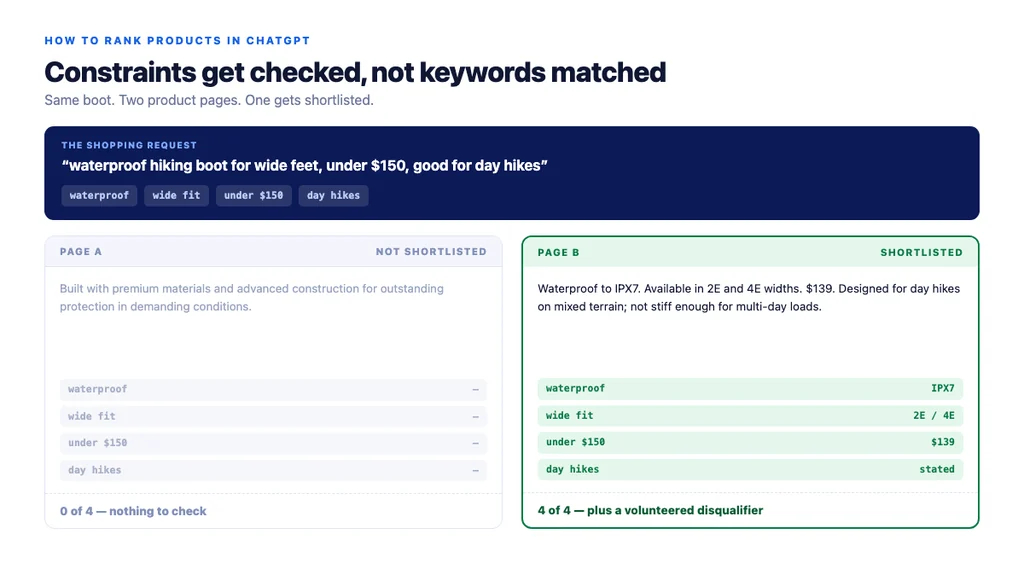
Page A says: "Built with premium materials and advanced construction for outstanding protection in demanding conditions."
Page B says: "Waterproof to IPX7. Available in 2E and 4E widths. $139. Designed for day hikes on mixed terrain; not stiff enough for multi-day loads."
Page A satisfies zero constraints — not because it is badly written, but because there is nothing in it to check. Page B satisfies all four and volunteers a disqualifier that builds trust.
This is the whole mechanism, and it is why small stores appear in these answers more often than their domain authority suggests. Matching is not weighted by brand size.
What a product page must state
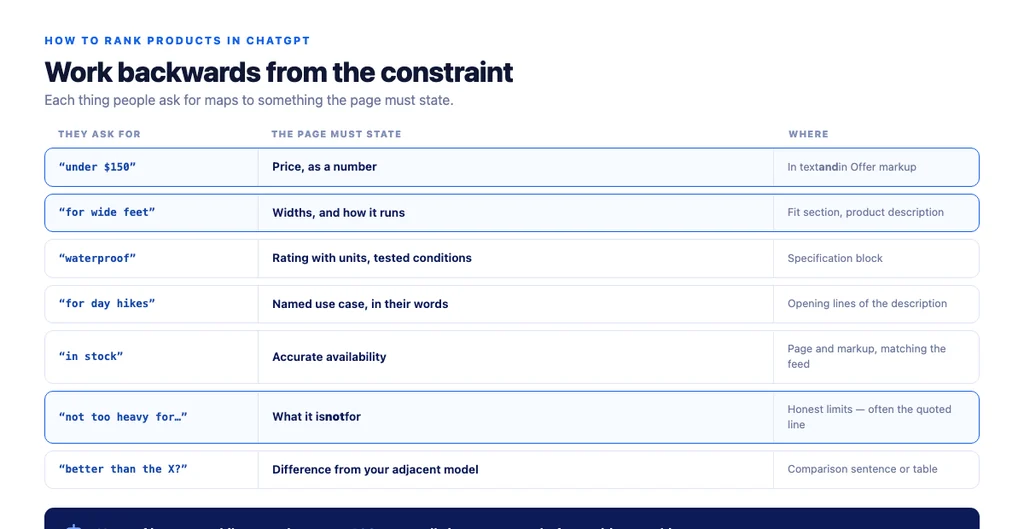
Work backwards from the constraints people actually use.
Price, in text and in Offer markup. "Under $150" is one of the most common constraints and cannot be evaluated without it.
Fit and sizing reality. Widths, whether it runs small, what to do between sizes. "For wide feet" is a constraint you either satisfy explicitly or lose.
Measured performance. Waterproof rating, weight, capacity, battery life, tested conditions. Numbers with units.
Intended use case, named. "Day hikes on mixed terrain" matches how people phrase requests. "Versatile performance" matches nothing.
Availability, accurate and in markup. A recommendation for something out of stock is a bad recommendation, and systems avoid it.
What it is not for. Counter-intuitive and genuinely effective: an explicit limitation helps a system decide the product is *right* for the cases it does fit, and it is the kind of statement that gets quoted.
Comparison to your adjacent model. Most requests are implicitly comparative. A page stating how it differs from the model above and below is doing the assistant's work for it.
The technical prerequisites
Crawler access. GPTBot, OAI-SearchBot, ChatGPT-User, ClaudeBot, PerplexityBot, Google-Extended. Blocked independently of Googlebot, and CDN bot rules catch them by default more often than anyone expects. Request your own product page with each user agent and confirm a 200 rather than a 403. It takes twenty minutes and it invalidates every other item on this list if skipped.
Structured data in the initial HTML. Product and Offer carrying price and availability, per Google's Product structured data documentation. Return and shipping markup answer the two questions that most often decide a purchase. Several AI crawlers do not execute JavaScript, so client-side markup is invisible to them.
Consistency across surfaces. If your product page, your feed and your marketplace listing state different prices, that is a contradiction — and contradictions get dropped rather than reconciled.
Where recommendations come from besides your site
Assistants synthesise across sources, so product shortlists frequently draw on comparison articles, review roundups and community discussions rather than on retailer pages alone.
The practical version for a store: be genuinely present where your category is discussed, make sure independent roundups have your facts right, and keep your specifications consistent everywhere they appear. This is slower and less controllable than your own pages, which is why it comes after the on-site work rather than instead of it.
Checking whether it worked
There is no rank tracker, and any tool presenting a precise figure is sampling and estimating.
- Write 15–25 shopping requests the way a customer would phrase them, with constraints — not keywords.
- Run them monthly against the assistants that matter for your market.
- Record whether your product appeared, and which sources were cited. The cited-source list tells you where to be present.
- Watch referral traffic from
chatgpt.com,perplexity.aiand similar. Volumes are small; intent is high. - Read server logs to confirm the crawlers are actually fetching your product pages.
The useful question is "did we appear at all, and did that change after we fixed something" — not "what is our position."
The checklist
- All six AI crawlers tested against a real product URL
- CDN or WAF bot rules checked, not only
robots.txt - Price stated in text and in
Offermarkup - Fit and sizing reality stated, including widths and how it runs
- Measured performance with units, not adjectives
- Intended use case named the way customers phrase it
- Availability accurate and in markup
- What the product is not for, stated explicitly
- Comparison to the adjacent model in your range
Product+Offerin the initial HTML- Return and shipping markup implemented
- Price and specs identical on site, feed and marketplaces
- 15–25 constraint-shaped shopping prompts written
- Prompts run monthly; cited sources recorded
- Server logs confirm AI crawlers fetch product pages
Sources
- Intro to Product Structured Data on Google — Google Search Central
- How To Add Merchant Listing Structured Data — Google Search Central
- Merchant Return Policy Structured Data — Google Search Central
- Merchant Shipping Policy Structured Data — Google Search Central
- Creating Helpful, Reliable, People-First Content — Google Search Central
- SEO Best Practices for Ecommerce Sites — Google Search Central
FAQs
Want this run against your store? Book a call with The Reach Bureau.