There is a version of ecommerce content marketing that consists of publishing three posts a week about topics adjacent to your products, and it does not work.
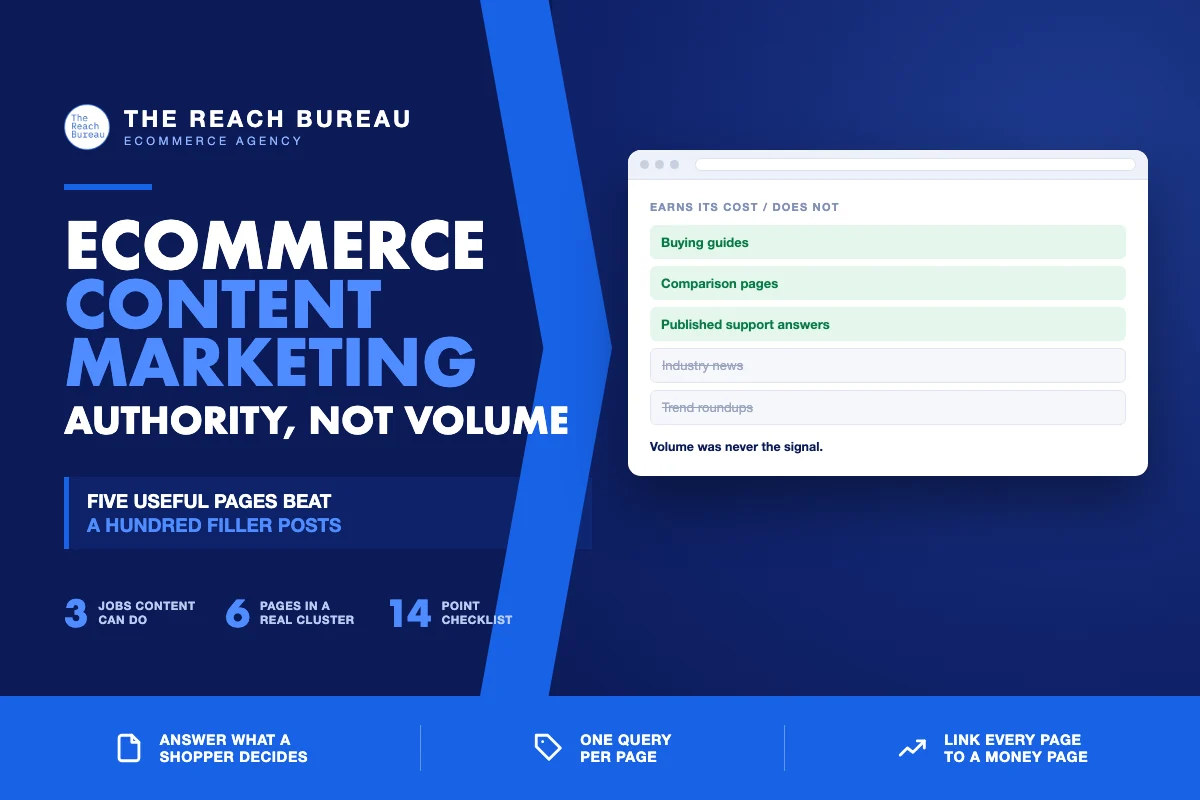
It does not work because volume was never the signal. A store publishing weekly for two years accumulates a hundred posts, none of which a shopper needed, none of which links to anything that converts, and all of which compete with each other for the same vague terms. The blog becomes a cost centre with a publishing schedule.
The version that works is smaller and more deliberate: a set of pages that answer the questions standing between a shopper and a purchase, structured so each one feeds the pages that take the money.
What content is actually for on a store
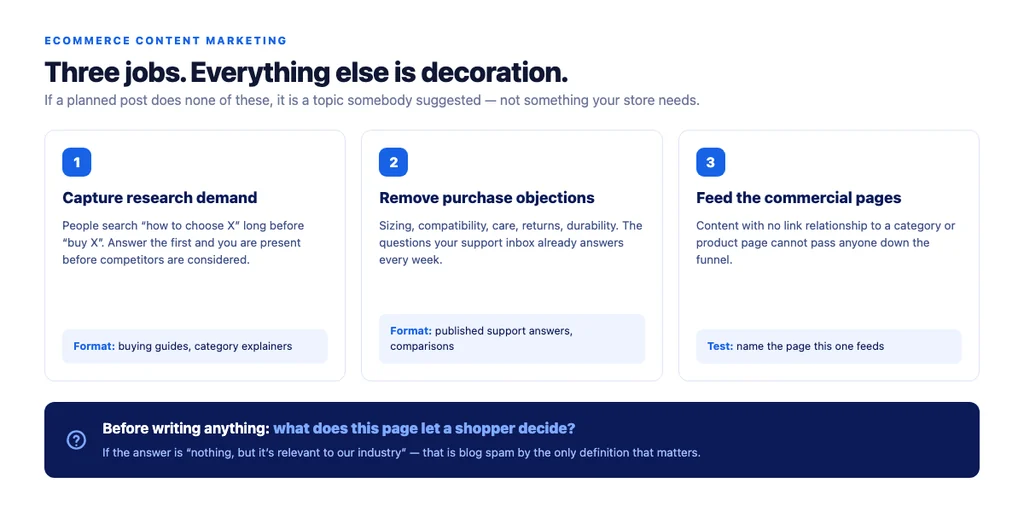
Three jobs, and only three. Every piece should be doing one of them.
Capturing research demand. People search "how to choose X" before they search "buy X." If you answer the first question, you are present before your competitors are considered.
Removing purchase objections. Sizing, compatibility, care, returns, durability. These are the questions your support inbox already answers, and answering them publicly closes sales.
Giving category pages something to point at, and something pointing back. Content that has no link relationship to a product or category page is decoration.
If a planned post does not do one of these, it is a topic somebody suggested rather than a thing your store needs.
The formats that earn their cost
Buying guides. "How to choose trail running shoes." Ranks for research demand, links down to the category and to two or three specific products. The highest-value format for most stores and the one most often skipped in favour of trend posts.
Comparison content. "X versus Y", "best for [use case]". Sits very close to the decision. If you sell both things being compared, this is the most commercially efficient page on the site.
Support questions, published. Take the ten questions your team answers most and give each a proper page or a section on the relevant category. Real demand, already validated by customers.
Original data. If you have transaction data, return-rate data, or sizing data nobody else has, publishing an honest analysis of it is the most linkable thing a store can produce — and links are the constraint most stores never solve.
Category explainers. The context a category page cannot carry without becoming unwieldy, linked from it.
What does not earn its cost
- Industry news. Somebody else already covered it, faster, with more authority.
- Trend roundups. Read once, never searched for again.
- Anything written to fill a slot. The calendar is not a strategy.
- Topics adjacent to your products but not to your buyer. A furniture store writing about interior design history is not wrong, it is just not near a purchase.
- Posts with no internal link to a commercial page. If it cannot pass a reader down the funnel, it is not doing the third job.
Structuring it so authority accumulates
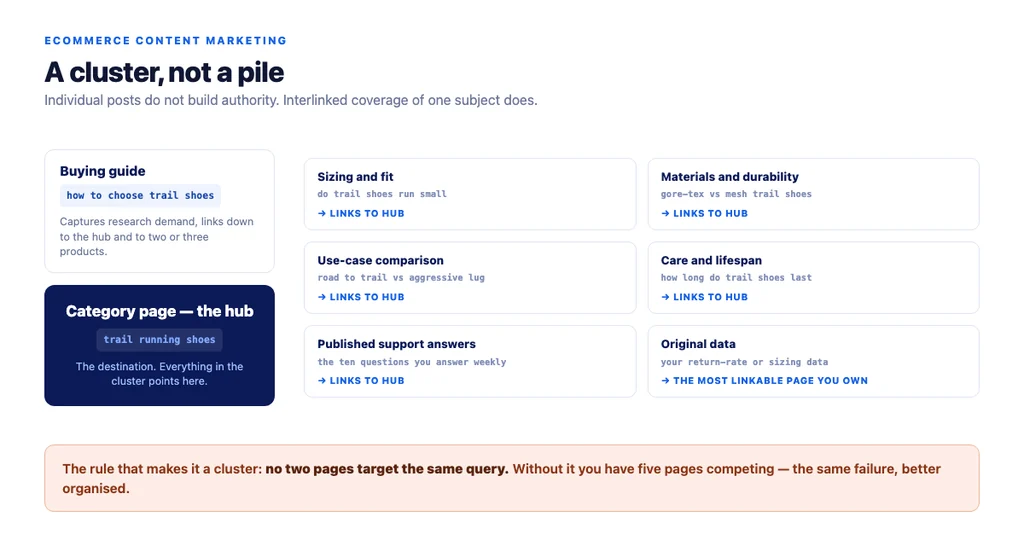
Individual posts do not build authority. Related sets of pages do, because they demonstrate coverage of a subject rather than a passing mention.
The practical shape:
1. Pick a subject your store genuinely owns — a category you have depth in, not everything you sell. 2. The category page is the hub. It targets the category term and is the destination. 3. A buying guide targets the research query and links down to the hub and to specific products. 4. Three to six supporting pages answer the specific questions inside that subject — sizing, materials, use cases, comparisons. 5. Every supporting page links to the hub, with the category name as the anchor. Every one is linked from the hub or the guide. 6. Nothing in the set targets the same query as anything else in it.
That last rule is what separates a cluster from a pile. Without it you have five pages competing, which is the same failure as publishing three posts a week, just better organised.
The rule that prevents blog spam
Before writing anything, answer: what does this page let a shopper decide?
If the answer is "nothing, but it's relevant to our industry," it is spam by the only definition that matters — not because it violates a guideline, but because nobody needed it and it will not earn anything.
Google's guidance on creating helpful, reliable, people-first content asks whether a reader leaves having learned enough to achieve their goal, and whether the content shows real first-hand expertise. A store has an unfair advantage on the second point: you handle these products, you see the returns, you know what customers get wrong. Content that uses that knowledge is difficult to replicate. Content that summarises what is already online is not.
Measuring it
- Track per page, not site-wide. Blog averages hide which pages work.
- Watch assisted conversions, not last click. Content sits early in the path; last-click attribution makes it look worthless and gets budgets cut.
- Count distinct queries per page. A genuinely useful page picks up phrasings you never targeted. A thin one picks up nothing.
- Check the link path. For each content page, can you name the commercial page it feeds? If not, that is the fix before writing another one.
- Six to eight weeks before judging anything.
The checklist
- Every planned page does one of the three jobs
- "What does this let a shopper decide?" answered before writing
- Buying guides exist for your main categories
- Comparison pages exist where you sell both options
- Top ten support questions published
- Original data published if you have any
- One subject chosen per cluster, not everything you sell
- Category page designated as the hub
- Every supporting page links to the hub with the category name as anchor
- Hub or guide links out to every supporting page
- No two pages in a cluster target the same query
- Every content page has a named commercial page it feeds
- Per-page tracking, assisted conversions included
- Results judged after six to eight weeks, not two
Sources
- Creating Helpful, Reliable, People-First Content — Google Search Central
- Google Search Essentials — Google Search Central
- Spam Policies for Google Web Search — Google Search Central
- SEO Best Practices for Ecommerce Sites — Google Search Central
- Ecommerce Product Data and Content on Google — Google Search Central
FAQs
Want this run against your store? Book a call with The Reach Bureau.