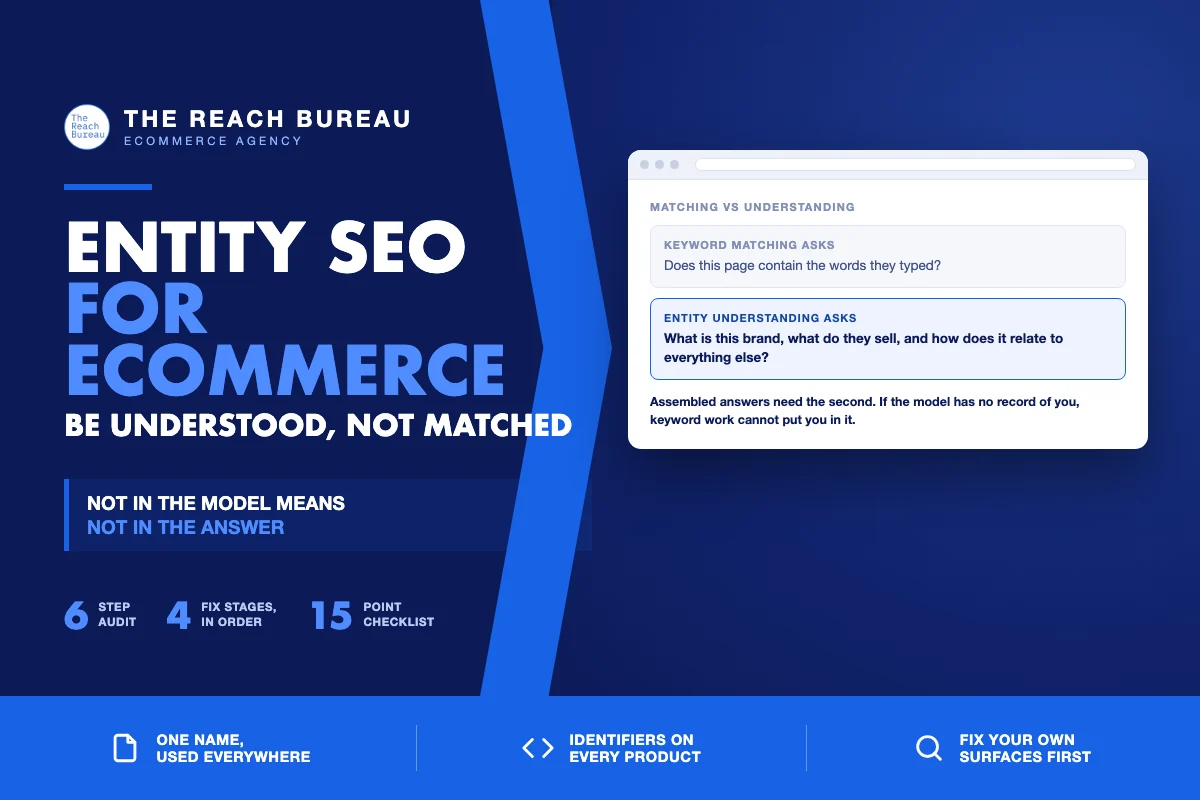
Keyword matching asks whether your page contains the words someone typed. Entity understanding asks whether a search engine knows what your brand is, what you sell, and how those things relate to everything else it knows.
The second question has quietly become the more important one, because assembled answers — AI Overviews, assistants, shopping panels — require understanding rather than matching. A system generating "the best waterproof boots for wide feet" is not scanning for a phrase. It is drawing on a model of which brands make what, at which price points, with which characteristics.
If that model does not contain you, no amount of keyword work puts you in the answer.
What an entity actually is
An entity is a thing a search engine has a record of: a brand, a product, a person, a place. It is not a keyword. "Merrell" is an entity; "best hiking boots" is a query.
Search engines build entity records from repeated, consistent information across many sources — your own site, retailers, review sites, directories, industry publications, Wikipedia-grade references where they exist. The record holds attributes (what category, what price range, what markets) and relationships (who makes it, who stocks it, what it competes with).
Two consequences follow, and they explain most of what looks mysterious about entity SEO:
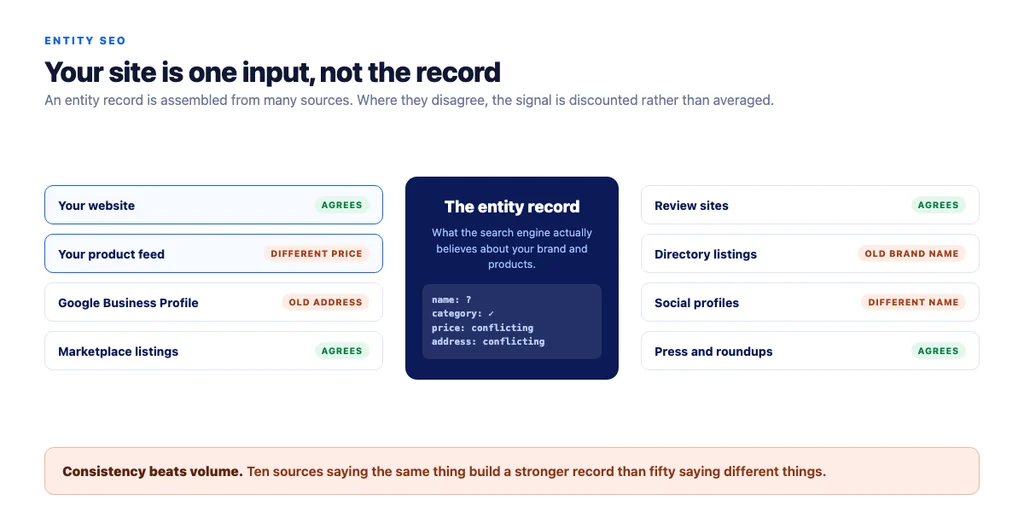
Consistency matters more than volume. Ten sources saying the same thing build a stronger record than fifty saying different things. Conflicting information does not average out — it gets discounted.
You do not fully control your own entity. Your site is one input. Retailers, marketplaces, reviews and mentions are others. This is uncomfortable and it is also why third-party presence is part of the work.
What strengthens a brand entity
Consistent naming. One canonical brand name, spelled identically everywhere. "The Reach Bureau", "Reach Bureau" and "TRB" as three interchangeable names across your site, your social profiles and your listings is three weak signals instead of one strong one.
Organization structured data, complete and accurate. Legal name, logo, URL, social profiles, contact details. This is your own explicit statement of what you are — and it is remarkably often wrong. We have seen legalName populated with an email address on a live site.
An About page that states facts. Founded when, based where, what you sell, to whom. Not brand poetry. This is one of the most-read pages by systems building an entity record and one of the least considered by the businesses writing it.
Consistent details across every profile. Name, address, phone, URL — identical on your site, your Google Business Profile, your marketplace seller pages, your social accounts. Discrepancies are the most common weakness we find.
Third-party mentions that agree with you. Reviews, roundups, directory listings, press. Not links bought for authority — mentions where the facts about you are stated consistently.
What strengthens a product entity
Real identifiers. GTIN, MPN and brand connect your listing to the product record that exists independently of you. Without them, your page is an unmoored description of something.
Consistent facts everywhere. The same price, availability and specifications on your product page, in your feed, and on any marketplace listing. Contradictions between your own surfaces are the most self-inflicted entity problem there is.
Complete structured data. Per Google's Product structured data documentation, Product and Offer carry the core facts, with variant, return and shipping markup adding the attributes that distinguish one listing from another. In the initial HTML, because that is what crawlers reliably read.
Explicit relationships. Which category it belongs to, which products it replaces, what it compares to. Breadcrumbs, internal links and comparison content all state relationships that would otherwise have to be inferred.
Checking what search engines currently think
This is the part nobody runs, and it takes an afternoon.
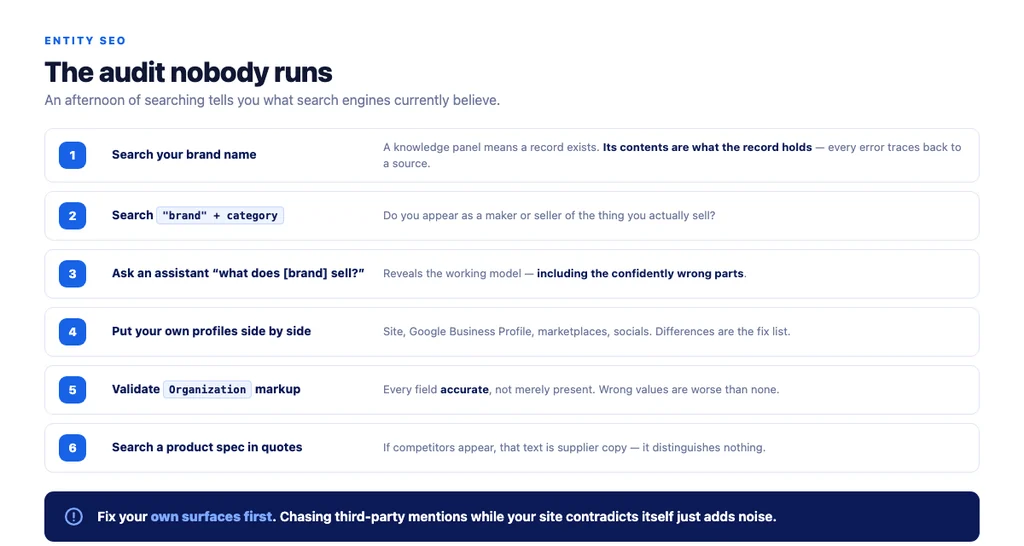
1. Search your brand name. What appears? A knowledge panel means an entity record exists. Its contents tell you what the record holds — and any error in it is an error you should trace to a source. 2. Search "your brand" + category. Do you appear as a maker or seller of the thing you actually sell? 3. Ask an assistant directly. "What does [brand] sell?" and "Who makes [product]?" The answer reveals the working model, including confidently wrong parts. 4. Audit your own consistency. Pull your brand name, address and description from your site, Google Business Profile, marketplace pages and social profiles. Put them side by side. Differences are your fix list. 5. Validate your Organization markup. Check every field is accurate, not just present. 6. Search a distinctive product spec in quotes. If competitors appear, that text is supplier copy and it is not distinguishing your product entity from theirs.
Fixing it, in order
1. Internal consistency first. Your own surfaces should agree before you worry about anyone else's. Brand name, Organization markup, About page facts, product specs across site and feed.
2. Owned profiles next. Google Business Profile, marketplace seller pages, social accounts. Same name, same details, same description.
3. Structured data completeness. Organization on the site, Product with real identifiers on every product page, BreadcrumbList stating hierarchy.
4. Third-party consistency last — because it is slowest and least controllable. Correct factual errors in directories and listings where you can, and be present where your category is genuinely discussed.
That order matters. Chasing third-party mentions while your own site contradicts itself is effort spent adding noise to a record that already disagrees with itself.
What this is not
- It is not link building. Mentions and consistency matter; buying links does not build an entity.
- It is not a Wikipedia page. Useful if you genuinely qualify, unavailable and inadvisable to fake if you do not.
- It is not a schema plugin checkbox. Emitting
Organizationmarkup with wrong values is worse than emitting none. - It is not fast. Entity records update slowly. This is foundational work, not a campaign.
The checklist
- One canonical brand name, used identically everywhere
Organizationmarkup present and every field verified accurate- About page states factual details, not brand poetry
- Name, address, phone and URL identical across all owned profiles
- Google Business Profile matches the site exactly
- Marketplace seller pages match the site exactly
- GTIN, MPN and brand populated on branded products
- Price, availability and specs identical on site, feed and marketplaces
Product+Offermarkup in the initial HTML- Variant, return and shipping markup implemented
BreadcrumbListpresent and valid- Product descriptions original, not supplier copy
- Brand searched; knowledge panel contents checked for errors
- Assistant asked what the brand sells; answer checked
- Factual errors in third-party listings corrected where possible
Sources
- Intro to Product Structured Data on Google — Google Search Central
- How To Add Merchant Listing Structured Data — Google Search Central
- Product Variant Structured Data (ProductGroup, Product) — Google Search Central
- Creating Helpful, Reliable, People-First Content — Google Search Central
- SEO Best Practices for Ecommerce Sites — Google Search Central
- Google Search Essentials — Google Search Central
Frequently Asked Questions
Want this run against your store? Book a call with The Reach Bureau.