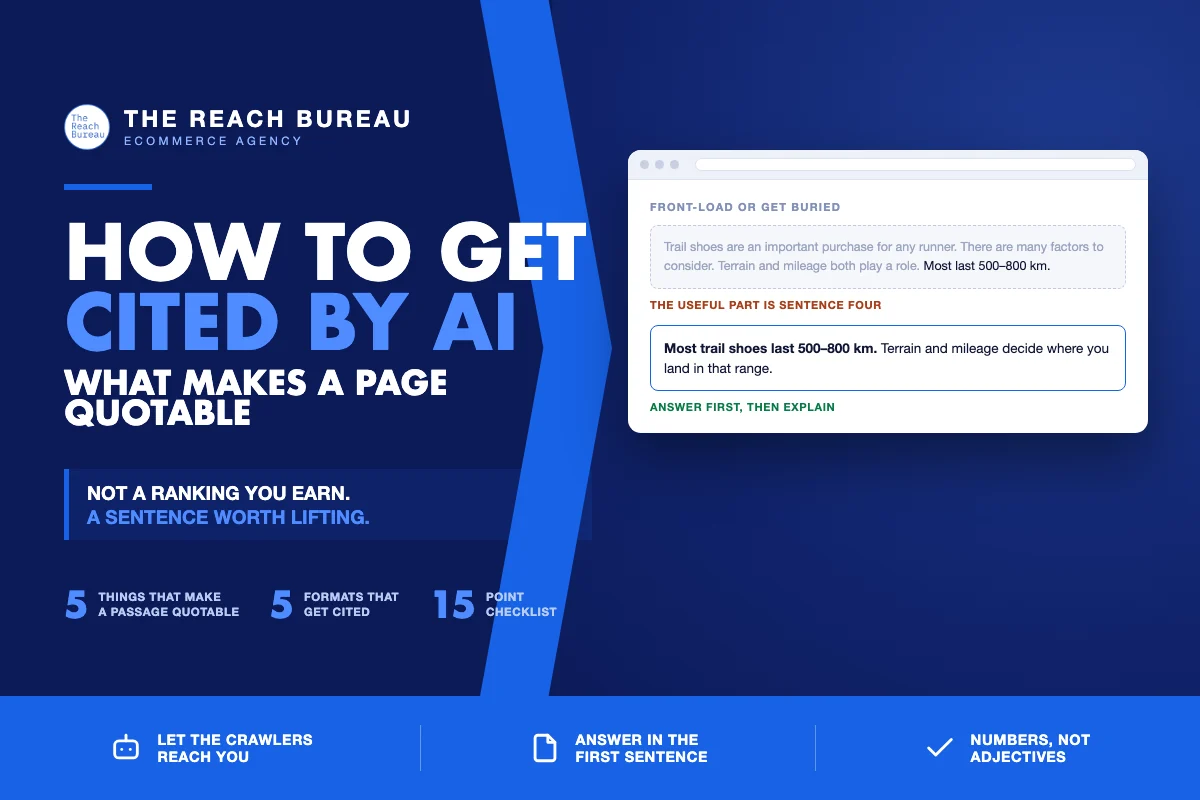
Being cited by an AI answer is not a ranking you earn. It is a passage being useful enough to lift.
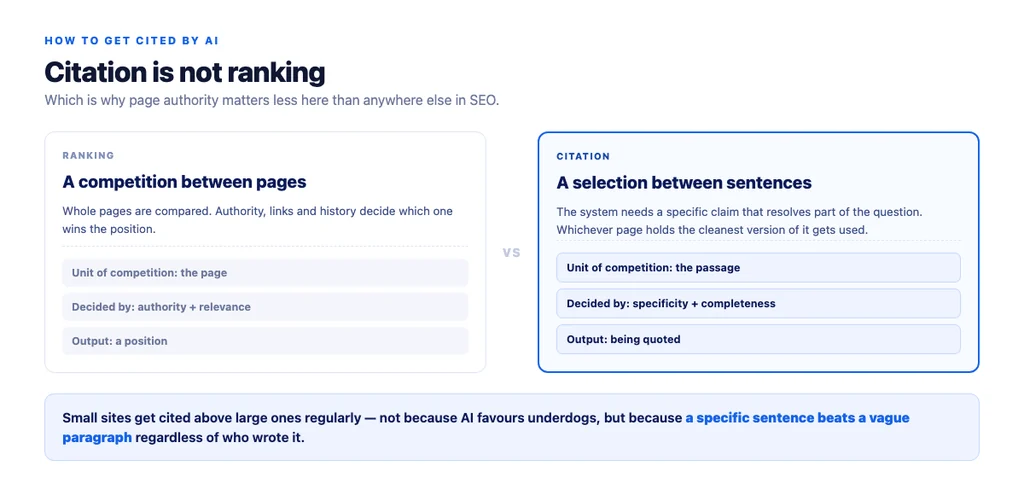
That distinction changes what you work on. Ranking is a competition between pages. Citation is a selection between *sentences* — the system is assembling an answer and needs a specific claim, figure or definition that resolves part of the question. Whichever page holds the cleanest version of that claim gets used, and page authority matters less than you would expect.
Which is why small sites get cited above large ones with some regularity. Not because AI favours underdogs, but because a specific sentence beats a vague paragraph regardless of who wrote it.
What makes a passage quotable
Look at what actually gets pulled into answers and the pattern is consistent.
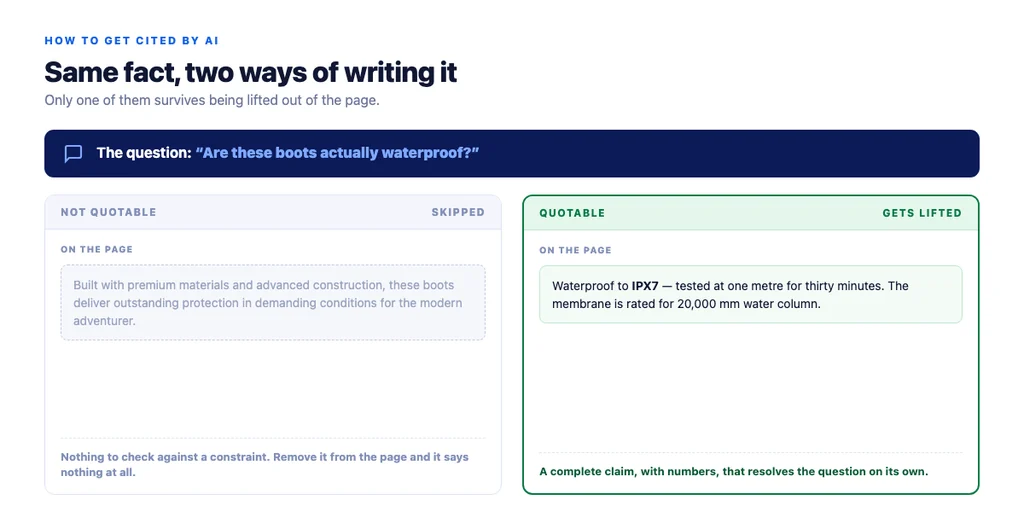
A complete claim in one or two sentences. The passage has to survive being removed from its surroundings. "Returns processed within 14 days of delivery" works alone; "we aim to make returns as easy as possible" does not.
A number attached to something. Measurements, durations, percentages, prices, thresholds. Numbers are the most liftable content that exists because they resolve a question definitively.
A direct answer at the start. If the answer to "how long do trail shoes last" appears in sentence four after three sentences of context, the useful part is buried. Answer first, then explain.
Named specificity. "IPX7, tested at one metre for thirty minutes" over "highly water resistant." The first can be checked against a constraint; the second cannot be used at all.
Comparison stated explicitly. Assistants answer a lot of "X versus Y" questions. A page that states the difference in a sentence provides exactly the shape of content needed.
The formats that get cited most
Direct-answer Q&A. A question as a heading, the answer as the first sentence beneath it. This is the most reliably citable structure because it matches the shape of the query.
Comparison tables. Structured, scannable, and each row is a complete comparison. Tables get read well and quoted often.
Definition sentences. "X is Y that does Z." One sentence, complete, unambiguous.
Specification blocks. Weight, dimensions, materials, tested conditions. Facts in a predictable place.
Numbered procedures. Each step complete on its own, so a single step can be quoted without the rest.
What rarely gets cited: narrative introductions, brand storytelling, and any paragraph where the key fact only makes sense after reading the two before it.
Structure that helps
Front-load every section. The answer in the first sentence, the explanation after. This is good writing anyway and it is what makes a passage extractable.
Write headings as questions where the content is an answer. Not for every heading, but where a section genuinely answers something someone asks.
Keep paragraphs self-contained. If a paragraph's meaning depends on the previous one, it cannot be lifted.
Use tables for anything comparative. Prose comparisons are hard to extract; tables are trivial.
Add structured data. FAQPage markup states the question-and-answer relationship explicitly rather than leaving it to be inferred. Google has retired FAQ rich results in search, so this is not for a snippet — it is machine-readable Q&A for everything that is not Google's blue links.
The prerequisite everyone skips
None of this matters if the crawler cannot reach the page.
AI crawlers are separate from Googlebot: GPTBot, OAI-SearchBot, ChatGPT-User, ClaudeBot, PerplexityBot, Google-Extended. Each can be blocked independently, and CDN bot-management rules catch them under generic "bot" categories surprisingly often — which is invisible from robots.txt.
Test it directly: request your own page with each user agent and confirm a 200 rather than a 403. Twenty minutes, and it is the single most common blocker.
Where citations come from besides your site
Assembled answers pull across sources, so your own pages are one input.
- Community discussions where your category is debated. Genuine participation, not link drops.
- Independent roundups and comparisons. Being included matters more than being linked.
- Consistent facts everywhere. If your site, your feed and your marketplace listings state different prices, the contradiction gets dropped rather than reconciled.
This is slower and less controllable than your own pages, which is why it belongs after the on-site work rather than instead of it.
Checking whether it worked
There is no citation report, so this is sampling.
- Write 15–25 questions a real customer would ask, in natural language.
- Run them monthly against the assistants your customers use.
- Record two things: whether you appeared, and which sources *were* cited. The second is more actionable — it tells you where to be present.
- Check referral traffic from
chatgpt.com,perplexity.aiand similar. Small volumes, high intent. - Read server logs to confirm the crawlers are fetching, and which pages.
Treat it as directional. Anyone offering a precise citation-share figure is selling an estimate produced the same way.
The checklist
- All six AI crawlers tested with real user-agent requests
- CDN or WAF bot rules checked, not just
robots.txt - Every section front-loads its answer in the first sentence
- Key claims complete in one or two sentences
- Numbers and measurements used instead of adjectives
- Paragraphs self-contained, not dependent on the previous one
- Comparisons presented as tables, not prose
- Headings written as questions where the content answers one
- Definition sentences present for the concepts you own
FAQPagemarkup on pages with genuine Q&A- Specification blocks in a predictable place on product pages
- Facts consistent across site, feed and marketplace listings
- 15–25 natural-language prompts written
- Prompts run monthly; cited sources recorded, not just appearances
- Server logs checked for AI crawler activity
Sources
- Creating Helpful, Reliable, People-First Content — Google Search Central
- Intro to Product Structured Data on Google — Google Search Central
- Mark Up FAQs with Structured Data — Google Search Central
- SEO Best Practices for Ecommerce Sites — Google Search Central
- Google Search Essentials — Google Search Central
Frequently Asked Questions
Want this run against your store? Book a call with The Reach Bureau.