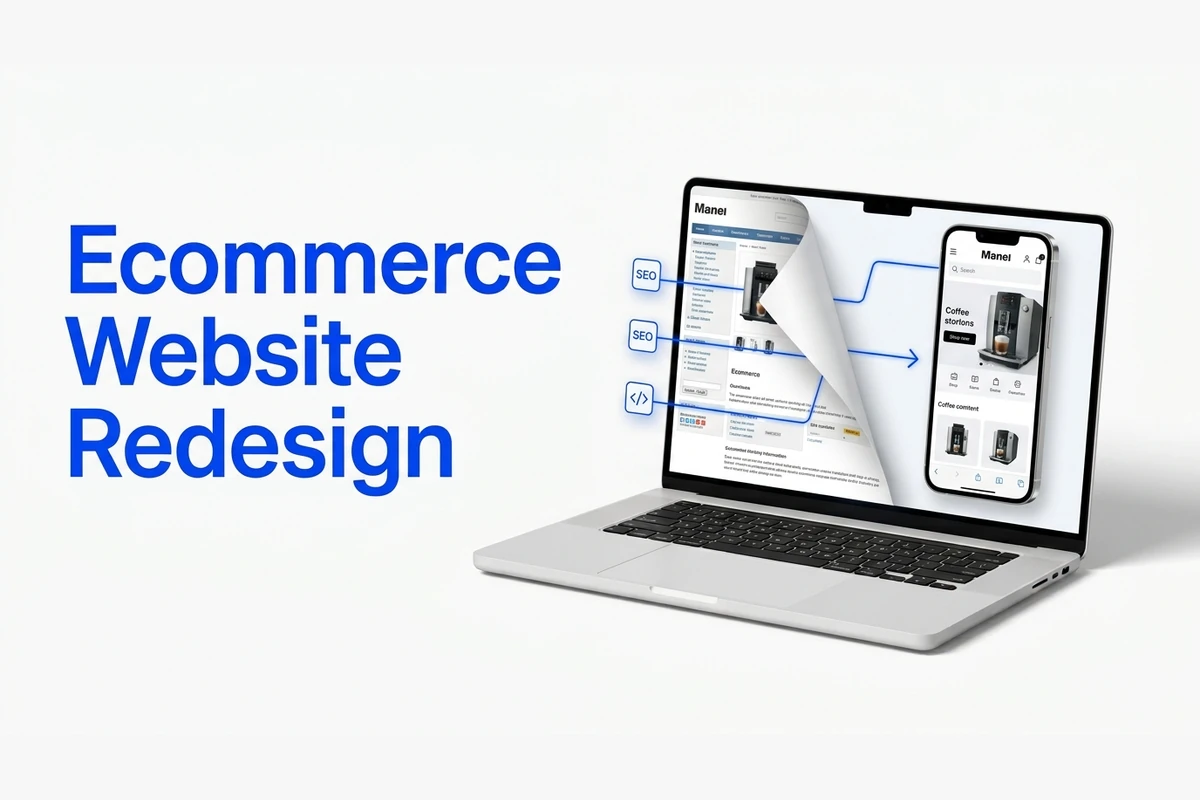
A redesign is the only project where a store voluntarily replaces something that works with something unproven.
That is not an argument against redesigning. Sites get dated, conversion patterns change, and a design built for a 200-product catalogue stops working at 2,000. But the framing matters, because most redesign briefs are written entirely about what the new site should look like and contain nothing about what the current site is already good at.
The result is predictable: traffic drops after launch, nobody can say which change caused it, and the recovery takes longer than the build did.
Start by documenting what currently works
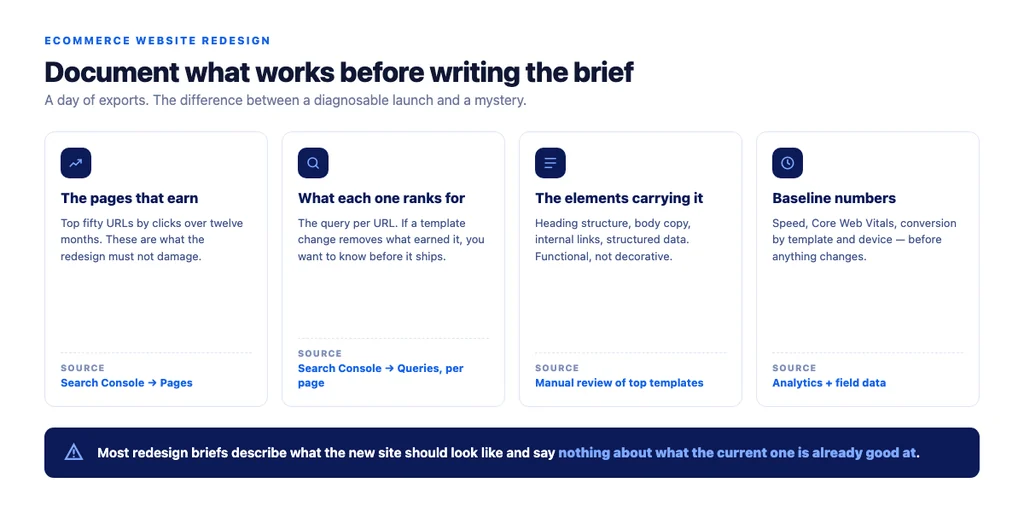
Before the design brief, produce this. It takes a day and it is the difference between a diagnosable launch and a mystery.
The pages that earn. Export Search Console for the last twelve months and list your top fifty URLs by clicks. These are the pages the redesign must not damage.
What each one ranks for. The query per URL. If a template change removes the content that earned a ranking, you want to know before it ships, not after.
The elements carrying the rankings. For your top templates: the heading structure, the body copy, the internal links, the structured data. These are functional, not decorative.
Current performance numbers. Page speed, Core Web Vitals, conversion rate by template and by device. Without a baseline you cannot tell whether the new design helped.
Design choices that actually affect rankings
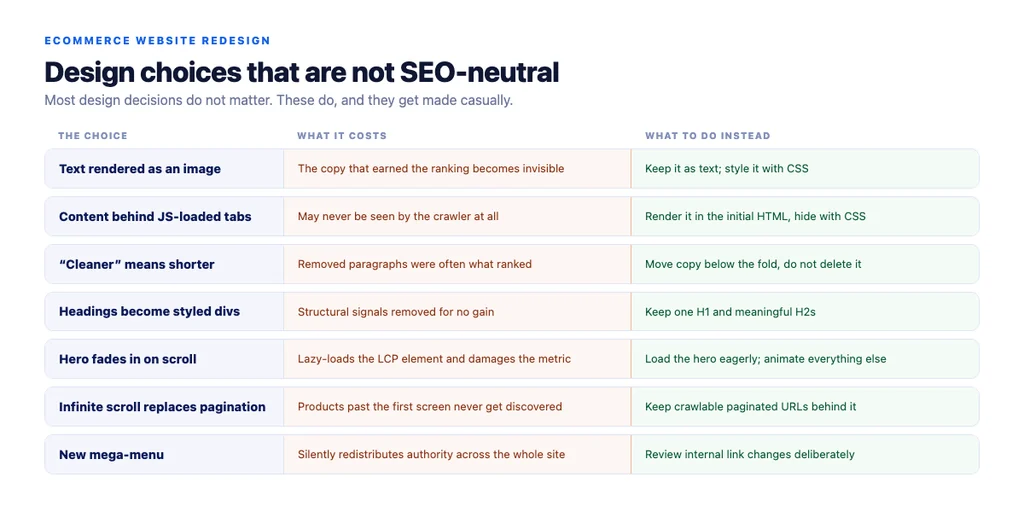
Most design decisions are neutral for SEO. A specific handful are not, and they are the ones that get made casually.
Replacing text with images. A category description rendered as a designed graphic is invisible. This happens surprisingly often when a designer wants typographic control.
Hiding content behind tabs or accordions. Generally fine — Google indexes it — but if the implementation loads content only on click via JavaScript, it may not be seen at all. Check what the crawler receives.
Reducing the copy. "Cleaner" frequently means "shorter," and if the removed paragraphs were what made the page rank, the ranking goes with them. Move copy rather than deleting it.
Changing heading structure. H1s and H2s carry meaning. A design that turns headings into styled divs, or uses H1 for a decorative strapline, removes signals for no gain.
Lazy-loading the hero. A design-led decision to fade in images on scroll routinely lazy-loads the Largest Contentful Paint element, which damages the metric it is measured by.
Infinite scroll replacing pagination. Products past the first screen may never be discovered if there are no crawlable paginated URLs behind it.
Mega-menus that change internal linking. The navigation is a large share of your internal link graph. Restructuring it redistributes authority across the whole site, usually without anyone deciding to.
Keep the URLs
The most valuable thing you can do in a redesign is change nothing about the URLs.
A redesign does not require new URLs. If someone proposes them, ask what problem it solves. If the answer is aesthetic or organisational rather than functional, the cost — a full redirect map, re-indexing, a recovery period — is not worth paying.
When URLs genuinely must change, treat it as a migration rather than a redesign: build a complete redirect map from crawl data, Search Console, analytics *and* backlink exports, map every URL to its closest genuine equivalent, and confirm each resolves in one hop.
The pre-launch checks
Run against staging, before the switch.
Content parity
- Every top-fifty page still contains the copy that earned its rankings
- Heading structure preserved: one H1, meaningful H2s
- Internal links from category text still present, still descriptive
- Structured data present on the new templates, in the initial HTML
Technical
- Staging is
noindex; the production build is *not* - Canonicals correct on every template
- Paginated pages still exist and are indexable
- Hero and first-row images not lazy-loaded
- Uncached generation time measured, not just cached response
Comparison
- Crawl staging and the live site, then diff the URL lists
- Diff the on-page text of your top twenty pages, old versus new
- Check every template on a real phone
After launch
Do not change anything else for a month. A redesign is already a large simultaneous change. Adding content edits or a platform update on top means no result can be attributed.
Watch by template, not site-wide. If category pages dropped and product pages held, that tells you where to look. A blended figure tells you nothing.
Expect a small dip even when nothing is wrong. Re-crawling and re-evaluation take time. Two to four weeks for a redesign that kept URLs; longer if URLs changed.
Keep the old design accessible internally — screenshots or a staged copy — so you can compare what a page used to contain when something drops.
The checklist
- Top fifty URLs by clicks exported before the brief is written
- Target query documented per URL
- Ranking-carrying elements identified per template
- Baseline recorded: speed, Core Web Vitals, conversion by template and device
- URL changes challenged and justified functionally, not aesthetically
- Redirect map built from four sources if URLs change
- No ranking copy replaced by images
- Tabbed or accordion content verified as crawler-visible
- Heading structure preserved; one H1 per page
- Hero and first-row images not lazy-loaded
- Pagination still exists behind any infinite scroll
- Navigation changes reviewed for internal link impact
- Structured data present on new templates, in initial HTML
- Staging noindexed; production verified indexable
- Staging and live crawled and URL lists diffed
- Top twenty pages text-diffed old versus new
- Every template checked on a real phone
- No other changes for a month after launch
Sources
- Google Search Essentials — Google Search Central
- Creating Helpful, Reliable, People-First Content — Google Search Central
- SEO Best Practices for Ecommerce Sites — Google Search Central
- Intro to Product Structured Data on Google — Google Search Central
- Ecommerce Product Data and Content on Google — Google Search Central
Frequently Asked Questions
Want this run against your store? Book a call with The Reach Bureau.