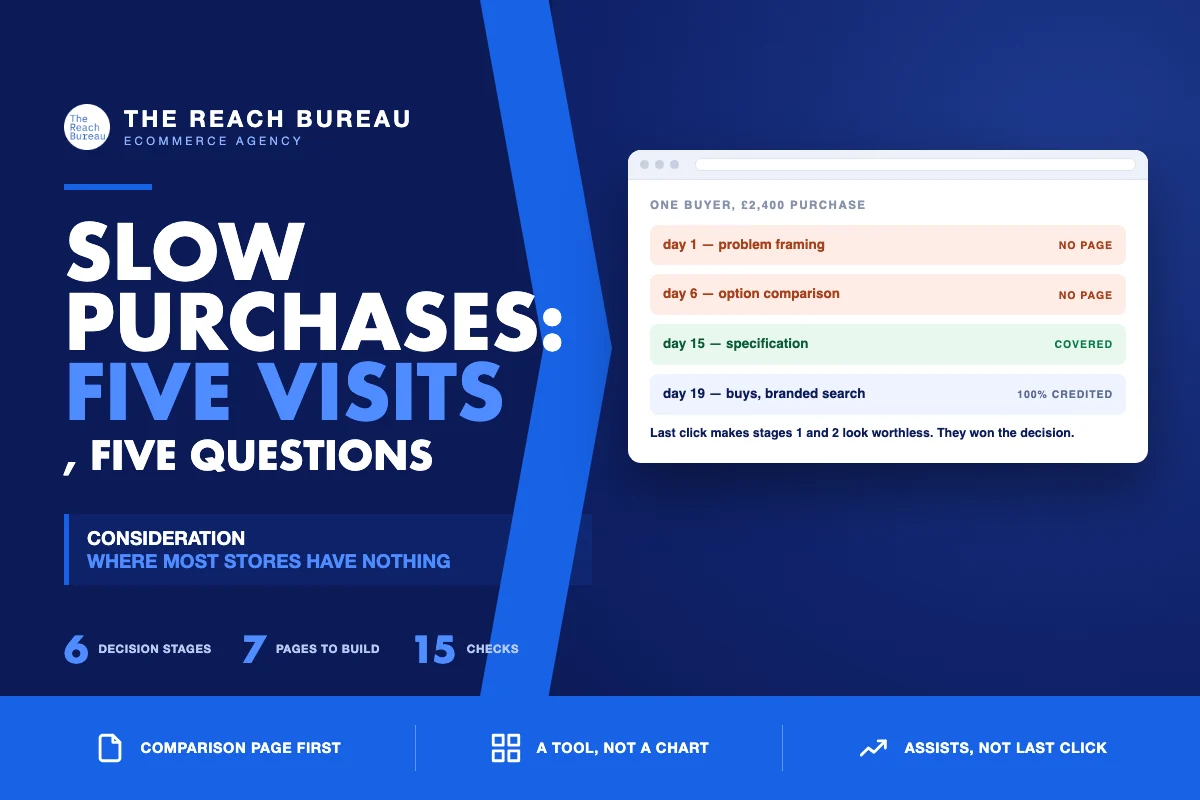
A £40 impulse purchase and a £2,400 considered one need different SEO, and most ecommerce advice is written for the first. On a slow purchase the visitor arrives four or five times over several weeks, asks a different question each time, and buys on a visit that looks like it came from nowhere.
Everything follows from that: which pages you need, what each one is for, and why your reporting will undervalue most of them.
What makes a purchase high-consideration
Not price alone. Any of these produces a long decision:
- High price relative to the buyer's normal spend.
- Difficult to reverse — installed, fitted, custom-made, or expensive to return.
- Compatibility risk. Will it fit, work with what I have, suit my situation.
- Infrequent purchase, so the buyer has no experience to draw on.
- Consequences of getting it wrong — safety, warranty, a professional's reputation.
- Multiple decision-makers. Two people in a household, or a specifier and a buyer.
The last one is routinely missed and changes the content requirement completely: you need a page one person can send to another.
The stages, and what each needs
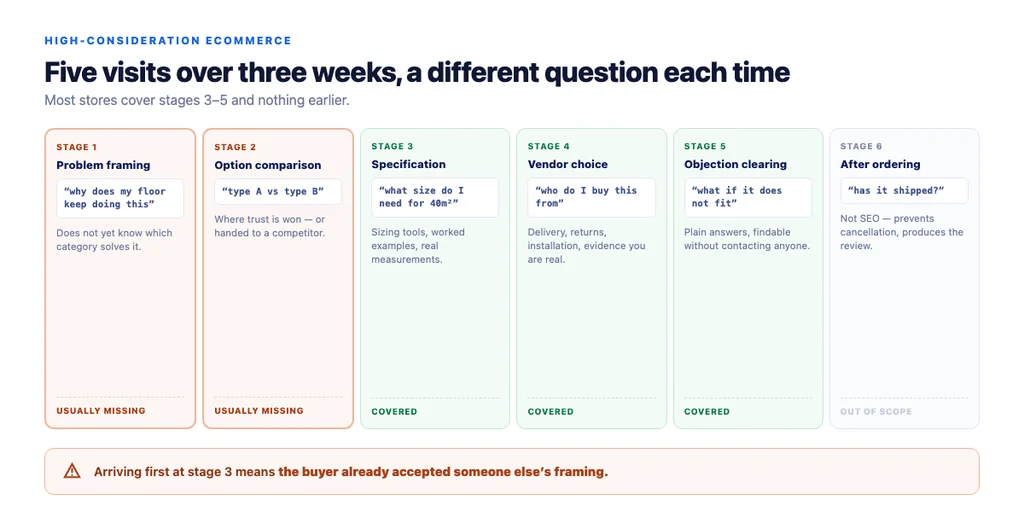
1. Problem framing. "Why does my floor keep doing this." The buyer does not yet know what product category solves it. Needs: explanatory content that names the category honestly, including when the answer is not to buy anything.
2. Option comparison. "Type A versus type B." Needs: a genuine comparison that admits trade-offs. This is the stage most stores skip, and the stage where trust is won.
3. Specification. "What size, what spec, what do I need for my situation." Needs: sizing and compatibility tools, worked examples, real measurements.
4. Vendor choice. "Who do I buy this from." Needs: delivery terms, returns, installation support, evidence you are a real business.
5. Objection clearing. "What if it does not fit / arrives damaged / I change my mind." Needs: plain answers, findable without contacting anyone.
6. Reassurance after ordering. Not SEO, but it prevents cancellation and produces the review and referral.
Mapping content honestly
Take your five highest-value products, list every question a buyer asks across those stages, then check which page answers it. On most stores the result is the same shape: stages 3 to 5 are covered, stages 1 and 2 are missing entirely.
That gap matters more than it looks. Stage 1 and 2 visitors are the ones who have not yet decided which vendor to trust. Arriving at stage 3 means the buyer already chose someone else's framing — often a competitor's comparison page, sometimes a marketplace's.
Why your reporting will undervalue this
- Last click credits the final visit, which is usually branded or direct. Every stage-1 and stage-2 page looks worthless.
- The path spans weeks, often exceeding the attribution lookback window entirely.
- It spans devices — researched on a phone, bought on a laptop.
- Conversion rate per session looks terrible on early-stage pages, because those sessions were never going to convert on that visit.
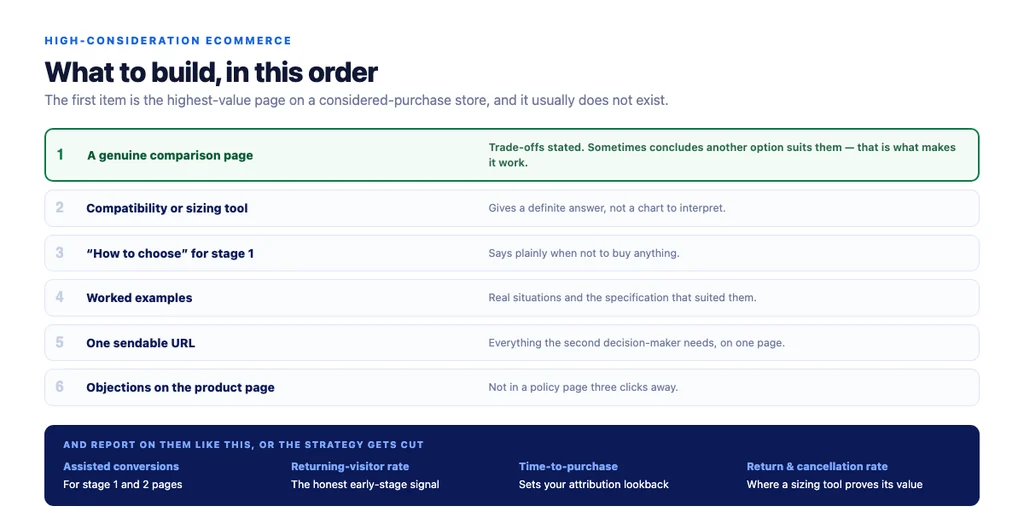
So report differently on these products: assisted conversions, first-click, and returning-visitor rate on early-stage pages. A store that judges stage-2 comparison content on last-click revenue will cut the content that wins the decision.
What to build, in order
1. One genuine comparison page for the main decision in your category. Trade-offs stated. This is the highest-value single page on a high-consideration store and it usually does not exist. 2. A compatibility or sizing tool that gives a definite answer. Not a chart to interpret — an answer. 3. A "how to choose" page written for stage 1, that says plainly when not to buy. 4. Worked examples — real situations with the specification that suited them. This is where first-hand experience shows. 5. A sendable page — one URL that contains everything the second decision-maker needs. 6. Objection answers on the product page, not on a policy page three clicks away. 7. A specification comparison across your own range, so the buyer does not leave to compare.
What not to do
- Publishing volume instead of depth. Thirty thin articles serve a slow decision worse than four thorough ones.
- Comparisons that always conclude with your product. A buyer at stage 2 recognises this instantly, and it costs you the trust the page existed to build.
- Hiding the price. On a considered purchase, "contact us for pricing" removes you from the shortlist before any conversation.
- Gating the useful content. A form in front of a sizing guide loses more decisions than it captures leads.
- Judging early-stage pages on last-click revenue. The reporting mistake that quietly dismantles the strategy.
- Assuming the buyer is the specifier. Content that only one of two decision-makers can follow stalls the purchase.
Measuring it properly
- Assisted conversions for stage 1 and 2 pages.
- Returning-visitor rate on early-stage pages — the honest signal that a page did its job.
- Time-to-purchase distribution. Knowing your real consideration window sets the attribution lookback.
- Conversion rate on stage 3–5 pages, where converting is actually the job.
- Tool completion rate for sizing and compatibility aids.
- Cancellation and return rate, which is where a specification tool proves its value commercially.
The checklist
- Consideration drivers identified beyond price
- Multiple decision-makers accounted for
- Every buyer question mapped to a page, across all six stages
- Stage 1 and 2 gaps identified and filled
- One genuine comparison page with stated trade-offs
- Compatibility or sizing tool that gives a definite answer
- "How to choose" page that says when not to buy
- Worked examples with real specifications
- One sendable URL for the second decision-maker
- Objections answered on the product page
- Prices visible, not gated behind an enquiry
- Useful content ungated
- Attribution lookback set from the real time-to-purchase distribution
- Early-stage pages judged on assists and return visits, not last click
- Return and cancellation rate tracked as a content outcome
Sources
- SEO Best Practices for Ecommerce Sites — Google Search Central
- Creating Helpful, Reliable, People-First Content — Google Search Central
- Ecommerce Product Data and Content on Google — Google Search Central
- Google Search Essentials — Google Search Central
- Intro to Product Structured Data on Google — Google Search Central
Frequently Asked Questions
Want this run against your store? Book a call with The Reach Bureau.