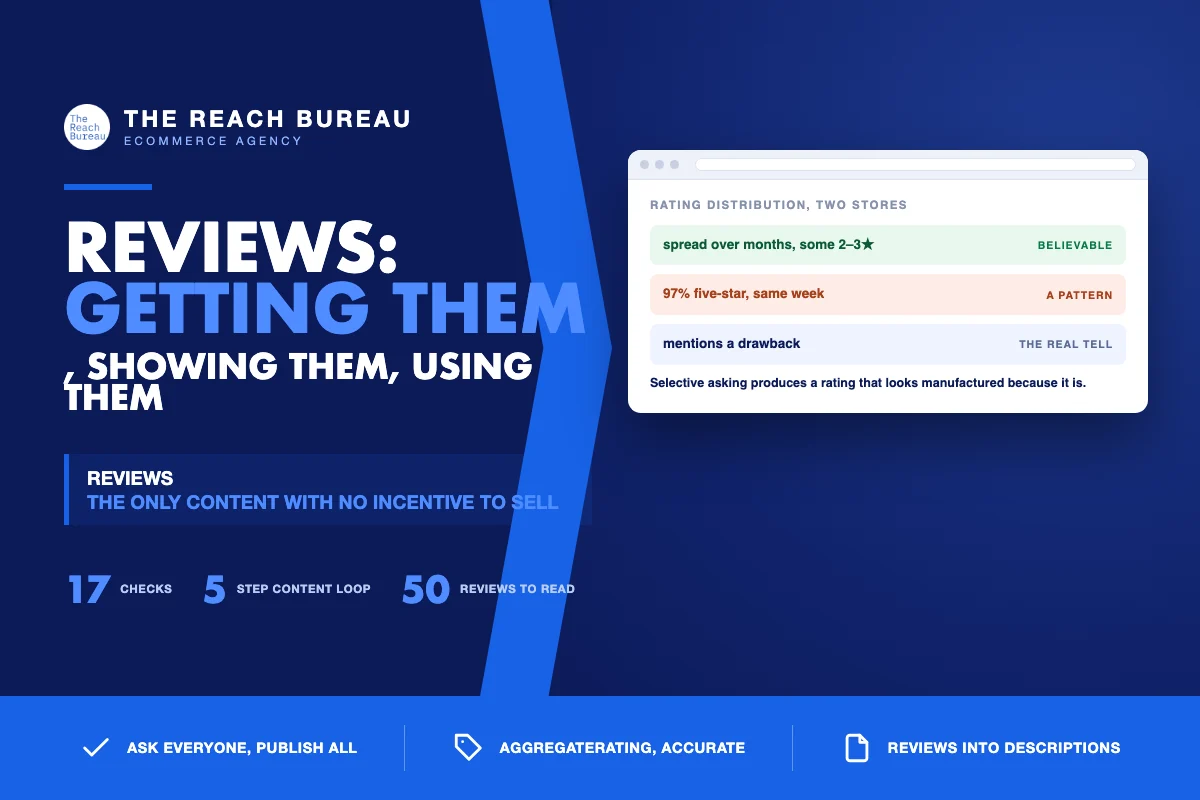
Reviews are the only content on a product page written by someone with no incentive to sell. That is what makes them useful to a shopper, to a search engine, and increasingly to an assistant summarising a category — and it is exactly what gets destroyed the moment a store starts curating them.
This is the operational version: how to collect reviews honestly, what markup is still worth having, and how to use the text they produce.
What reviews actually do for you
They are unique content on a page that otherwise duplicates the manufacturer. On a catalogue of resold products, reviews may be the only thing distinguishing your product page from forty others.
They answer questions you did not think to answer. Buyers mention sizing, durability, what it did not do. That is content you can act on.
They are corroboration. An assistant deciding whether to recommend a store looks for evidence beyond your own claims. Reviews are the cheapest form of that.
They reduce returns. A review mentioning that something runs small prevents the return that review would otherwise be about.
They convert. Independently of SEO, and usually by more than any ranking gain.
Collecting them without gaming
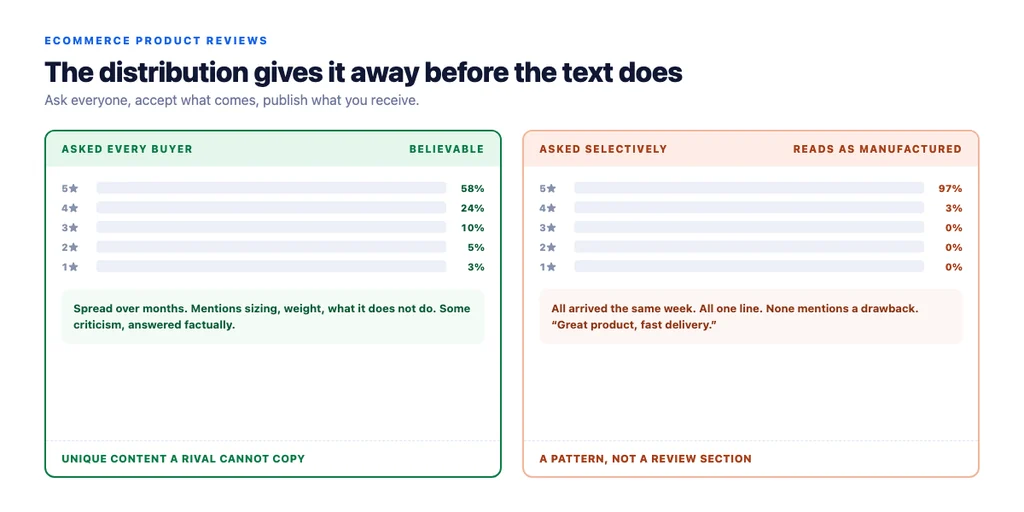
The line is simple: ask everyone, accept what comes, publish what you receive.
- Ask every buyer, not the ones you expect to be happy. Selective asking produces a rating that looks manufactured because it is.
- Ask at the right time — after they have used the product, not when it ships. For a coat, weeks; for a consumable, days.
- One reminder, then stop. Persistent chasing produces low-quality reviews and irritation.
- Never incentivise a positive review. Incentivising *a review* is defensible if disclosed; incentivising a *good* review is not, and platforms increasingly detect the resulting pattern.
- Ask for specifics. "How did the sizing work out?" produces more useful text than "How would you rate this?".
- Publish the negatives. A page of nothing but five stars is read as fake by shoppers and looks like a pattern to any system checking.
The tell that you are getting this wrong: all reviews arrive in the same week, all are short, all are five stars, and none mentions a drawback.
Markup, honestly
This is where most advice is out of date.
AggregateRating on Product can still produce review stars in results where Google chooses to show them. It remains worth implementing correctly.
Self-serving review markup is not eligible. Reviews of your *business* on your own site do not qualify for rich results. Product reviews from customers are a different thing and remain valid.
Do not mark up what is not visible. The rating in the markup must be the rating on the page. Mismatches are a structured data violation, and they are trivially detectable.
Do not aggregate across variants dishonestly. If a rating covers a product family, the page should say so.
Individual Review markup is fine alongside the aggregate but rarely changes what is displayed.
Do not expect FAQ-style enhancement from reviews. Google restricted FAQ rich results to government and health sites in 2023 and has wound the feature down further since. Review stars are a separate feature and still exist; treat them as the one worth pursuing.
The practical position: implement AggregateRating accurately, keep it consistent with the page, and treat rich-result appearance as a possibility rather than a plan.
Using the content reviews produce
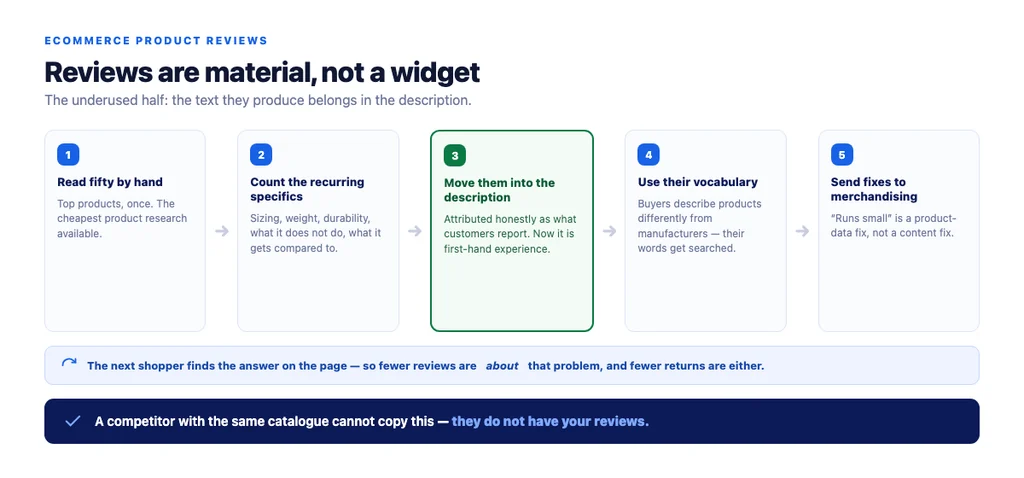
This is the underused half, and it is where reviews stop being a widget and become material.
1. Read fifty reviews of your top products. By hand, once. It is the cheapest product research available. 2. Count recurring specifics. Sizing, weight, durability, what it does not do, what people compare it to. 3. Move the recurring ones into the description — attributed honestly as what customers report. 4. Answer the recurring question on the page, so the next shopper does not need the reviews to find it. 5. Feed the vocabulary into your copy. Buyers describe products differently from manufacturers, and their words are the ones searched. 6. Send the returns-related findings to merchandising. "Runs small" is a product data fix, not a content fix.
Steps 3 and 4 are what turn reviews into the first-hand experience content Google's guidance asks for — and a competitor with the same catalogue cannot copy it, because they do not have your reviews.
Handling negatives
- Reply publicly, once, factually. A calm reply to a fair criticism is more persuasive than any five-star review.
- Do not delete criticism that is accurate. Deleting it is what makes a review section worthless.
- Do remove abuse, spam and off-topic content. That is moderation, not curation.
- Fix the cause. If four reviews say the packaging arrives crushed, the finding is about packaging.
- Publish a policy describing what you moderate and why. It costs nothing and pre-empts the accusation.
What not to do
- Buying reviews. Detectable, and a trust problem that outlives any ranking benefit.
- Filtering by rating before publishing. The pattern is visible even when individual reviews are real.
- Marking up a rating you do not display.
- Aggregating unrelated products to inflate a count.
- Using review text as a page's only content — a category page of stitched-together review quotes helps nobody.
- Treating the review count as the metric. Twenty specific reviews beat four hundred one-liners for both shoppers and machines.
The checklist
- Every buyer asked, not a selected subset
- Timing matched to the product's usage cycle
- One reminder maximum
- No incentive tied to a positive rating
- Specific questions asked, not just a star rating
- Negative reviews published
- Rating distribution checked for a manufactured pattern
AggregateRatingimplemented and matching the visible rating- No self-serving business-review markup
- Variant aggregation disclosed on the page
- Fifty reviews of top products read by hand
- Recurring specifics moved into descriptions
- Recurring questions answered on the page
- Customer vocabulary used in copy
- Returns-related findings passed to merchandising
- Negatives replied to factually, not deleted
- Moderation policy published
Sources
- Review Snippet Structured Data — Google Search Central
- Intro to Product Structured Data on Google — Google Search Central
- SEO Best Practices for Ecommerce Sites — Google Search Central
- Creating Helpful, Reliable, People-First Content — Google Search Central
- Spam Policies for Google Web Search — Google Search Central
Frequently Asked Questions
Want this run against your store? Book a call with The Reach Bureau.