Most gap analyses produce a spreadsheet of a thousand keywords a competitor ranks for and you do not. That is not an analysis. It is a list, and lists do not change what anyone does on Monday.
A useful gap analysis answers a narrower question: what could we do in the next quarter that would move revenue, that we are not doing. Getting there means being disciplined about who you compare against and ruthless about what you ignore.
Pick the right competitors first
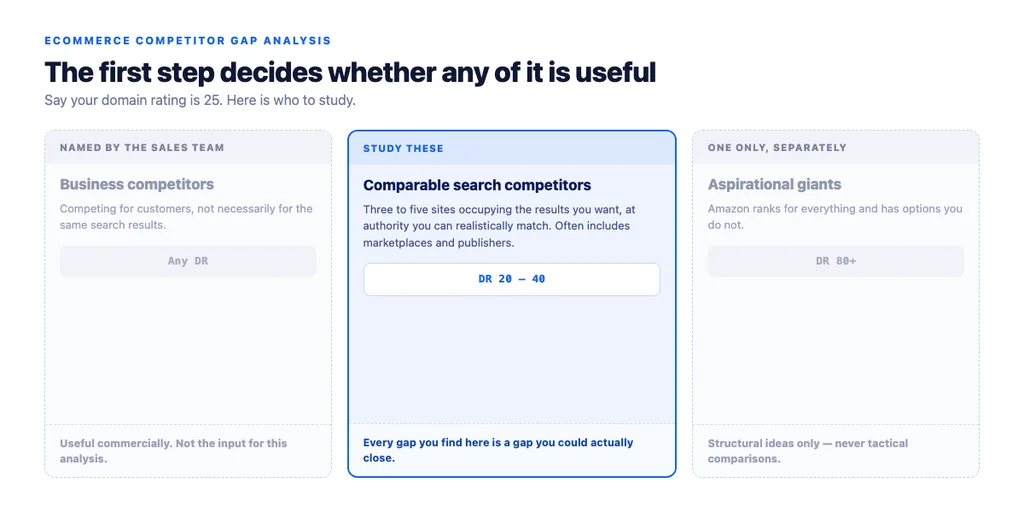
This step decides whether the whole exercise is useful, and it is usually done carelessly.
Not your business competitors. The brands your sales team names are competing for customers. Your search competitors are whoever occupies the results you want, which frequently includes marketplaces, publishers and comparison sites that are not competitors in any commercial sense.
Not the biggest sites in your space. Amazon ranks for everything and tells you nothing you can act on. A site ten times your size has options you do not.
Pick three to five sites of comparable authority that rank for your commercially important terms. If your domain rating is 25, study the sites at 20–40, not the ones at 80. The gaps you find will be closeable.
Include one aspirational site, studied separately, for structural ideas rather than tactical ones.
What to actually compare
Five areas, in order of how often they produce something worth doing.
1. Page-type coverage. Do they have page types you lack? Buying guides, comparison pages, use-case landing pages, size or compatibility tools. This is structural, and it is where the biggest findings usually are — a whole class of page you never built.
2. Category and facet depth. Do they have category pages for terms where you only have filtered URLs? A competitor with a crawlable, indexable page for "waterproof walking boots" where you have a facet that is noindex is winning a term you could take with a template change.
3. Product page completeness. Compare ten of your product pages against theirs, on the same products where possible. Attributes, images, specification depth, reviews, delivery information. This is the least glamorous comparison and the one most likely to explain a persistent ranking difference.
4. Content that supports commercial pages. Not their blog volume — the specific articles that link into their category and product pages. Volume is a vanity comparison; the linking pattern is the useful one.
5. Technical and speed differences. Compare like for like: their category page against your category page on mobile. Aggregate site scores hide the pages that matter.
Keyword gaps come after all five, and are read through them. A keyword gap is a symptom; the five areas above are the causes.
Turning it into decisions
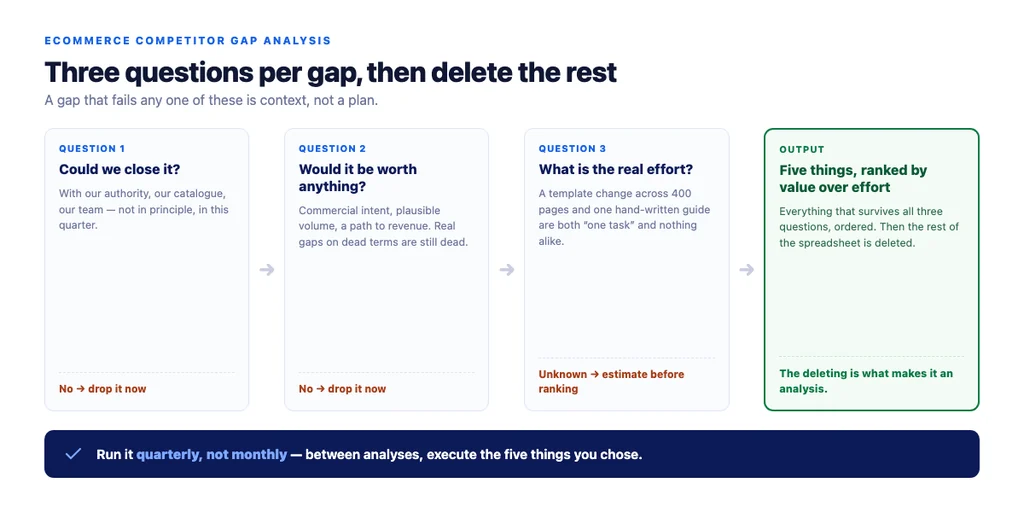
For each gap found, answer three questions.
- Could we close it? With our authority, our catalogue, our team. If not, drop it now.
- Would closing it be worth anything? Commercial intent, plausible volume, revenue relevance. A gap on informational terms with no path to purchase is real and not worth your quarter.
- What is the effort? A template change affecting 400 pages and a hand-written buying guide are both "one task" on a list and are nothing alike.
Rank by value over effort, take the top five, and delete the rest of the spreadsheet. The deleting is the part that makes it an analysis.
What to ignore
- Keyword counts. "They rank for 12,000 keywords, we rank for 4,000" is not a finding. Most of those terms have no commercial value.
- Their blog volume. Publishing frequency is not a gap. What their articles link to is.
- Backlink totals. A large number you cannot replicate. The useful version is which specific pages earned links and why — that is repeatable.
- Anything you cannot execute. A gap requiring a capability you do not have is context, not a plan.
- Aggregate scores. Domain authority, site health, content grades. They compress away everything actionable.
Doing it without a big budget
The full comparison needs a keyword tool, but a lot of it does not.
- Crawl their site with a free-tier crawler to see page-type coverage and category structure. This is where the structural findings are, and it costs nothing.
- Read ten of their product pages properly, next to ten of yours. An hour, and consistently the most useful hour in the whole exercise.
- Check their category pages for what is indexable —
robots.txt, meta robots, canonical behaviour on facets. - Search your own top twenty commercial terms manually and note who appears and in what format.
- Run their pages and yours through a page speed tool, comparing like for like.
That is most of the value. The keyword tool adds precision to a picture you can already see.
A cadence that works
Once a quarter, not continuously. Gap analysis is a planning input, and running it monthly produces churn rather than progress. Between analyses, execute the five things you chose.
Re-run after any significant change on your side — a replatform, a catalogue expansion, a structural rebuild — because the gaps will have moved.
The checklist
- Search competitors identified, not business competitors
- Three to five sites of comparable authority selected
- One aspirational site studied separately for structure only
- Page-type coverage compared
- Category and facet indexability compared
- Ten product pages compared side by side
- Content-to-commercial-page linking pattern examined
- Speed compared like for like, page type against page type
- Every gap tested: closeable, valuable, effort estimated
- Top five chosen, everything else deleted
- Keyword counts, blog volume and aggregate scores ignored
- Re-run scheduled quarterly, not monthly
Sources
- SEO Best Practices for Ecommerce Sites — Google Search Central
- Faceted Navigation Best Practices — Google Search Central
- Google Search Essentials — Google Search Central
- Creating Helpful, Reliable, People-First Content — Google Search Central
- Page Experience in Google Search Results — Google Search Central
Frequently Asked Questions
Want this run against your store? Book a call with The Reach Bureau.