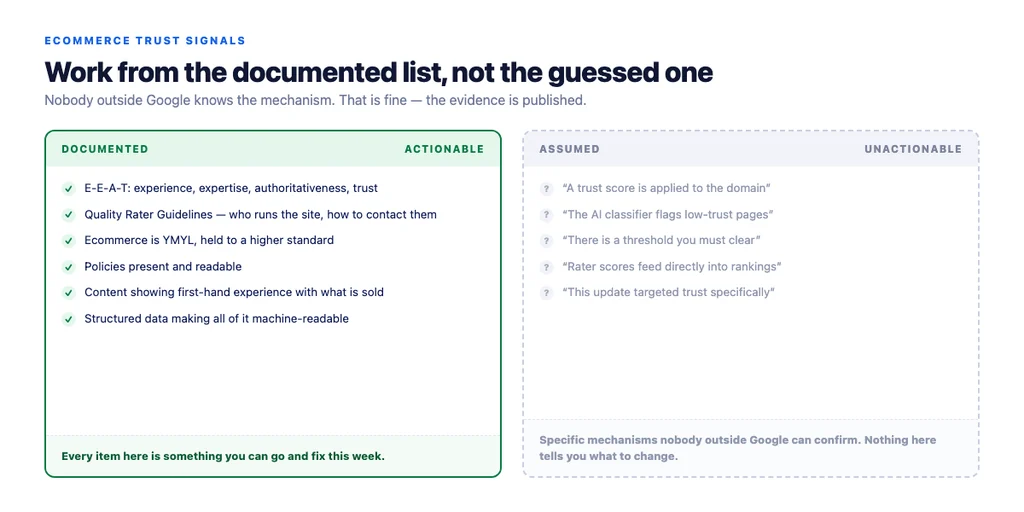
Nobody outside Google knows exactly how trust is assessed, and anyone claiming a specific mechanism is guessing. What is documented is different and more useful: the kinds of evidence Google says its systems look for, and the guidelines its human raters are given.
Working from documented signals rather than speculation gives you a list you can act on. It also makes clear why some stores get recommended by AI assistants and others never appear.
What is actually documented
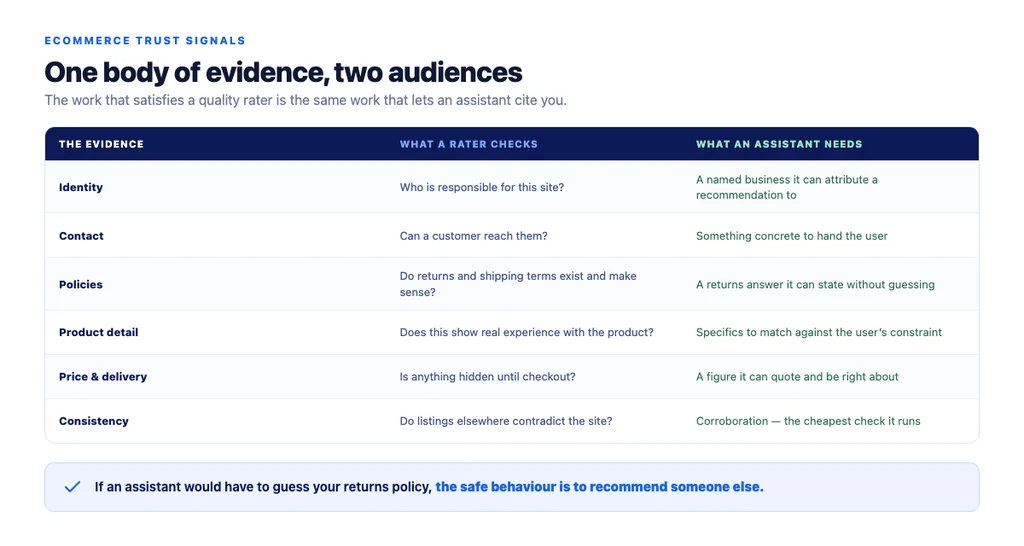
Google's guidance describes evidence of first-hand experience, expertise, authoritativeness and trustworthiness — E-E-A-T. Its Quality Rater Guidelines apply this specifically to ecommerce: raters are asked to look for who is responsible for the site, how to contact them, whether policies exist, and whether the content shows real experience with what is sold.
The raters do not directly change rankings. What they produce is a judgment of what "good" looks like, which is used to evaluate the ranking systems. That makes the guidelines the closest thing to a published specification of trust that exists.
Ecommerce is also classified as YMYL — "Your Money or Your Life" — because a transaction can cost someone money. YMYL pages are held to a higher standard, and this is why identical content quality produces different outcomes on a blog and on a store.
The signals a store can actually control
Who you are. A real business name, a physical address, and a company registration where applicable. A store with none of these is indistinguishable from a store that will not ship.
How to reach you. A phone number, an email, a contact form — reachable, not a form that goes nowhere. This is one of the specific things raters are told to look for.
Policies that exist and are readable. Returns, shipping, privacy, terms. Not a template with the placeholder company name still in it, which is a signal in its own right.
Product content showing real experience. Manufacturer descriptions copied unchanged appear on a hundred sites. Content describing what the product is actually like — sizing that runs small, what is in the box, what it does not do — cannot be copied and demonstrates first-hand experience.
Honest reviews with substance. Reviews that all arrived the same week, all five stars, all two sentences long, are a negative signal, not a neutral one. Reviews mentioning specific drawbacks read as genuine, and they convert better too.
Prices, availability and delivery, stated plainly. Ambiguity here is a trust cost. It is also what AI assistants need in order to recommend you, which is covered below.
Consistency across the web. Your name, address and phone matching what appears on your social profiles, business listings and marketplaces. Contradictions are visible and cheap to check.
Working HTTPS, no broken checkout, no interstitial mess. Basic, and still commonly broken.
What reads as low-trust
- No identifiable owner. No about page, no address, no company details.
- Contact details that go nowhere. A form with no reply, a phone number that is not connected.
- Template policies with placeholders left in, or policies that contradict each other.
- Copied product descriptions across the whole catalogue.
- Review patterns that look manufactured — same date, same length, no negatives.
- Prices hidden until checkout, or shipping costs revealed at the last step.
- Thin, generated category text that says nothing a shopper could use.
- Contradictory information between the site and its listings elsewhere.
None of these is a penalty. They are absence of evidence, and in a YMYL context absence of evidence is itself a finding.
Why this decides whether AI assistants recommend you
When someone asks an assistant for a recommendation, the assistant has to choose between stores it can verify and stores it cannot. It has no way to develop a hunch. It works from what is stated on the page and what is corroborated elsewhere.
A store with a clear identity, readable policies, plain prices and specific product content is straightforwardly summarisable. A store where the assistant would have to guess at the returns policy is not — and the safe behaviour is to recommend something else.
This is the practical reason trust work has become more valuable rather than less. The same evidence that satisfies a quality rater is the evidence an assistant needs to cite you.
A remediation order
Work in this order, because it is roughly the order of effort against payoff.
1. Fix identity. About page with a real business name, address and registration. One afternoon. 2. Fix contact. Working phone, monitored email, tested form. 3. Rewrite policies in plain language. Remove placeholders. Make them consistent with each other. 4. Add structured data — Organization with contact details, Product with price and availability, BreadcrumbList. This makes what a human can read machine-readable. 5. Fix the top 50 product pages first — add specifics no manufacturer sheet contains. Then work down. 6. Audit reviews. Stop any practice that produces a manufactured-looking pattern. Publish the critical ones. 7. Make prices and delivery unambiguous before the cart. 8. Reconcile your details across listings, social profiles and marketplaces.
Steps 1–3 take days and remove the strongest negative signals. Step 5 takes months and is where the durable gain is.
The checklist
- Real business name, address and registration on the site
- Working phone, monitored email, tested contact form
- Returns, shipping, privacy and terms present and readable
- No template placeholders left in policy text
- Policies do not contradict each other
- Top product pages carry specifics beyond the manufacturer description
- Reviews include critical ones and are not date- or length-clustered
- Price, availability and delivery cost visible before checkout
Organization,ProductandBreadcrumbListstructured data present- Name, address and phone consistent across listings and profiles
- HTTPS working across the whole site
- Checkout completes without errors on mobile
- Category pages say something a shopper could use
Sources
- Creating Helpful, Reliable, People-First Content — Google Search Central
- Search Quality Rater Guidelines: An Overview — Google Search Central Blog
- SEO Best Practices for Ecommerce Sites — Google Search Central
- Intro to Product Structured Data on Google — Google Search Central
- Google Search Essentials — Google Search Central
Frequently Asked Questions
Want this run against your store? Book a call with The Reach Bureau.