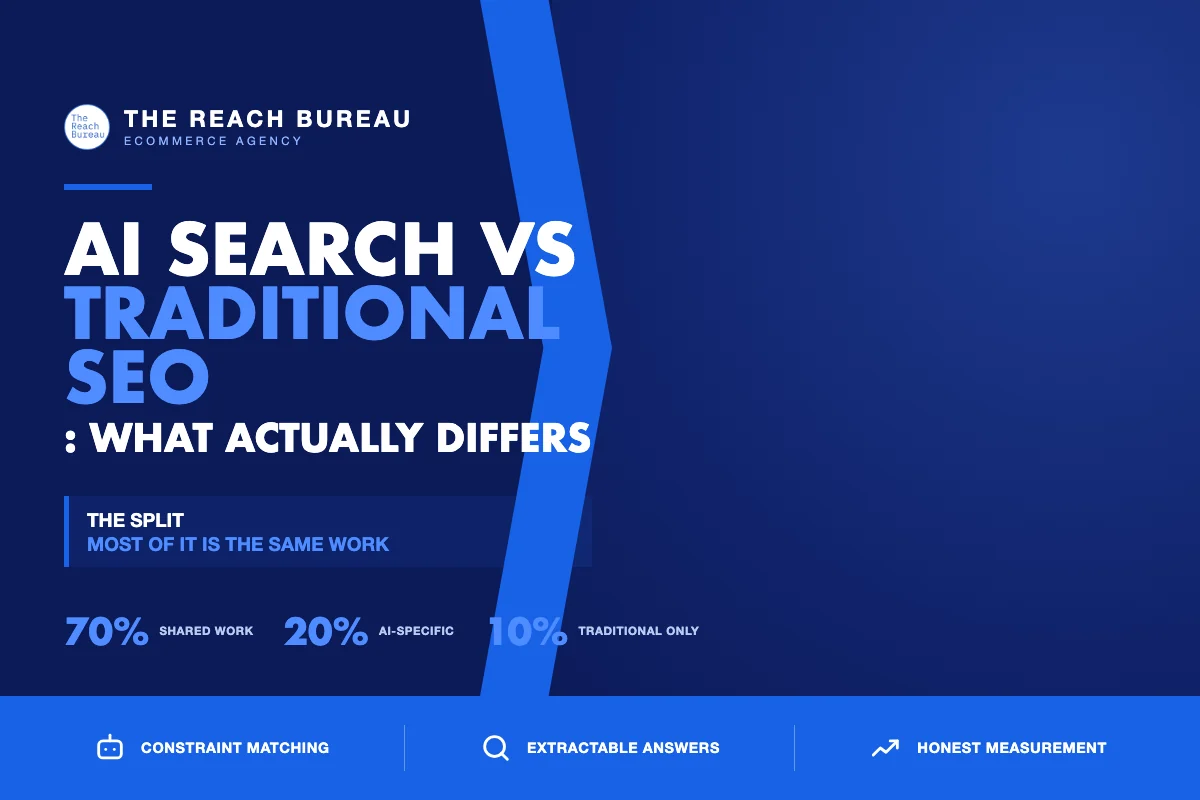
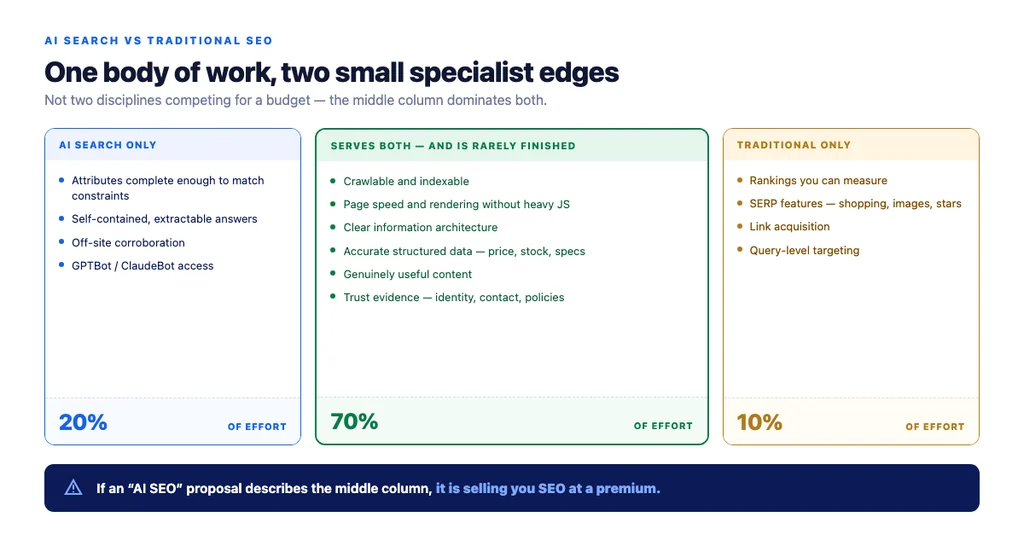
The framing of this question is usually wrong. It is not two disciplines competing for a budget. It is one body of work, most of which serves both, plus a small set of things that only matter for one.
Getting the split right matters because the "AI SEO" market is full of services selling the overlap back to you as something new. Knowing which part is genuinely different is what stops that.
What is genuinely the same
Most of it.
- Being crawlable and indexable. Assistants that browse use the same web. Assistants that draw on a search index depend on you being in one.
- Page speed and rendering. Content behind heavy client-side JavaScript is harder for everything to read.
- Clear information architecture. A logical structure helps a crawler and an assistant equally.
- Accurate structured data. Prices, availability, specifications. Machine-readable facts serve both.
- Genuinely useful content. The thing search has rewarded for a decade.
- Trust evidence. Identity, contact, policies. Both a quality rater and an assistant need it.
If a service offers "AI SEO" and this list is what they deliver, they are selling you SEO. That is not necessarily bad — it is just not new, and it should not carry a premium.
What is genuinely different for AI search
Constraint-shaped queries. People ask assistants things they would never type into a search box: "a waterproof jacket under £150 that packs down small and is not black." Your pages need the attributes that answer constraints like these — packed size, waterproof rating, colour range — as facts, not adjectives.
Extractability over ranking. In traditional search you want position one. In an assistant answer you want to be the source that is cited, which depends on whether a clear, self-contained statement exists on your page. A paragraph that answers a question completely without needing the rest of the page is what gets pulled.
Corroboration off-site. Assistants cross-check. A specification stated only on your site is weaker than one that matches what appears on manufacturer listings, marketplaces and reviews. Consistency across the web is a ranking factor for traditional search too, but it carries more weight when the reader is a machine that can check cheaply.
Answering the whole question. A query with three constraints needs all three addressed. Traditional search will still show you for a partial match; an assistant filtering on constraints will not.
Crawler access for AI bots. Separate from Googlebot. Blocking GPTBot, ClaudeBot, PerplexityBot in robots.txt removes you from those systems entirely. This is a real, common, and completely invisible mistake.
What is genuinely different for traditional search
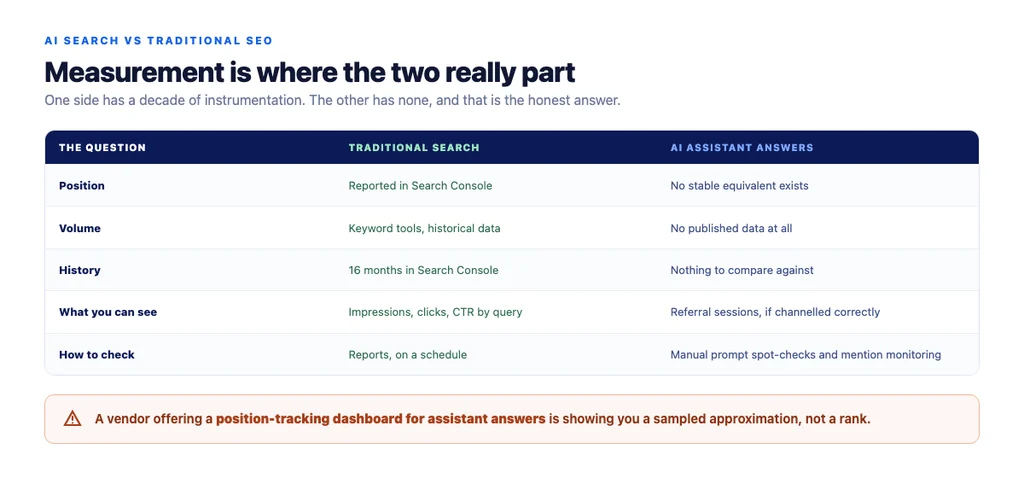
Rankings you can measure. Position, impressions, clicks, in Search Console, historically. There is no equivalent for assistant answers — no reliable position, no volume data, no history.
SERP features. Shopping listings, image results, review stars. These are real traffic sources with their own requirements, and they do not have an assistant analogue.
Link acquisition. Still influences traditional ranking directly. Its effect on assistant citation is indirect at best.
Query-level optimisation. Targeting a specific keyword with a specific page is a strategy that works in a system where you can see the query. Much less so where you cannot.
How to split the effort
Not 50/50, and not by picking one.
Roughly 70% on the shared work. Crawlability, speed, structure, structured data, product content quality, trust evidence. It serves both, and on most ecommerce sites it is not finished.
Roughly 20% on the AI-specific slice. Attribute completeness for constraint matching, self-contained answer paragraphs, off-site consistency, AI crawler access. Cheap, and mostly a byproduct of doing the shared work properly.
Roughly 10% on the traditional-only slice. SERP features, link acquisition, query-level targeting for terms that matter commercially.
The percentages are a starting point, not a formula. What matters is the shape: the shared work dominates, and neither specialist slice justifies a separate programme.
How to tell if a service is selling you the overlap
Ask what they will do that is different from standard SEO. A good answer names specific things: attribute completeness on product pages, self-contained answer structure, AI crawler access, off-site consistency auditing.
A poor answer describes crawlability, page speed, structured data and useful content — the shared list — with "for AI" appended.
Ask how they will measure it. There is no reliable AI-search rank tracking. Anyone offering a position-tracking dashboard for assistant answers is showing you a sampled approximation at best. The honest measurements are assistant referral traffic in analytics, manual spot-checks of relevant prompts, and brand mention monitoring.
The checklist
- Site crawlable and indexable — the foundation for both
GPTBot,ClaudeBot,PerplexityBotand similar not blocked inrobots.txt- Content readable without executing heavy JavaScript
- Structured data accurate for price, availability and specifications
- Product attributes complete enough to match constraint-shaped queries
- Key answers written as self-contained paragraphs
- Specifications consistent with manufacturer and marketplace listings
- Trust evidence present — identity, contact, policies
- Assistant referral traffic visible as its own analytics channel
- Manual prompt spot-checks scheduled, not a rank-tracking dashboard
- Traditional measurement still running in Search Console
- Any "AI SEO" proposal checked against the shared-work list
Sources
- SEO Best Practices for Ecommerce Sites — Google Search Central
- Google Search Essentials — Google Search Central
- Introduction to robots.txt — Google Search Central
- Creating Helpful, Reliable, People-First Content — Google Search Central
- Intro to Product Structured Data on Google — Google Search Central
FAQs
Want this run against your store? Book a call with The Reach Bureau.