Most advice about landing pages comes from paid media, where the page exists to receive traffic you bought and has no obligation to rank. An organic landing page has a different job, and copying the paid playbook is why so many of them sit unindexed.
The question that decides everything is whether a landing page is the right page type at all. On an ecommerce site, most of the time it is not.
When a landing page is the wrong answer
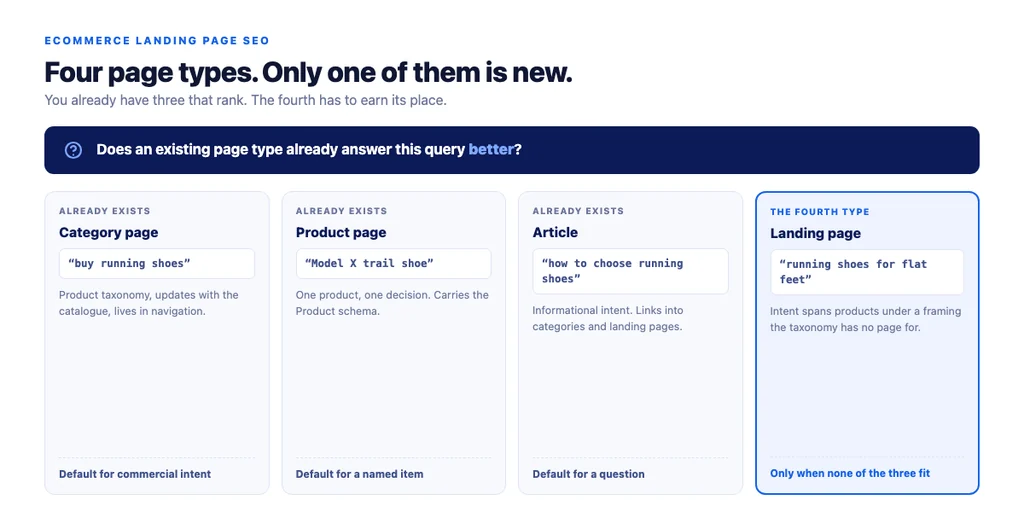
You already have page types that rank: product pages, category pages, articles. A landing page is a fourth type, and it only earns its place when none of the three fit.
If the query is "buy X" — that is a category page. It should exist, be crawlable, and be linked from navigation.
If the query is about one product — that is a product page.
If the query is a question — that is an article.
A landing page belongs where the intent spans several products under a framing your category structure does not express: a use case ("commercial kitchen setup"), a customer type ("for small clinics"), a seasonal grouping, a bundle. Something real that a shopper searches for and that your taxonomy does not have a page for.
The failure case is building a landing page that duplicates a category page. Now two of your pages target the same query, and Google picks one — usually not the one you wanted.
What makes it different from a category page
A category page lists products in a taxonomy. A landing page frames a decision.
| Category page | Landing page | |
|---|---|---|
| Organising idea | Product taxonomy | Use case, customer, or occasion |
| Content | Filters, listing, brief intro | Framing, guidance, curated selection |
| Query it answers | "buy running shoes" | "running shoes for flat feet" |
| Lives in navigation | Yes | Usually linked contextually |
| Updates | Automatic with catalogue | Deliberate, editorial |
The distinction matters because it tells you what to write. A landing page that just lists products with a paragraph on top is a worse category page. One that helps someone decide, then shows the relevant products, is doing something the category page cannot.
The requirements that get skipped
It must be indexable. Paid landing pages are often noindex by convention. Organic ones cannot be, and this is a genuinely common mistake when the same team builds both.
It must be linked. A page reachable only from an ad or an email is orphaned. Link it from the relevant category, from related articles, and from anywhere a shopper would plausibly want it.
It must have a canonical pointing to itself. Template-inherited canonicals pointing at a parent category quietly remove the page from consideration.
It must load fast. These pages often carry hero video, sliders and heavy imagery inherited from campaign design. Organic visitors on mobile connections do not tolerate what a click-funnel audience does.
It must not be a doorway. Twenty near-identical pages differing only by a city name or a swapped adjective are exactly what Google's spam policies describe. The test is whether each page would be worth existing if search did not.
Structure that works
1. A heading that matches the query — the framing the visitor searched for, in their words. 2. Framing in two or three sentences — what this page covers and who it is for. 3. The decision help — what actually differs between the options, what to consider, what the trade-offs are. This is the part that makes it rank, because it is the part that does not exist elsewhere. 4. The curated selection — the products, with a reason each one is here rather than a generic grid. 5. Objections — sizing, compatibility, returns, delivery. Whatever stops the purchase. 6. A clear next step — one primary action, not five competing ones.
The order matters. Help before selling, on a page arrived at from search, because the visitor has not yet decided they want your version of the thing.
Content, links and schema
Write for the framing, not the keyword. If the page is "running shoes for flat feet", the content should genuinely address flat feet — arch support, stability, pronation — not repeat the phrase.
Link it into the site properly. From the parent category, from related landing pages, from articles on the topic. Orphaned landing pages are the single most common reason they never rank.
Link out from it to the products it curates, and to a relevant guide. It should be a hub, not a dead end.
Schema: ItemList for the curated products, BreadcrumbList for position. Product schema belongs on the product pages, not repeated here.
Do not add FAQPage schema expecting a rich result. Google restricted FAQ rich results to government and health sites in 2023 and has since wound the feature down further. Structured FAQ content is still worth having — it is used by AI assistants and other engines — but not as a route to a bigger snippet.
Measuring it honestly
A landing page has two jobs and needs measuring on both.
- Organic entrances — is it ranking and getting clicked?
- Conversion rate of organic entrances specifically — not blended with paid, which arrives pre-qualified and will flatter the page.
- Assisted conversions — these pages often sit mid-path.
- Whether it cannibalised anything — check that the parent category did not lose the queries this page now takes.
That last check is the one nobody runs, and it is where the damage from a badly-scoped landing page shows up.
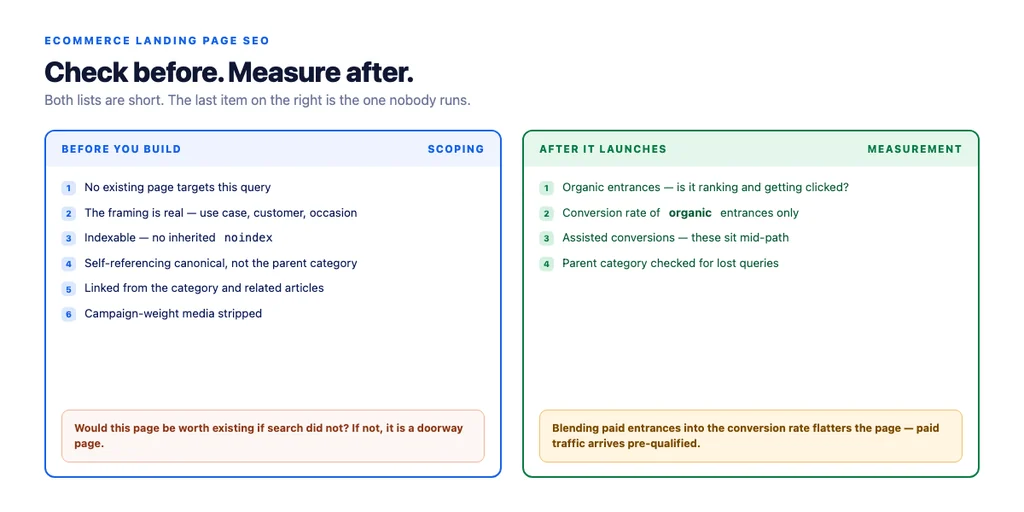
The checklist
- A category, product or article page would not serve this query better
- The framing is real — a use case, customer type or occasion people actually search
- No existing page targets the same query
- Indexable — no inherited
noindex - Self-referencing canonical
- Linked from the parent category and from related content
- Links out to curated products and a relevant guide
- Decision help present, not just a product grid with an intro
- Campaign-weight media stripped for organic performance
ItemListandBreadcrumbListschema- One primary call to action
- Organic conversion rate measured separately from paid
- Parent category checked for lost queries after launch
Sources
- SEO Best Practices for Ecommerce Sites — Google Search Central
- Spam Policies for Google Web Search — Google Search Central
- Consolidate Duplicate URLs with Canonicals — Google Search Central
- Creating Helpful, Reliable, People-First Content — Google Search Central
- Google Search Essentials — Google Search Central
FAQs
Want this run against your store? Book a call with The Reach Bureau.