A list of tool names goes out of date in months, and half of them will have been acquired or repositioned by the time you read it. Categories do not move nearly as fast, and neither do the questions you should ask before paying for anything.
So this is organised by what a tool does, what it structurally cannot do, and how to tell whether the AI in it is doing real work or is a wrapper around a general model you already have access to.
The categories that matter
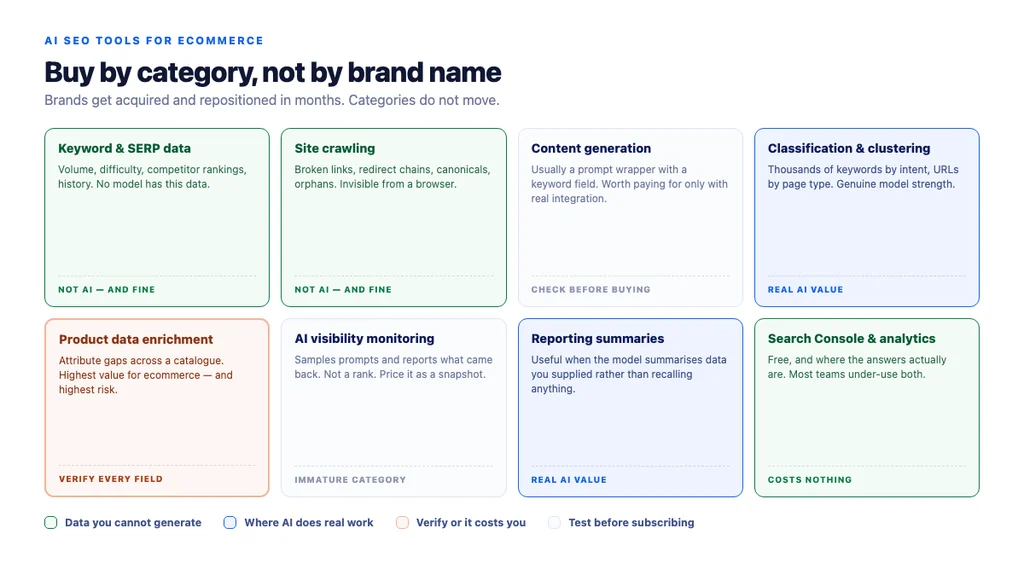
Keyword and SERP data. The data platform — search volume, difficulty, competitor rankings, historical trends. This is a data subscription, not an AI product, and the AI features bolted on top are usually the least valuable part of it. You need one. Which one is largely a budget question.
Site crawling and technical auditing. Crawls the site, finds broken links, redirect chains, missing canonicals, duplicate titles, orphaned pages. Essential on any catalogue above a few hundred URLs, where the problems are invisible from the browser. Again, mostly not AI, and none the worse for it.
Content generation and rewriting. Where general-purpose models do the work. A dedicated "AI SEO writer" is frequently a prompt wrapper with a keyword field, charging a subscription for something you can do directly. Worth paying for only when it adds real integration — pulling your product feed, writing into your CMS, managing a queue with review states.
Bulk classification and clustering. Grouping thousands of keywords by intent, classifying URLs by page type, tagging products by attribute. Genuinely valuable, genuinely tedious by hand, and a real strength of language models.
Product data enrichment. Filling attribute gaps across a catalogue — material, dimensions, compatibility. High value for ecommerce specifically, because attribute completeness is what makes products findable and matchable against constraint-shaped queries. Also the highest-risk category: an invented specification is a returns problem, not just an SEO one.
AI visibility monitoring. Tracking whether assistants mention your brand. New, immature, and worth understanding clearly before buying — see below.
Analytics and reporting. Automated summaries of Search Console and analytics data. Useful when the underlying data is real and the model is summarising rather than inventing.
The question to ask before buying anything
Is the AI doing something a general model cannot?
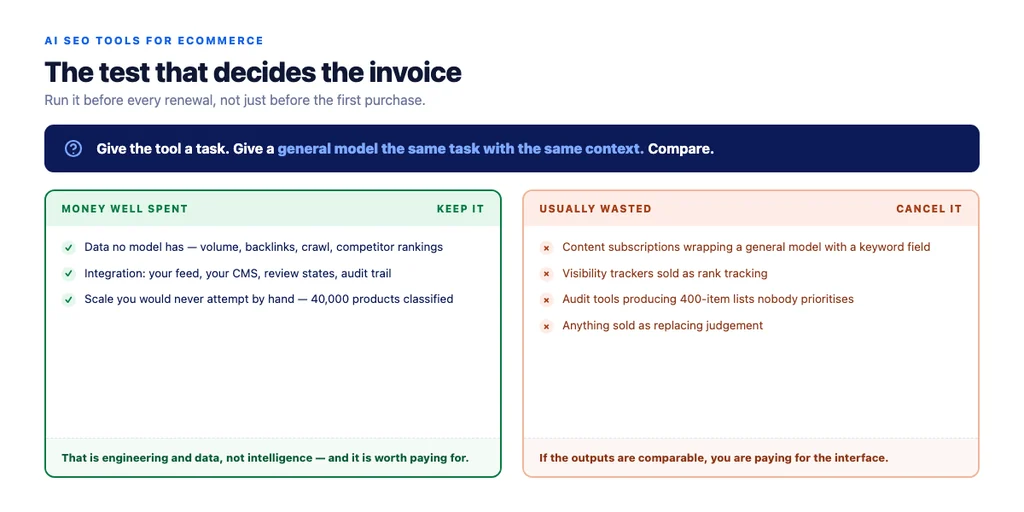
Sometimes yes: it has your product feed, your Search Console data, your crawl, and it operates on them at scale inside a workflow. That integration is the product, and it is worth money.
Sometimes no: it takes a keyword, sends a prompt, returns text. You are paying a subscription for a prompt you could write once.
The test is direct. Give the tool a task, then give the same task to a general model with the same context. If the outputs are comparable, you are paying for the interface.
Where the money is actually well spent
Data you cannot generate. Search volume, backlink indexes, competitor rankings, crawl data. No model has these. This is the least glamorous spend and the most necessary.
Integration and workflow. A tool wired into your catalogue and CMS, with review states and an audit trail, saves real time on a large site. That is engineering, not intelligence, and it is worth paying for.
Scale you would not otherwise attempt. Classifying 40,000 products by attribute is not something anyone was going to do by hand.
Where it is usually wasted
- Content generation subscriptions that wrap a general model with a keyword field.
- AI visibility trackers sold as rank tracking. There is no stable ranking in an assistant answer to track. What these tools do is sample prompts and report what came back — useful directionally, but a sampled snapshot, not a position. Price them accordingly.
- Automated audit tools that only produce lists. A 400-item issue list nobody prioritises has cost you money and changed nothing.
- Anything replacing judgement. Which keyword to target, whether to merge two pages, what to prioritise this quarter — these need context about your business that no tool has.
The verification each category needs
| Category | What to verify |
|---|---|
| Keyword and SERP data | Spot-check figures against a second source |
| Technical crawling | Confirm a sample of flagged issues actually exist |
| Content generation | Every fact, every source URL, before publishing |
| Classification | Read 10 groupings at random for sense |
| Product enrichment | Check against manufacturer data — always |
| AI visibility | Run the prompts manually yourself |
| Reporting summaries | Reconcile the numbers against the source export |
The product enrichment row is the one that matters most for ecommerce. An invented dimension or compatibility claim reaches a customer, becomes a return, and costs more than the tool saved.
A sensible stack
For most ecommerce teams:
1. One keyword and SERP data platform. Non-negotiable, and the one place to spend properly. 2. One crawler. Run it monthly, act on the top five issue types, ignore the long tail. 3. A general-purpose AI assistant. For clustering, classification, drafting and analysis. Covers most of what dedicated content tools sell. 4. Search Console and analytics. Free, and where the answers actually are. 5. Manual assistant spot-checks. A list of twenty prompts relevant to your category, run monthly by a human. Costs nothing and beats most visibility tools.
Add specialist tools only where you have a specific, recurring problem the stack above does not solve. Most teams do the opposite — buy the specialist tools first, then discover the crawler was the thing that mattered.
The checklist
- One keyword and SERP data platform, paid for properly
- One crawler, run on a schedule
- Every AI tool tested against a general model with the same context
- No subscription paid for a prompt you could write once
- Product enrichment output verified against manufacturer data
- Generated facts and source URLs verified before publishing
- Classification output spot-checked, ten items at random
- Reporting summaries reconciled against the source export
- AI visibility claims understood as sampled, not ranked
- Manual prompt spot-checks scheduled monthly
- Crawl issue lists prioritised, not just generated
- Judgement calls kept with a human
Sources
- SEO Best Practices for Ecommerce Sites — Google Search Central
- Google Search and AI-Generated Content — Google Search Central Blog
- Creating Helpful, Reliable, People-First Content — Google Search Central
- Intro to Product Structured Data on Google — Google Search Central
- Google Search Essentials — Google Search Central
Frequently Asked Questions
Want this run against your store? Book a call with The Reach Bureau.