Conversion copy fails for a specific reason: it does not answer the objection standing between the reader and the purchase. A language model does not know your objections. It knows how conversion copy sounds.
That distinction sets the boundary. A model can produce something that reads like good copy immediately. Producing copy that converts requires inputs only you have — and once you supply them, the model becomes genuinely useful.
What only you can supply
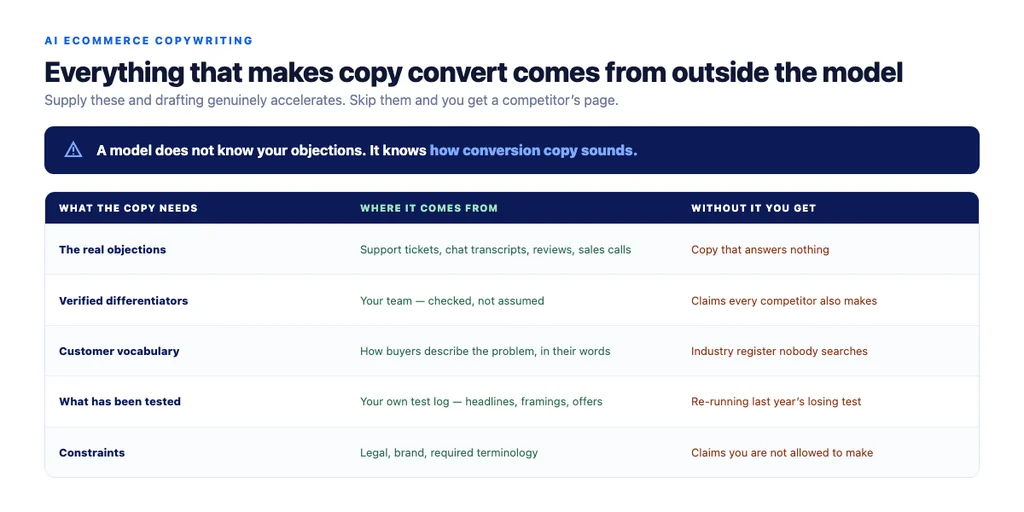
Everything that makes copy convert comes from outside the model.
- The actual objections. From support tickets, chat transcripts, reviews, sales calls. What stops people buying, in their own words.
- The real differentiators. What you do that competitors do not — verified, not assumed.
- Customer vocabulary. How buyers describe the problem, which is rarely how the industry describes it.
- What has already been tested. Which headlines, framings and offers have been tried, and what happened.
- Constraints. Legal claims you cannot make, terms you must use, tone the brand requires.
Give a model none of this and you get competent, generic copy that could sit on any competitor's site. Give it all of it and the drafting genuinely accelerates.
Where it genuinely helps
Variations for testing. Twenty headline options in a minute. You pick three worth testing. This is the strongest use — models are good at variation and bad at judging which variation wins.
Structural first drafts. Given the objection list and the differentiators, a draft that covers all of them in a sensible order. Faster than a blank page, and it rarely forgets an input you supplied.
Rewriting for a different reader. The same product page for a technical buyer and a first-time buyer. Mechanical transformation with a checkable result.
Turning specifications into benefits — with care. "IPX7 rated" becomes "survives being dropped in a sink". Useful, and the exact place fabrication creeps in, so every claim needs checking against the spec sheet.
Consistency at scale. Applying an agreed tone and structure across 300 category descriptions after you have written and approved the pattern on five.
Objection-handling passes. Give it the objection list and ask what the draft fails to address. Good at this, because it is a checking task rather than a knowledge task.
Where it costs you conversions
Superlatives instead of specifics. Models default to "premium quality", "cutting-edge", "unmatched". These are the words shoppers skip. Specifics convert; adjectives do not.
Invented benefits. A claimed feature that does not exist reaches a customer, becomes a return and possibly a complaint. This is the highest-cost failure and it looks exactly like good copy.
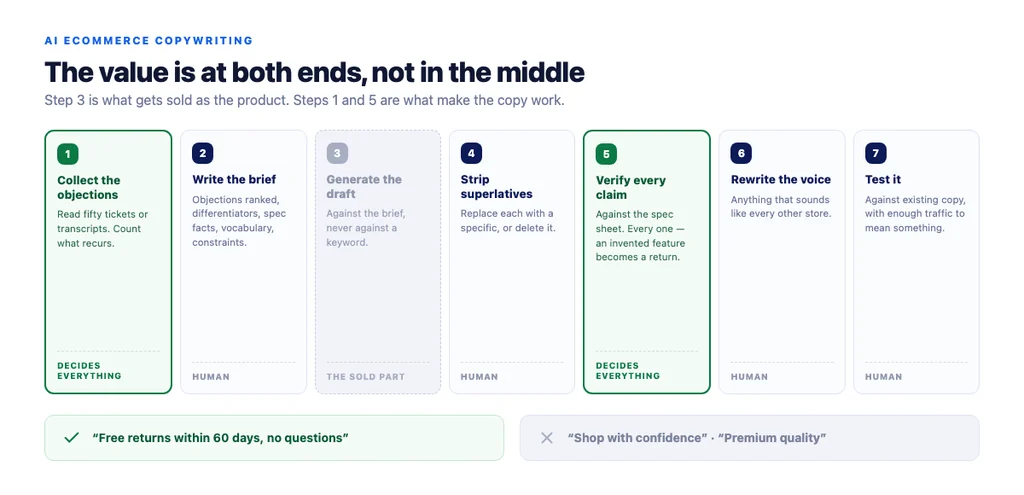
Generic reassurance. "Shop with confidence" instead of "free returns within 60 days, no questions". One is filler; the other is the objection answered.
The same voice as everyone else. Trained on the same web, models converge on the same register. If your differentiator is how you talk, unedited output erases it.
Filler that lengthens without adding. Copy that repeats the framing three ways for length is worse for conversion and does nothing for search either.
A workflow that produces copy that converts
1. Collect the objections first. Read fifty support tickets or chat transcripts. Count what recurs. This step, not the drafting, decides whether the copy works. 2. Write the brief — objections in priority order, differentiators, the specification facts, customer vocabulary, constraints, what has already been tested. 3. Generate the draft against the brief, not against a keyword. 4. Strip every superlative. Replace each with a specific, or delete it. 5. Verify every factual claim against the spec sheet. Every one. 6. Read it in your brand's voice and rewrite what sounds like everyone else. 7. Check the objection list is addressed in priority order. 8. Test it against the existing copy, with enough traffic to mean something.
Steps 1 and 5 are where the value is. Step 3 is the part that gets sold as the product.
Conversion copy and search, together
The two goals conflict less than people assume, but not never.
They agree on: specifics over adjectives, answering real questions, clear structure, covering the objection a searcher arrived with.
They conflict on: length. Search sometimes rewards depth; a product page converts better when it is scannable. Resolve it with structure — a scannable top section and depth below — rather than by compromising both.
Where AI helps both: attribute completeness. Filling in material, dimensions, compatibility and use cases across a catalogue serves the shopper deciding and the assistant matching a constraint-shaped query. It is also the highest-risk task, so verify every enriched field against manufacturer data.
The checklist
- Objections collected from real tickets, transcripts or reviews
- Differentiators verified, not assumed
- Customer vocabulary captured in their words
- Brief written before any generation
- Draft generated against the brief, not a keyword
- Every superlative replaced with a specific or deleted
- Every factual claim checked against the spec sheet
- Voice rewritten where it sounds like everyone else
- Objections addressed in priority order
- Generic reassurance replaced with concrete terms
- Scannable top, depth below — not a compromise of both
- Tested against existing copy with meaningful traffic
Sources
- Google Search and AI-Generated Content — Google Search Central Blog
- Creating Helpful, Reliable, People-First Content — Google Search Central
- SEO Best Practices for Ecommerce Sites — Google Search Central
- Intro to Product Structured Data on Google — Google Search Central
- Google Search Essentials — Google Search Central
FAQs
Want this run against your store? Book a call with The Reach Bureau.