There are two different questions people mean by "AI and SEO", and conflating them wastes a lot of effort.
One is optimising *for* AI search — getting your products into assistant answers. The other is using AI *to do* SEO work: research, drafting, auditing, analysis. This article is entirely about the second.
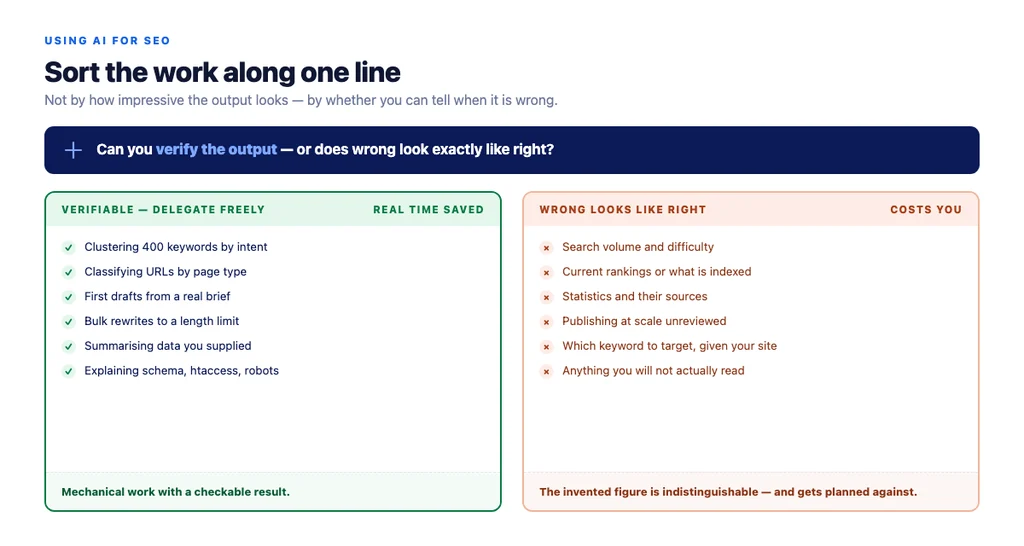
The short version: AI is excellent at tasks with a verifiable output and dangerous at tasks where wrong looks the same as right. Sorting your workflow along that line is the whole skill.
Where it saves real time
Clustering and classification. Give a model 400 keywords and ask it to group by intent, or 200 URLs and ask it to classify by page type. Tedious, mechanical, and reliably done. This is the highest-value use and the least discussed.
First drafts from a real brief. Not "write an article about X" — a draft from a brief containing the target query, heading structure, the facts to include, and the sources. The model assembles; you verify and rewrite. Saves the blank-page problem, not the thinking.
Bulk transformation. Turning a spec table into readable prose, rewriting 200 meta descriptions to a length limit, converting a list into structured data. Mechanical work with a checkable result.
Summarising your own data. Feed it a Search Console export and ask which pages gained and lost queries. It is reading data you supplied, so it cannot invent the underlying numbers.
Explaining code and configuration. Reading a .htaccess file, a schema block, or a robots directive and explaining what it does. Fast, and easy to verify.
Generating variations. Fifty title options, twenty ways to phrase a benefit. You pick; it produces raw material.
Where it costs you
Anything requiring live data. Search volume, difficulty, current rankings, what is in the index today. A model will answer confidently and be making it up. This is the single most expensive misuse because the invented number gets planned against.
Facts and statistics. "Studies show 73% of shoppers…" — check every one. The failure mode is a plausible statistic attributed to a real-sounding source that never published it.
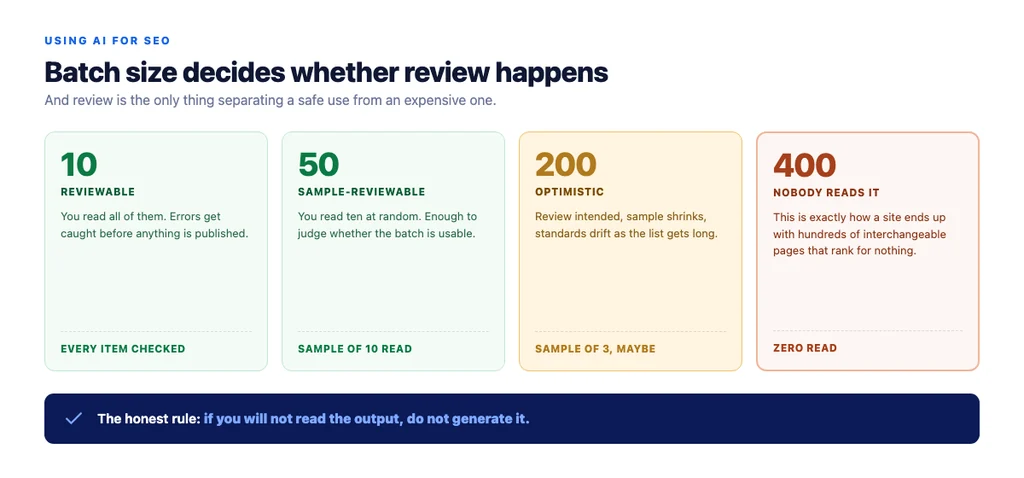
Publishing at scale without review. Generating 400 category descriptions from category names produces 400 interchangeable pages. Nothing is penalised; nothing ranks either.
Strategic judgement. Which of two keywords to target given your domain's strength, whether to merge or keep two pages, what to prioritise this quarter. These need context about your business that the model does not have.
Anything you will not check. The honest rule: if you will not read the output, do not generate it.
The review step is the whole thing
Every safe use of AI in SEO has a verification step attached. Every unsafe one skips it.
| Task | The verification |
|---|---|
| Keyword clustering | Spot-check 10 groupings for sense |
| Draft article | Verify every fact and every source URL resolves |
| Bulk meta descriptions | Check length limits and read a sample of 20 |
| Category descriptions | Read 10 at random; can you swap two without noticing? |
| Data summary | Confirm the numbers against the source export |
| Schema generation | Validate it and check what the crawler receives |
| Anything with a statistic | Find the primary source, or remove the claim |
That last row is the one that matters most. A fabricated statistic on a client site is a credibility problem that outlives whatever ranking it was meant to help.
A workflow that works
1. Decide what you are asking for — a mechanical transformation, or a judgement. Only the first is safe to delegate fully. 2. Give real context. Product details, your Search Console data, the brief, the constraints. Output quality tracks input quality almost linearly. 3. Ask it not to estimate anything it cannot know. Otherwise it will fill gaps with plausible numbers. 4. Generate in batches you can actually review. Ten is reviewable; four hundred is not. 5. Verify against the table above before anything is published. 6. Keep the human on strategy. Which pages to fix, which terms to chase, what to prioritise — those need business context.
The honest accounting
AI in SEO work saves time on the parts that were always mechanical: clustering, transformation, first drafts, summarising your own data. That is a genuine and meaningful gain, and teams that use it well move faster.
It does not save time on the parts that were always the work: deciding what to target, judging whether a page is good enough, verifying claims, and knowing your own business. Those still take exactly as long as they did.
Anyone selling the second as automatable is selling the failure mode.
The checklist
- Task classified: mechanical transformation or judgement
- Real context supplied — data, brief, constraints
- Model told explicitly not to estimate what it cannot know
- No search volume or difficulty figures taken from a model
- Every statistic traced to a primary source, or removed
- Every source URL in a draft opened and confirmed live
- Generation done in batches small enough to review
- Sample of every batch actually read before publishing
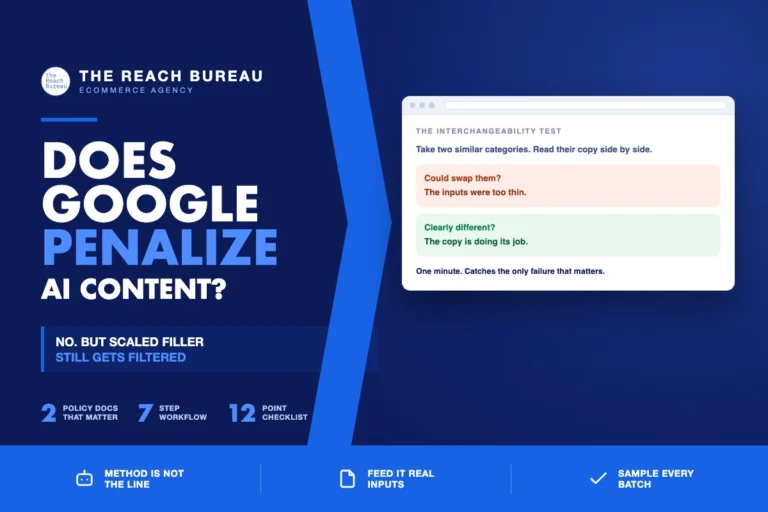
- Interchangeability test run on bulk-generated pages
- Generated schema validated and checked as the crawler receives it
- Data summaries confirmed against the source export
- Strategy and prioritisation kept with a human
Sources
- Google Search and AI-Generated Content — Google Search Central Blog
- Spam Policies for Google Web Search — Google Search Central
- Creating Helpful, Reliable, People-First Content — Google Search Central
- Google Search Essentials — Google Search Central
- SEO Best Practices for Ecommerce Sites — Google Search Central
Frequently Asked Questions
Want this run against your store? Book a call with The Reach Bureau.