Most of what is written about AI search optimization is traditional SEO with the vocabulary swapped, and a smaller amount is genuinely new. Separating the two is the whole value of this article, because the new part is short and the recycled part is enormous.
Here is the honest summary: the way people search changed, the shape of the answer changed, and the technical prerequisites changed slightly. What did not change is that specific, well-structured, accessible pages win — which is the same thing that has always been true, now with a different failure mode when you get it wrong.
What genuinely changed
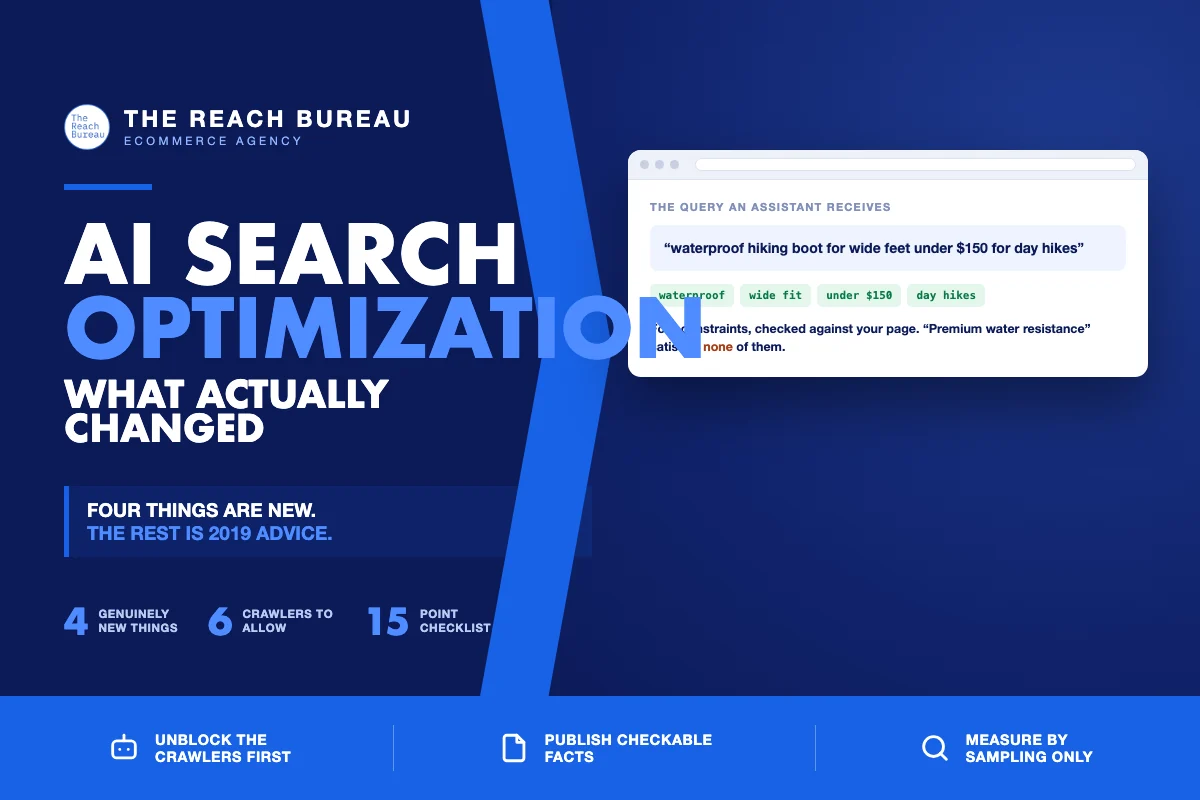
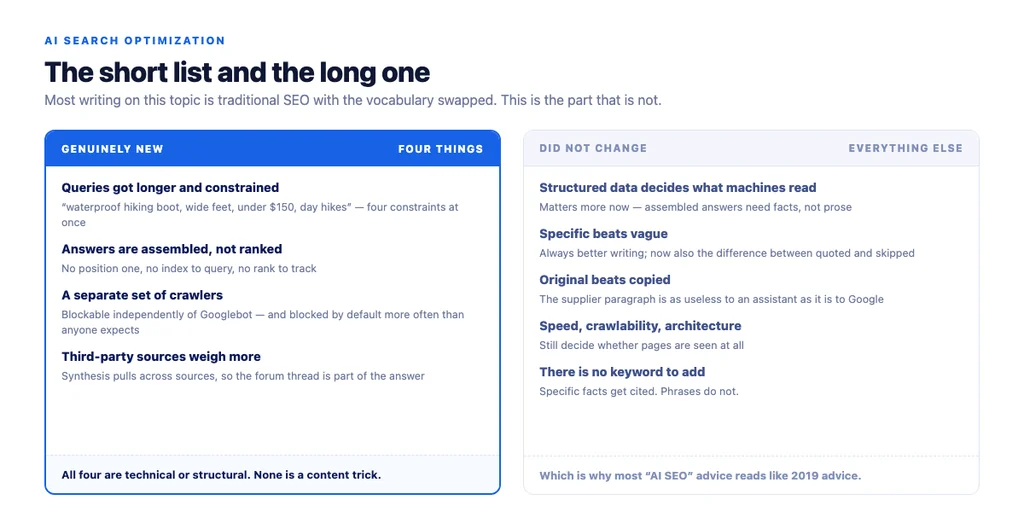
Queries got longer and more constrained. People type "waterproof hiking boot for wide feet under $150 for day hikes" into an assistant because it can handle that. Nobody typed it into a search box. This changes which pages can satisfy a query — a page has to hold facts that satisfy four constraints simultaneously.
The answer is assembled, not ranked. There is no position one. An assistant retrieves pages and synthesises from what they say, which means "visibility" is the probability of being retrieved and then being useful in synthesis. There is no index you can query and no rank to track.
A new class of technical blocker exists. AI crawlers are separate from Googlebot. GPTBot, OAI-SearchBot, ChatGPT-User, ClaudeBot, PerplexityBot and Google-Extended each need to reach your pages, and CDN bot-management rules block them by default surprisingly often — invisibly from robots.txt.
Third-party sources carry more weight. Synthesis pulls across sources, so the forum thread, review roundup and comparison article discussing your category are part of the answer whether you like it or not.
What did not change
Structured data still decides what machines can read. If anything it matters more, because assembled answers need facts rather than prose. Per Google's Product structured data documentation, Product and Offer carry price and availability — and it should sit in the initial HTML, since several AI crawlers do not execute JavaScript.
Specific beats vague. "IPX7, tested at one metre for thirty minutes" is usable in a comparison; "premium water resistance" is not. This was always better writing; now it is also the difference between being quoted and being skipped.
Original content still beats copied content. The manufacturer's paragraph is as useless to an assistant as it is to Google, for the same reason: it is not distinctive enough to prefer.
Site speed, crawlability and clean architecture still determine whether your pages are seen at all.
There is no keyword you can add. Nothing you write makes a page "AI-optimised" in the way a keyword once made a page relevant. Specific facts get cited; phrases do not.
The work, in priority order
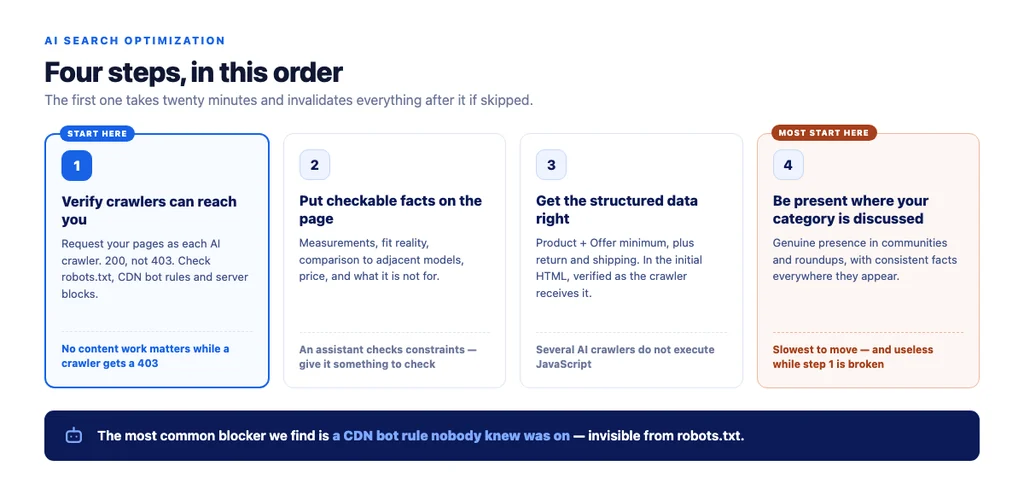
1. Verify AI crawlers can reach you
The highest-value check on this page and the one almost nobody runs. Request your own pages with each crawler's user agent and confirm a 200 rather than a 403.
Check three places, not one: robots.txt, your CDN or WAF bot rules, and any server-level blocks left over from a scraping incident. The CDN is where most accidental blocks hide.
Then decide deliberately. Allowing retrieval also allows training use — that is a genuine business decision. But it should be a decision, not a default nobody chose.
2. Make product pages hold checkable facts
An assistant evaluating "waterproof, wide fit, under $150, day hikes" is checking constraints against your page. Give it something to check:
- Measurements, weight, dimensions, tested conditions
- The fit and sizing reality, including how it runs
- Explicit comparison to the adjacent model in your own range
- Price and availability, in text and in markup
- What the product is *not* for
3. Get the structured data right
Product and Offer at minimum. Return and shipping markup answer the two objections that most often stop a purchase and are the most commonly skipped. Everything in the initial HTML, verified as the crawler receives it.
4. Be present where your category is discussed
Not link buying — genuine presence. Answering questions in the communities that cover your products, being included in independent roundups, keeping your factual claims consistent everywhere they appear. Contradictions between your site, your marketplace listings and your feed get dropped rather than reconciled.
Measuring it honestly
There is no Search Console for assistants, and any vendor offering a precise share-of-voice figure is selling an estimate produced by sampling.
What actually works:
- Prompt testing. 15–25 realistic buying questions, run monthly, recording whether you appear and which sources got cited. The cited-source list is the most actionable output.
- Referral traffic from
chatgpt.com,perplexity.aiand similar. Small volumes, high intent. - Server logs confirming the AI crawlers are fetching, and which pages.
- Brand mention tracking across the sources assistants tend to cite.
Treat all of it as directional. The useful question is "did we appear at all, and did that change after we fixed the crawler block" — not "what is our score."
What to ignore
- AI-optimised content packages. There is no phrase that makes a page citable.
- Separate landing pages for AI. A page written for models rather than people is a thin page with extra steps.
- Per-platform tactics. Crawler access, structured data and specific copy serve all assistants. There is no ChatGPT-specific trick worth the effort.
- Precise visibility scores. The measurement is genuinely immature; directional is the honest ceiling.
The checklist
- All six AI crawlers tested with real user-agent requests
robots.txt, CDN/WAF rules and server-level blocks all checked- Allow-or-block decided deliberately rather than by default
- Product pages carry measurements and tested conditions
- Fit and sizing reality stated
- Explicit comparison to adjacent models
- What the product is not for, stated
Product+Offermarkup in the initial HTML- Return and shipping markup implemented
- Facts consistent across site, feed and marketplace listings
- Genuine presence in the communities covering your category
- 15–25 prompt tests written and run monthly
- Cited-source list reviewed, not just whether you appeared
- Analytics checked for AI referral sources
- Server logs confirm AI crawler activity
Sources
- Intro to Product Structured Data on Google — Google Search Central
- How To Add Merchant Listing Structured Data — Google Search Central
- Merchant Return Policy Structured Data — Google Search Central
- Creating Helpful, Reliable, People-First Content — Google Search Central
- SEO Best Practices for Ecommerce Sites — Google Search Central
- Google Search and AI-Generated Content — Google Search Central Blog
Frequently Asked Questions
Want this run against your store? Book a call with The Reach Bureau.