# Does SEO Still Matter With AI? What Changed and What Did Not
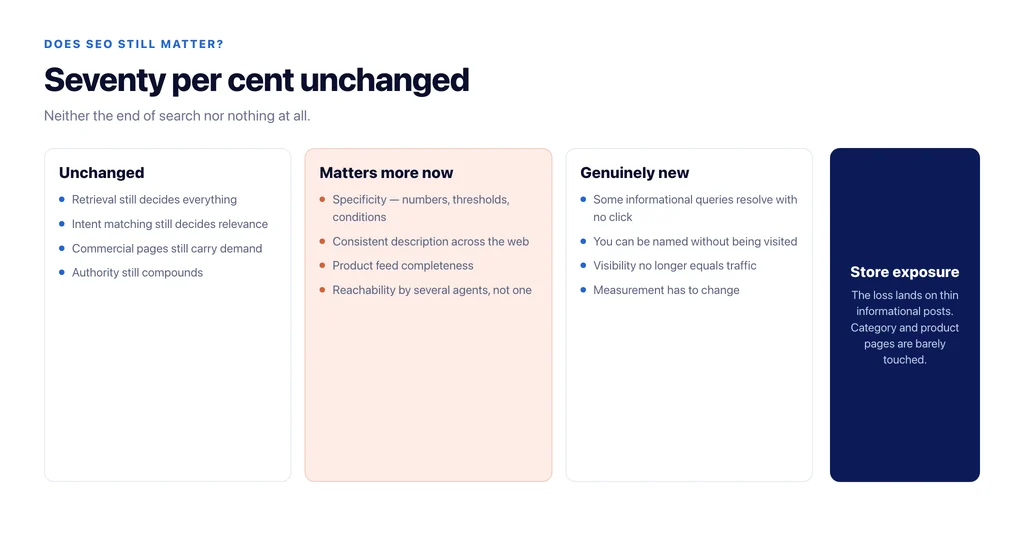
The question is usually asked as a yes or no, and the honest answer is that about seventy per cent of the work is unchanged, about twenty per cent matters more than it did, and about ten per cent is genuinely new. Nothing about that is dramatic, which is why it gets written up as either the end of search or a nothingburger.
Here is the split, for a store rather than for a publisher, because the two have very different exposure.
What did not change
Retrieval still decides everything. Whether a page can be fetched, read and indexed governs both classic results and AI answers. A page blocked at the CDN is invisible to both. The technical foundations are the same foundations.
Intent matching still decides relevance. A page that answers a different question than the one asked loses in both systems. The work of aligning page type to query has not moved an inch.
Commercial pages still carry commercial demand. Category and product pages remain where transactional queries land, and they remain the pages worth investing in first.
Authority still compounds. Being referenced by sources that discuss your category feeds both classic rankings and AI selection. The mechanism differs; the input is the same.
What matters more than it did
Specificity. Vague copy always underperformed. Now it also fails to be quotable, because a summariser needs a statement it can lift. Numbers, thresholds and conditions have gone from good practice to the deciding factor in whether you appear.
Consistency of description. How your brand is described across other sites has always mattered a little. It now matters considerably, because it determines whether a system holds you as a distinct thing or as an ambiguous string.
Product data quality. Feed completeness and feed-page agreement were a shopping-channel concern. They are now the gate for a whole class of AI commercial results.
Being reachable by more agents. One crawler became several, each with its own rules, and the failure mode is silent.
What is genuinely new
Two things.
The first is that a share of informational queries now resolve without a click. For a store, this hits the top of the funnel — the definitional and how-does-it-work content — and barely touches the pages where people buy. If your traffic model depended on informational posts monetised by display, that is a real loss. If it depended on category and product pages, the exposure is small.
The second is that you can be named without being visited. A brand can be recommended in an answer where the citation goes elsewhere, or nowhere. That breaks the assumption that visibility equals traffic, and it means measurement has to change even where the work does not.
What to do differently, concretely
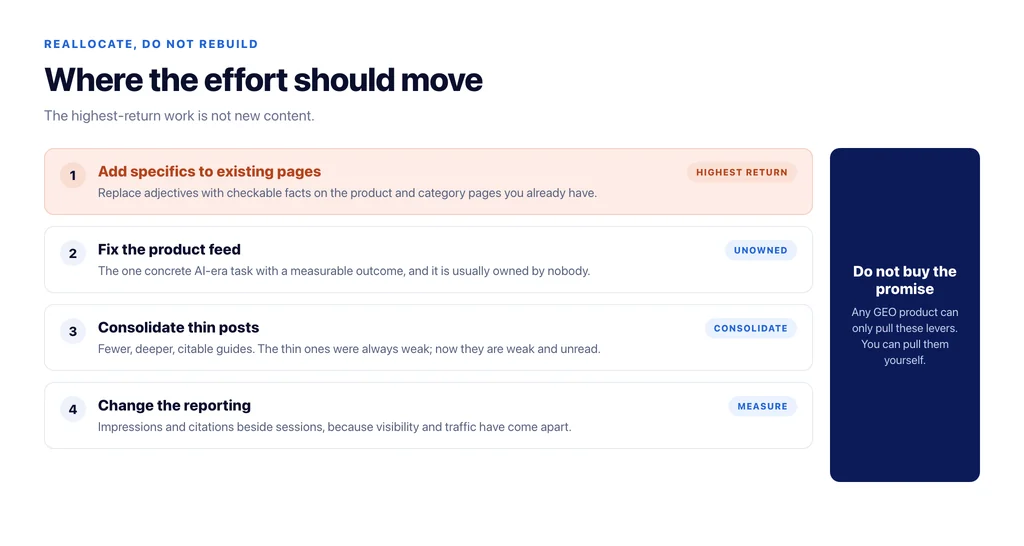
Reallocate, do not rebuild. Move effort from thin informational posts toward the commercial pages and the small number of deep guides that get cited. The thin posts were always weak; they are now weak and unread.
Add specifics to what you already have. The highest-return work on most stores is not new content, it is putting checkable facts into existing product and category pages that currently carry adjectives.
Fix the feed. For a store, this is the single most concrete AI-era task with a measurable outcome, and it is usually owned by nobody.
Change what you report. Add impressions and citation appearances to the traffic numbers, and expect the relationship between visibility and sessions to loosen. We set out how to measure it in how to get cited by AI.
What not to do
Do not delete content because traffic dipped; check whether it was informational traffic and whether the page still supports a commercial page through internal links.
Do not buy a GEO product that promises rankings in assistants. The levers it can pull are the ones described above, and you can pull them yourself.
Do not publish more to compensate. Volume was never the mechanism and it is now actively counterproductive when the additions have nothing checkable in them.
What this means for the next twelve months of work
Two practical consequences, and they pull in opposite directions from the usual advice.
Content volume should probably fall. Most stores are publishing more than they can maintain, and maintenance now matters more because an outdated specific claim is worse than a vague one — it fails visibly, in an answer, to somebody who trusted it. Fewer pages, each owned, each dated, each carrying facts you can defend.
Data work should probably rise, and it does not look like marketing. Feed completeness, identifier coverage, price and availability parity, crawler access at the edge, structured data that matches the rendered page. This is the part nobody wants to own because it sits between the developer, the merchandiser and the marketer, and it is where the measurable movement is for a store.
If the budget has to come from somewhere, it comes from the content calendar. That trade is uncomfortable and it is usually correct.
The checklist
- Verify every relevant crawler gets a 200 at the edge.
- Audit commercial pages for checkable facts, and add them where copy is currently adjectives.
- Complete the product feed and reconcile it against the pages continuously.
- Standardise how the brand is described everywhere you control.
- Consolidate thin informational posts into fewer, deeper, citable guides.
- Report impressions and citations alongside sessions.
- Keep doing the technical and intent work that was already correct.
Sources
- Creating helpful, reliable, people-first content — Google Search Central
- Introduction to robots.txt — Google Search Central
- Merchant listing structured data — Google Search Central
- SEO best practices for ecommerce sites — Google Search Central
Frequently Asked Questions
Want this run against your store? Book a call with The Reach Bureau.