There is no ranking in ChatGPT, and that is the first thing worth getting straight.
There is no position one, no blue link list, and no algorithm you can reverse-engineer into a checklist. What exists is a retrieval step — the assistant fetches pages relevant to the question — and a synthesis step, where it assembles an answer from what those pages actually say. "Ranking" means being retrievable in step one and quotable in step two.
That distinction is not pedantry. It changes what you work on. Most of the advice circulating about AI search is traditional SEO with the terminology swapped. The parts that genuinely differ are narrow, technical, and mostly unglamorous — and they are the parts that decide whether your products appear at all.
Step zero: check the crawlers can reach you
This is the failure we find most often, and stores are almost never aware of it.
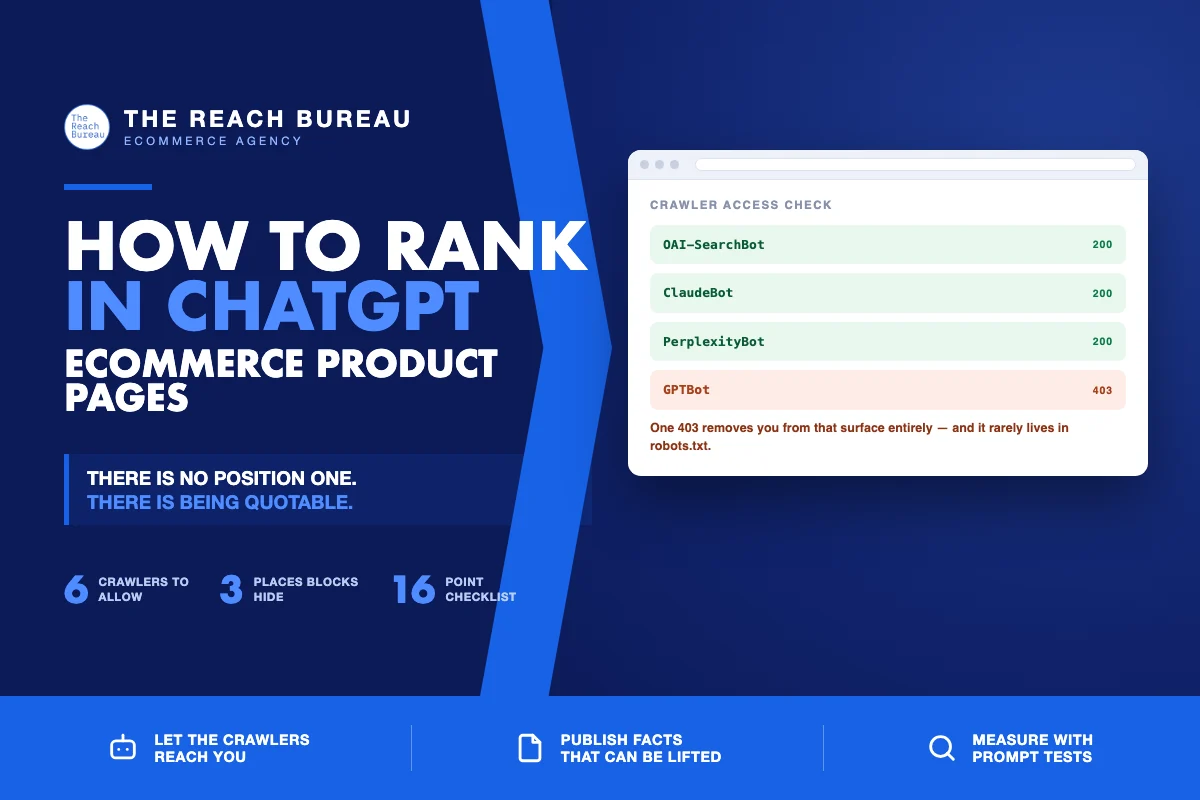
AI search engines use their own crawlers. If those crawlers are blocked, no amount of content work matters — you are not in the retrieval set, and there is nothing to synthesize from.
| Crawler | Who it serves |
|---|---|
GPTBot | OpenAI — training and retrieval |
OAI-SearchBot | ChatGPT search results |
ChatGPT-User | Live page fetches during a conversation |
ClaudeBot | Anthropic |
PerplexityBot | Perplexity |
Google-Extended | Google's AI surfaces |
Blocks happen in three places, and robots.txt is only one of them:
1. robots.txt — check for a Disallow under any of the agents above. 2. The CDN or WAF. Cloudflare and similar services ship bot-management rules that catch AI crawlers under a generic "bots" category. This is the most common cause, and it is invisible from robots.txt. 3. Server-level rules — a stray .htaccess or nginx block added during a scraping incident and never removed.
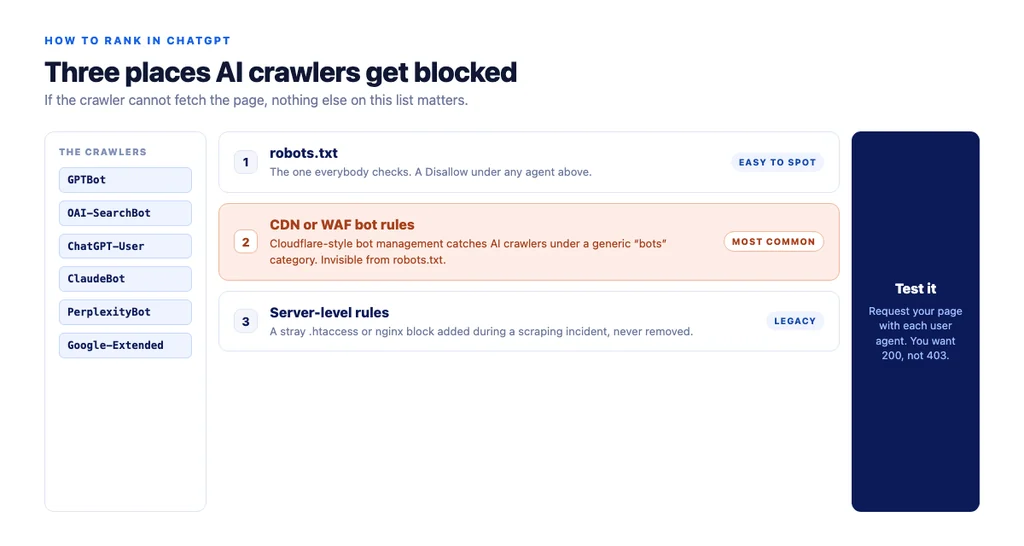
Test it directly rather than assuming. Request your own page with each crawler's user agent and confirm you get a 200, not a 403. It takes two minutes and it is the highest-value check on this page.
The decision to allow them is a real one — allowing retrieval also means allowing training use. But it should be a decision, not an accident, and most stores discover they were blocking by default.
Why some pages get quoted and others do not
Once you are retrievable, being useful in synthesis comes down to a single property: does the page contain facts that can be lifted into an answer?
Consider the query an assistant actually receives. Not "hiking boots" but "waterproof hiking boot for wide feet under $150 that works for day hikes." The model needs to check four constraints against a page. A page that says "premium construction and superior comfort for the modern adventurer" fails every check — not because it is badly written, but because there is nothing in it to check.
A page that says "IPX7 waterproof, available in 2E and 4E widths, $139, 480 g per boot" answers all four.
This is the whole mechanism, and it explains why the winners in AI search are frequently not the biggest brands. Specificity beats authority in synthesis, because synthesis is a matching problem before it is a trust problem.
What makes a page quotable:
- Numbers and measurements — weight, dimensions, capacity, tested conditions, price.
- Explicit comparisons — how this model differs from the one above and below it in your range.
- Constraint language — the qualifiers people search with: "wide fit," "for sensitive skin," "under $150," "quiet."
- Direct answers to direct questions — a Q&A block where the answer is a sentence, not a paragraph of throat-clearing.
- Honest limits — "not suitable for hardwood" is exactly the kind of statement a comparison needs.
Structured data does the same job for machines
Everything above is text a model reads. Structured data is the same information in a form it does not have to interpret.
Per Google's Product structured data documentation, Product and Offer markup carry price, currency and availability. Return policy and shipping policy markup carry the two facts that most often decide a purchase and are hardest to extract from prose.
One implementation detail matters more here than anywhere else: put the markup in the initial HTML. Google's merchant listing guidance states that dynamically generated markup makes shopping crawls less frequent and less reliable. Crawlers that do not execute JavaScript see nothing at all — and several AI crawlers fall into that category.
If your store is headless or heavily JavaScript-driven, verify what the crawler receives rather than what the browser renders. This single check invalidates a surprising amount of otherwise correct schema work.
Where third-party mentions fit
Assistants synthesize across sources, and product recommendations frequently pull from places that are not your site: forums, review roundups, community discussions, comparison articles.
This is not a reason to buy links. It is a reason to be genuinely present where your category is discussed — answering questions in the communities that cover your products, being included in independent roundups, having a Wikipedia-grade factual footprint if your brand is large enough to warrant one.
The practical version for a small store is narrower: make sure the factual claims about your products are consistent everywhere they appear. Conflicting prices, specs, or availability across your site, your marketplace listings and your feed give a model contradictory inputs, and contradictions get dropped from answers.
Measuring something that has no rank tracker
This is the honest part. There is no Search Console for ChatGPT, and anyone selling you a definitive "AI rank tracking" number is selling you an estimate.
What you can actually do:
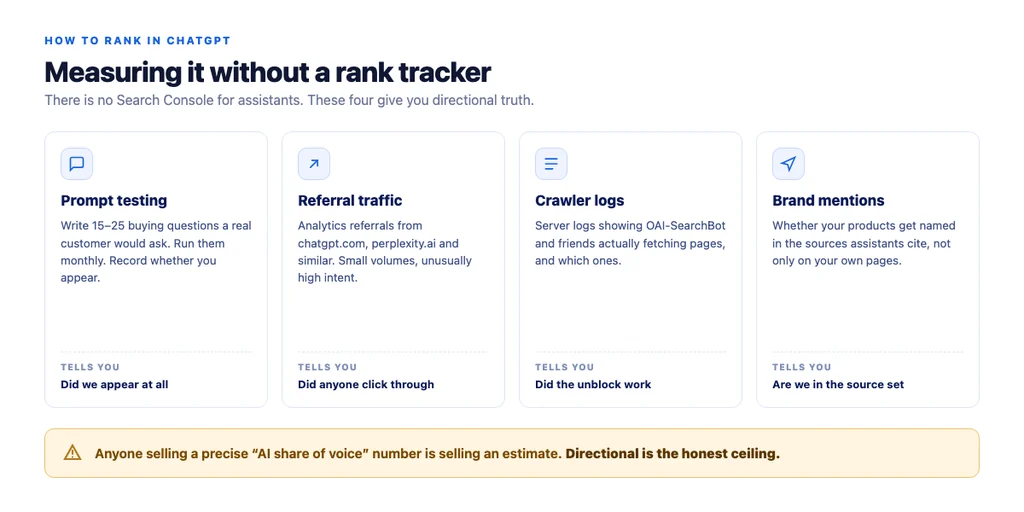
- Prompt testing. Write 15–25 buying questions a real customer would ask, run them monthly against the assistants that matter to you, and record whether your brand or product appears. It is manual and it is a real signal.
- Referral traffic. Check analytics for referrals from
chatgpt.com,perplexity.aiand similar. The volumes are small but the intent is unusually high. - Crawler logs. Server logs tell you whether
OAI-SearchBotand friends are actually fetching your pages, and which ones. This confirms step zero worked. - Brand mention tracking. Watch whether your products get named in the sources assistants cite, not only on your own pages.
Treat these as directional. The useful question is not "what position are we" but "did we appear at all, and did that change after we fixed the crawler block."
What not to spend time on
- Stuffing "AI-optimized" content. There is no keyword that makes a page more citable. Specific facts do.
- Separate AI landing pages. A page written for models rather than people is a thin page with extra steps.
- Chasing every new assistant. The technical work — crawler access, structured data, specific copy — serves all of them. There is no per-platform tactic worth the effort.
- Believing precise share-of-voice numbers. The measurement is genuinely immature. Directional is the honest ceiling right now.
The checklist
robots.txtchecked for GPTBot, OAI-SearchBot, ChatGPT-User, ClaudeBot, PerplexityBot, Google-Extended- CDN or WAF bot rules checked — the most common hidden block
- Server-level rules checked for legacy blocks
- Each crawler user agent tested against a live page, confirming 200 not 403
- Allow-or-block decided deliberately, not by default
- Product pages carry numbers, measurements and tested conditions
- Differences from adjacent models stated explicitly
- Constraint language included: fit, price band, use case
- Q&A answers written as direct sentences
- Honest limits published
Product+Offermarkup present in the initial HTML- Return and shipping markup implemented
- Facts consistent across site, marketplaces and feeds
- 15–25 prompt tests written and run monthly
- Analytics checked for AI referral sources
- Server logs checked for AI crawler activity
Sources
- Intro to Product Structured Data on Google — Google Search Central
- How To Add Merchant Listing Structured Data — Google Search Central
- Merchant Return Policy Structured Data — Google Search Central
- Merchant Shipping Policy Structured Data — Google Search Central
- Creating Helpful, Reliable, People-First Content — Google Search Central
- SEO Best Practices for Ecommerce Sites — Google Search Central
FAQs
Want this run against your store? Book a call with The Reach Bureau.