The GEO tooling market got ahead of the thing it measures.
A category of software now promises to track your visibility inside ChatGPT, Perplexity and AI Overviews, report a share-of-voice percentage, and tell you which prompts to optimise for. Some of it is genuinely useful. Some of it is a dashboard around a number nobody can verify.
This is a category-by-category look at what these tools actually do, which parts are measurement and which are estimation, and what you can run yourself before spending anything. Written for ecommerce, where the stakes are product recommendations rather than blog citations.
First, what there is to measure
Worth being precise, because the vagueness is where the marketing lives.
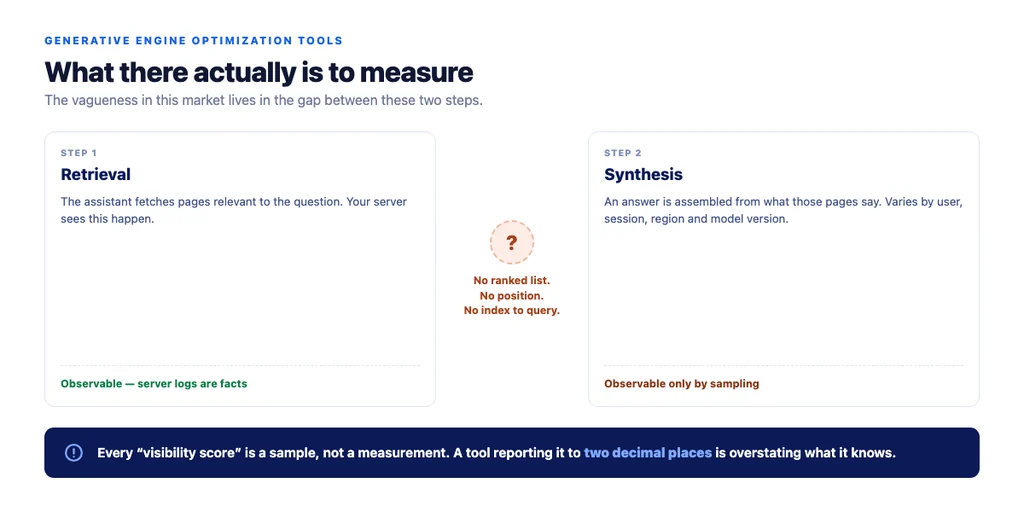
Assistants work in two steps. Retrieval — fetching pages relevant to the question. Synthesis — assembling an answer from what those pages say. There is no ranked list in between, no position, and no index you can query.
So "visibility" in an assistant is not a rank. It is the probability that your page enters the retrieval set and gets used in synthesis, for a given phrasing, at a given moment, for a given user. Every tool in this market is estimating that by sampling — asking the assistant things and recording what comes back.
That is a legitimate method. It is not the same as Search Console data, and any tool presenting it with two decimal places is overstating what it knows.
The five categories of tool
1. Prompt tracking and answer monitoring
What it does. Runs a set of prompts against assistants on a schedule and records whether you appear, in what position within the answer, and which sources were cited.
What it genuinely gives you. Trend over time, and — the most useful output — the list of domains being cited for your category. That tells you where to be present.
Where it estimates. Answers vary by user, session, region and model version. A tool sampling once a day from one location is one sample, not the truth.
Worth it when you have a category worth monitoring and want the trend without running prompts manually.
2. Crawler access and log analysis
What it does. Confirms whether GPTBot, OAI-SearchBot, ClaudeBot, PerplexityBot and Google-Extended can reach your pages, and which pages they fetch.
What it genuinely gives you. This is real measurement, not estimation — server logs are facts.
Worth it when you have not already checked. Honestly, most stores discover a block here and the check costs nothing to run yourself.
3. Content structuring and schema tools
What it does. Audits whether your pages carry the structured data and the answerable formatting an assistant can use.
What it genuinely gives you. Real, checkable output — schema is either present and valid or it is not.
Where the marketing creeps in. Some of these promise "AI-optimised content scores." There is no published scoring model to validate against; the underlying schema audit is the part with substance.
4. Brand and entity monitoring
What it does. Tracks mentions of your brand across the web, weighted toward sources assistants tend to cite.
What it genuinely gives you. Useful, because synthesis pulls from third-party sources as much as from your own site.
Where it estimates. "Which sources assistants cite" is itself inferred.
5. All-in-one GEO platforms
What it does. Bundles the above with a headline share-of-voice figure.
Where to be careful. The headline number is a composite of estimates. It is fine as a directional trend for your own account. It is not a measurement you should report to a client as fact, and it is not comparable across vendors.
What you can run yourself, free
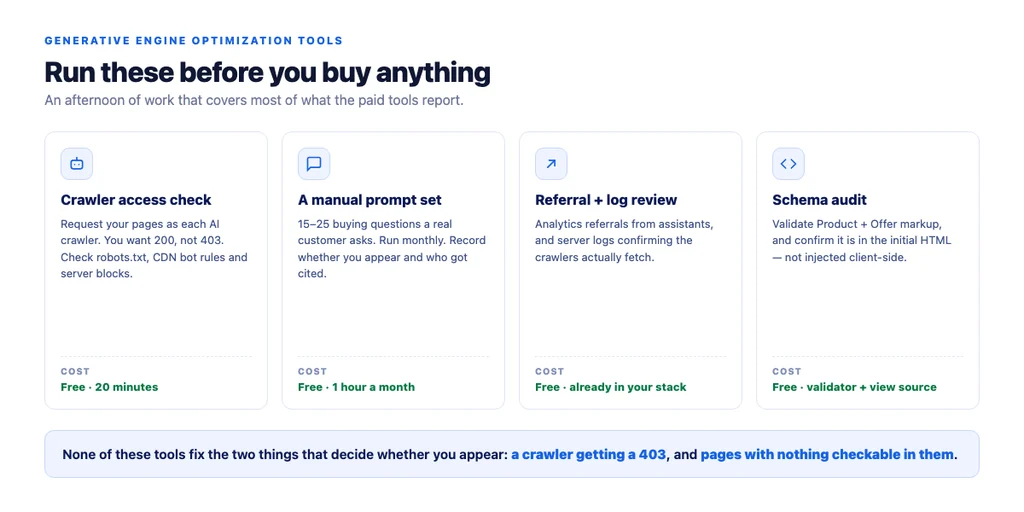
Before buying anything, this takes an afternoon and covers most of the value.
Crawler access check. Request your own pages with each AI crawler's user agent and confirm you get 200 rather than 403. Check three places: robots.txt, your CDN or WAF bot rules, and any server-level blocks. The CDN is where most accidental blocks hide.
A manual prompt set. Write 15–25 buying questions a real customer would ask. Run them monthly. Record whether you appear and which sources got cited. Tedious, genuinely informative, and free.
Referral tracking. Check analytics for traffic from chatgpt.com, perplexity.ai and similar. Volumes are small; intent is unusually high.
Server log review. Confirm the AI crawlers are actually fetching, and which pages.
A schema audit. Validate your Product and Offer markup, and confirm it sits in the initial HTML rather than being injected client-side — Google's merchant listing documentation notes that dynamically generated markup makes shopping crawls less frequent and less reliable, and several AI crawlers do not execute JavaScript at all.
How to evaluate a tool before paying
- Ask how the number is produced. How many samples, from which regions, against which models, how often. A vendor who will not answer is selling a dashboard.
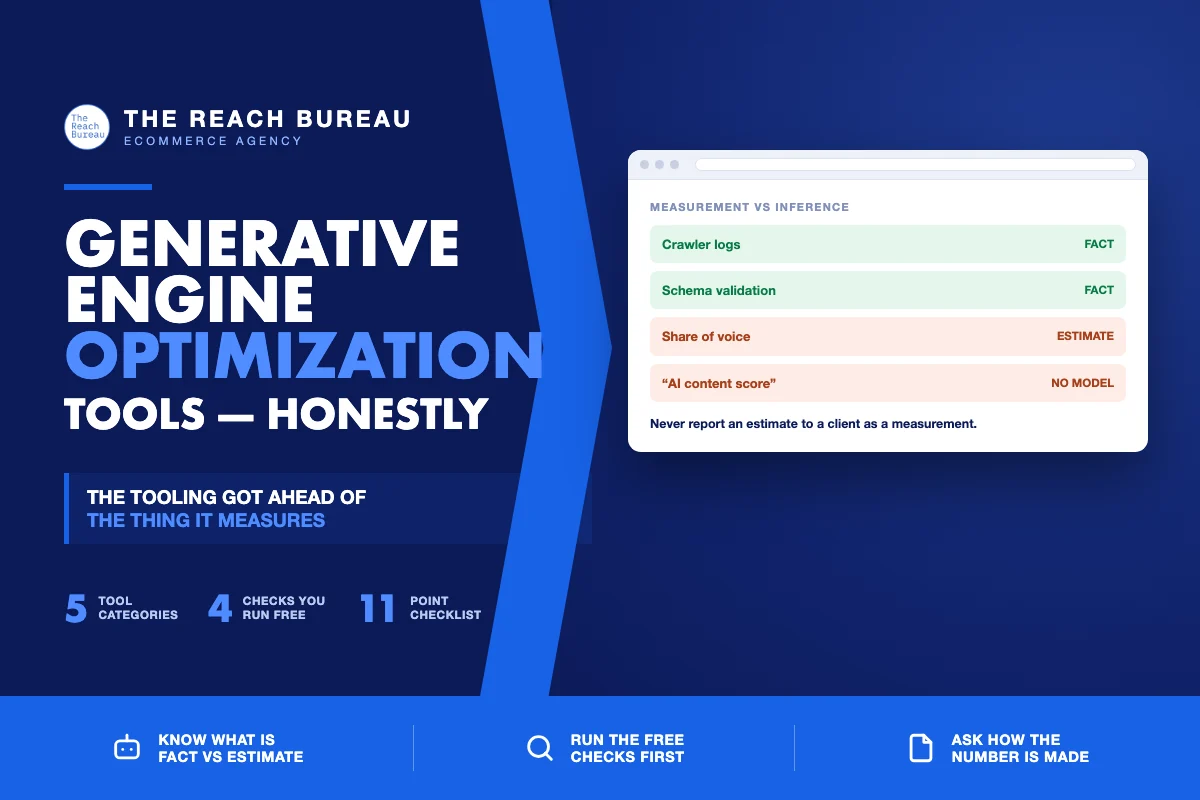
- Ask what is measurement and what is inference. Crawler logs are facts. Share of voice is not.
- Check it reports cited sources, not only whether you appeared. The source list is where the actionable work is.
- Check it covers the assistants your customers use, not only the one with the best API.
- Be sceptical of prescriptive advice. "Add these phrases to rank in ChatGPT" is not a thing. Specific facts get cited; keywords do not.
- Run it alongside your manual set for a month and see whether it agrees with reality.
What none of them fix
The tools measure. They do not solve the two problems that actually determine whether you appear.
Access. If a crawler gets a 403, no tool changes that — and this is genuinely common.
Substance. An assistant answering "waterproof hiking boot for wide feet under $150" checks four constraints against a page. Marketing prose fails every check because there is nothing in it to check. Pages stating measurements, fit, price and tested conditions answer all four.
This is why the tooling question is less important than it looks. The work is unblocking crawlers and writing pages with checkable facts. A tool tells you how that is going.
The checklist
- Crawler access verified for GPTBot, OAI-SearchBot, ChatGPT-User, ClaudeBot, PerplexityBot, Google-Extended
robots.txt, CDN/WAF rules and server-level blocks all checked- 15–25 realistic buying prompts written
- Prompt set run and results recorded at least monthly
- Cited-source list reviewed, not just whether you appeared
- Analytics checked for AI assistant referrals
- Server logs confirm AI crawlers are fetching
Product+Offerschema validated and present in the initial HTML- Product pages carry measurements, fit and tested conditions
- Any vendor asked how their number is produced, and how often
- Tool output compared against your manual set before renewal
Sources
- How To Add Merchant Listing Structured Data — Google Search Central
- Intro to Product Structured Data on Google — Google Search Central
- Creating Helpful, Reliable, People-First Content — Google Search Central
- SEO Best Practices for Ecommerce Sites — Google Search Central
- Google Search Essentials — Google Search Central
FAQs
Want this run against your store? Book a call with The Reach Bureau.