When to Replatform Your Ecommerce Store (and When Not To)
July 13, 2026
4 min read
by Max Tymoshyn
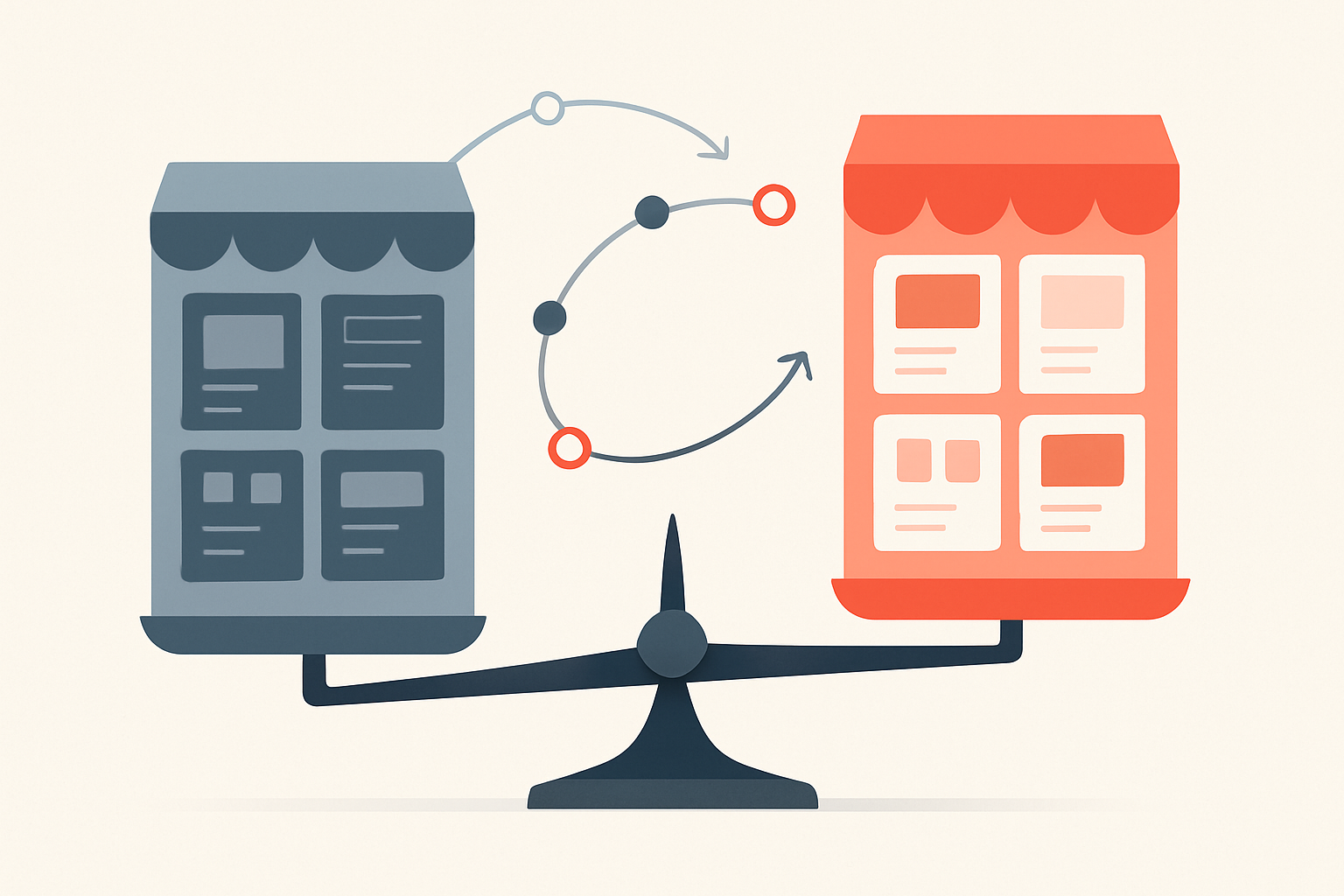
The decision to replatform your ecommerce store is one of the most expensive bets a brand makes, and most of the time the trigger is wrong. A bad quarter, a slow site, a competitor’s flashy redesign — none of those are reasons to move. A platform that actively blocks revenue is. This guide draws the line, so you spend six figures only when the math demands it.
The honest part most agencies skip: replatforming usually works out. In commercetools’ 2024 migration report, 90% of recent migrators saw revenue improvements, and 30% reported sales jumps of 30%+. That is the seductive number. The cost of getting it wrong is the one nobody quotes back to you.
What replatforming actually costs you
Replatforming is not a redesign — you are rebuilding the engine (catalog, customer data, order history, integrations, URL structure) and reconnecting every system that touches a sale. The budget is real (small brands $15k–$50k, mid-market $50k–$150k), but the budget is not the risk. The biggest exposure is SEO: botched migrations lose 20–50% of organic traffic, almost always from broken 301s, unmapped URLs, or dropped metadata. With one-to-one redirect mapping and nothing else changing at once, traffic typically wobbles four to six weeks and recovers. The second exposure is data — the single highest failure point of the whole effort.
When to replatform your ecommerce store
Move when the platform is the constraint on revenue — not when it is merely annoying. The test: can the problem be fixed inside the current platform with money you’d spend anyway? If yes, fix it. If the architecture is the blocker, you have a real case.
| Signals it’s time to replatform | Signals to stay put (fix instead) |
|---|---|
| Checkout or catalog limits the platform structurally can’t lift (no headless, capped SKUs, locked checkout) | Site feels slow — but the cause is unoptimized images, bloated plugins, or cheap hosting |
| Core systems (ERP, PIM, 3PL) won’t integrate, forcing daily manual data entry | You dislike the admin UI or a competitor launched a prettier site |
| Total cost of plugins, patches, and dev hours is climbing faster than revenue | One feature is missing and an app or custom build adds it for a fraction of a migration |
| Security or compliance gaps the vendor can’t or won’t close | A new exec wants “their” stack — with no revenue thesis behind it |
| Frequent downtime or failed checkouts traced to the platform itself | You’re inside 90 days of peak season — wait, then plan |
If three or four rows in the left column are true at once, the platform is taxing growth and a structured project is overdue.
When not to replatform
Don’t replatform because the site is slow — most speed problems are hosting, oversized media, and plugin sprawl, all fixable on your current stack for a fraction of a migration. Carry those habits onto a new platform and it will also be slow. Don’t replatform because a competitor looks better (that’s design and merchandising), for a single missing feature (an app is cheaper), or because a new hire prefers a different platform. And never start a migration inside 90 days of peak season.
WooCommerce vs. Shopify: matching platform to stage
When you do have a real case, WooCommerce gives full ownership of code, data, and checkout — ideal for complex catalogs and custom logic if you have dev support. Shopify trades some flexibility for speed and a managed checkout that converts well out of the box, suiting leaner teams. The wrong move is picking the platform first and reverse-engineering the justification. Pick the constraint you’re solving, then choose the platform that removes it.
The bottom line
Replatform your ecommerce store when the platform itself caps revenue. Stay put, and fix instead, when the real problem is speed, design, one feature, or a personal preference dressed up as strategy. The brands that win at migration aren’t the ones that move fastest; they’re the ones who proved they had to move at all, then mapped every redirect before launch.
Frequently Asked Questions
Not sure which side of the line you’re on? Book a call with The Reach Bureau and we’ll pressure-test whether you actually need to replatform — or whether a few weeks of optimization gets the result for a fraction of the cost.
Ready to scale your e-commerce?
Let's discuss your project and how we can help you achieve your growth goals.