Internal Linking Architecture That Actually Compounds Revenue
July 9, 2026
3 min read
by Max Tymoshyn
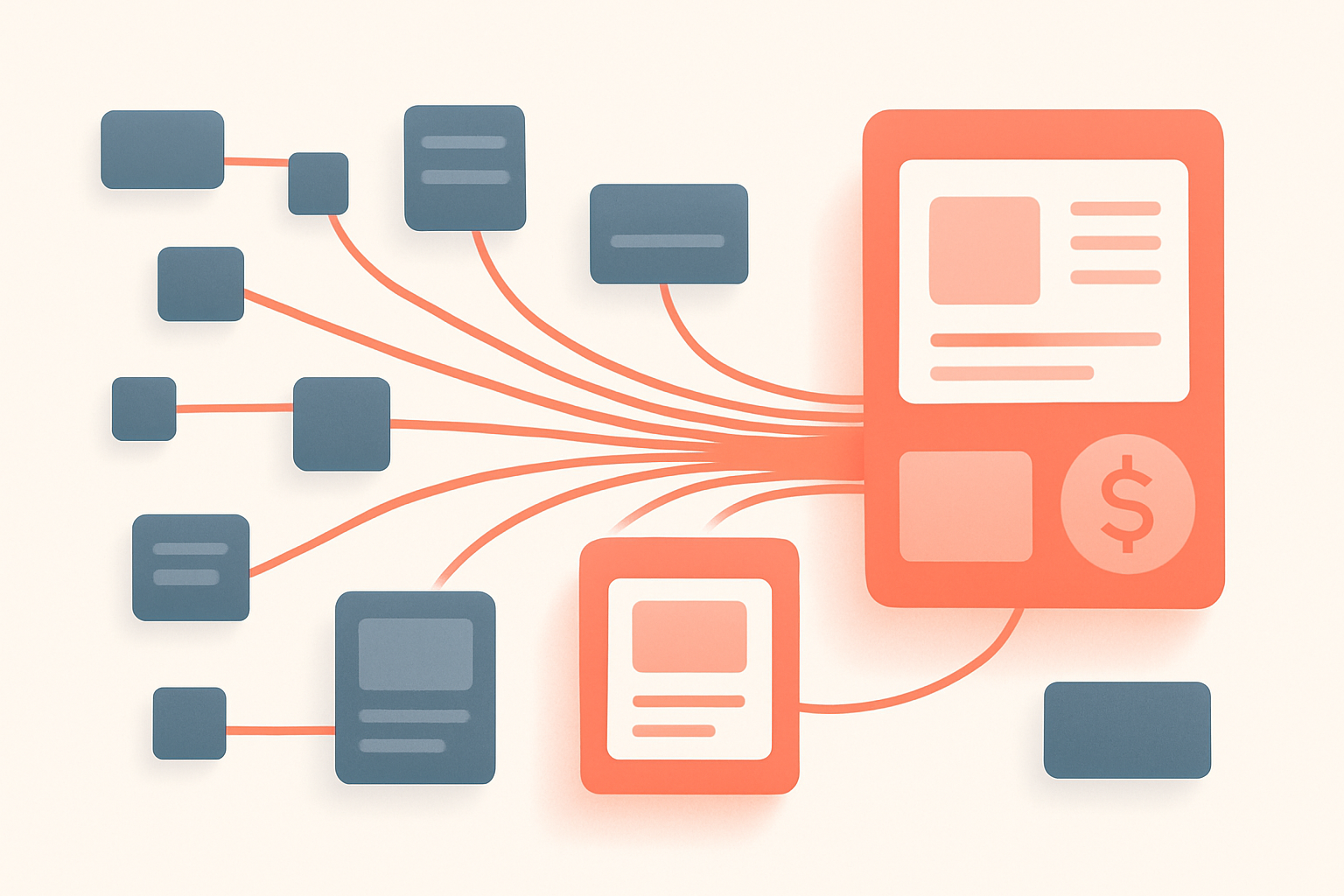
Most ecommerce stores treat internal links as an afterthought — a “related products” widget here, a breadcrumb there. That is why they leak. An internal linking architecture that compounds revenue is deliberate: it routes authority from the pages that earn it to the pages that sell, and it keeps doing that long after you publish. Done right, it is the cheapest growth lever you own.
Why most internal linking never compounds
Link equity flows along the links you build. Earn 100 backlinks to a guide, and if that guide does not link to your product and category pages with intent, the authority stays trapped. Google’s guidance is blunt: every page you care about should have a link from at least one other page, and that link must be a real <a href> with descriptive anchor text. John Mueller has noted that pages linked close to the homepage read as important; pages buried many clicks away read as less critical.
The hub-and-spoke model that moves product rankings
A hub is a broad authority page — a pillar guide or top-level category. Spokes are the supporting pages: buying guides, comparisons, and the product pages themselves. Every spoke links up to its hub, the hub links down to every spoke, and spokes link sideways where it genuinely helps the shopper. A “best running shoes for flat feet” guide earns links because it is useful; because it links to specific product pages with commercial anchor text, those products inherit the authority. Keep important pages within roughly three clicks of the homepage.
A link map you can actually build
| Link type | SEO / revenue job | Where to place it |
|---|---|---|
| Hub-to-spoke | Distributes topical authority across the cluster | Pillar guide and top-level category body |
| Spoke-to-hub | Consolidates relevance back to the money page | Buying guides, blog posts, comparisons |
| Contextual to product | Sends buying-intent equity straight to PDPs | In-body links inside guides, commercial anchors |
| Category to product | Surfaces best sellers, spreads equity down | Curated blocks on collection pages |
| Cross-sell / related | Lifts AOV and keeps sessions alive | Product “pairs with” and cart pages |
| Breadcrumb | Reinforces hierarchy for crawlers and users | Sitewide template, above the fold |
Template links (breadcrumbs, related blocks) build the skeleton at scale; contextual in-body links do the heavy lifting on the pages that earn authority. You need both.
Anchor text: where revenue leaks or compounds
Google uses anchor text to understand the linked page. A product linked as “this one” gets no topical signal; linked as “waterproof trail running shoes,” it gets a precise one. Use descriptive, commercial anchors for links to products and categories, and vary them — repeating the exact same anchor 30 times reads as manipulation. Don’t bolt sales links onto informational pages unnaturally; place them where the content already leads the reader toward a decision.
Fix the leaks first, then build the map
Run three checks: find orphaned products (zero internal links in) and link them from a category or guide; audit anchor text on your top guides and replace generic phrases; map your highest-margin collections and confirm they sit within three clicks of the homepage. Those three fixes alone routinely move pages from page two to page one, because you are finally pointing the authority you already have at the pages that make money. Every new guide strengthens its hub; every backlink now has a paved path into your catalog.
Frequently Asked Questions
If your internal links are leaking equity instead of routing it to revenue, we can map the fix for your store. Book a call with The Reach Bureau and we’ll audit your linking architecture.
Ready to scale your e-commerce?
Let's discuss your project and how we can help you achieve your growth goals.